


FLASHBACK 2024 — Former mayor Sheng Thao, former city administrator Jestin Johnson, and developer Ray Bobbitt hold a signing ceremony and press conference heralding the first iteration of the Oakland Coliseum Complex sale agreement on July 30, 2024. Bobbitt’s company ultimately missed scheduled payments on the original deal, triggering a multimillion-dollar city budget shortfall and contingency cuts. (Video sources: Instagram / @mayorshengthao; Adobe Stock; Oakland Report)
Oakland Agenda Watch provides summaries of key items on upcoming public meeting agendas that catch our attention. In this installment, we examine today’s Oakland city council meeting to vote on final passage of the restructured Oakland Coliseum sale. Also: a refined estimate of the avoided interest for the buyer and foregone potential revenue to the city; and a response to city officials’ claims that the deal is not a loan.
A loan by any other word would smell as sweet
Today the Oakland city council takes up its final vote on the sale and “seller financing” of the city’s share of the Oakland Coliseum Complex property to a group led by Ray Bobbitt’s company — a developer with no prior large-scale projects under his belt.
Up for votes are the second reading and council approval of a new sale agreement, and a resolution directing $50 million of sale proceeds toward the city’s roughly $2 billion in pension debt.12
The city is set to convey its 50 percent share to a group led by Bobbitt’s company, Oakland Acquisition Company (OAC), while financing roughly half the price with a deferred payment schedule at a below-market interest rate — in other words, a loan.
Notably, Bobbitt’s company intends to immediately resell the Oakland Arena portion of the complex to another buyer — apparently to raise needed cash that OAC has not secured, and has not shown it can secure, from other lenders.34
Additionally, according to eyewitness accounts shared with Oakland Report, some Oakland officials have been telling constituents the proposed deal is not a “loan.”
When is a loan not a “loan”? We checked the city’s own documents to examine the question — and will leave it to our readers to decide for themselves.
Why the Coliseum deal is being voted on again
The latest iteration of the deal requires two public readings at city council meetings. City council held the first reading at a special meeting on July 13, and voted 6-1 to approve it. Council member Noel Gallo opposed it and council president Kevin Jenkins was absent from the vote.5
In 2024, then-mayor Sheng Thao’s administration struck the original deal to sell the city’s half of the Coliseum to Bobbitt’s company, then known primarily as the African American Sports and Entertainment Group (AASEG) for $105 million.6
The city then built that money into its budget before the payments had been secured — counting on roughly $63 million in sale revenue to avoid cuts.
Bobbitt’s company missed its scheduled payments that fall, the promised money never came, and the city imposed contingency budget cuts to close the gap.7 The city then revised the deal to give Bobbitt’s company more time to pay.
Today’s vote comes three weeks after the revised agreement’s own closing deadline — June 30, 2026 — passed without a closing.8 OAC never made the payments scheduled under the prior versions of the deal; the initial $5 million deposit remains its only payment made to date. The council removed the interim payment deadline entirely in May 2025.9
The proposed new deal has moved on an expedited track because officials want to close the deal by January. The deal was reviewed in closed session July 7, forwarded to the council’s scheduling committee July 9, and heard at the full council four days later.10
At a celebratory pre-vote press conference on July 13, mayor Barbara Lee called the proposed new deal “a step forward,” and Oak View Group co-founder Irving Azoff — whose company is reported to be set to buy the Oakland Arena portion of the property from Bobbitt’s company after the deal is signed — appeared alongside council members celebrating the deal.11
When a loan is not a ‘loan’: city officials offer bespoke definitions
According to eyewitness accounts shared with Oakland Report, council member Charlene Wang (District 2) told a recent neighborhood meeting that the proposed new Coliseum deal is not a loan.
At the same meeting, council member Zac Unger (District 1) reportedly offered an explanation to the effect that “loan” was not the right term to describe the city’s seller financing of the sale.
Similar arguments by supporters of the deal have circulated in some venues, describing the arrangement instead as an “installment sale” or a “land write-down.”
We stand behind our reporting — and our accurate use of the common English word “loan” to describe the deal — and the city’s own documents show why.
A loan, in the simplest terms, is an arrangement in which one party (lender) provides money or an asset to another party (borrower), to be repaid over time, usually with interest.
In this case, the asset being loaned is the Oakland Coliseum Complex.
“Seller financing” — the terminology used by the city to describe the deal — refers to a type of loan in which the seller also acts as the lender, extending credit to the buyer/borrower instead of receiving the price up front.12
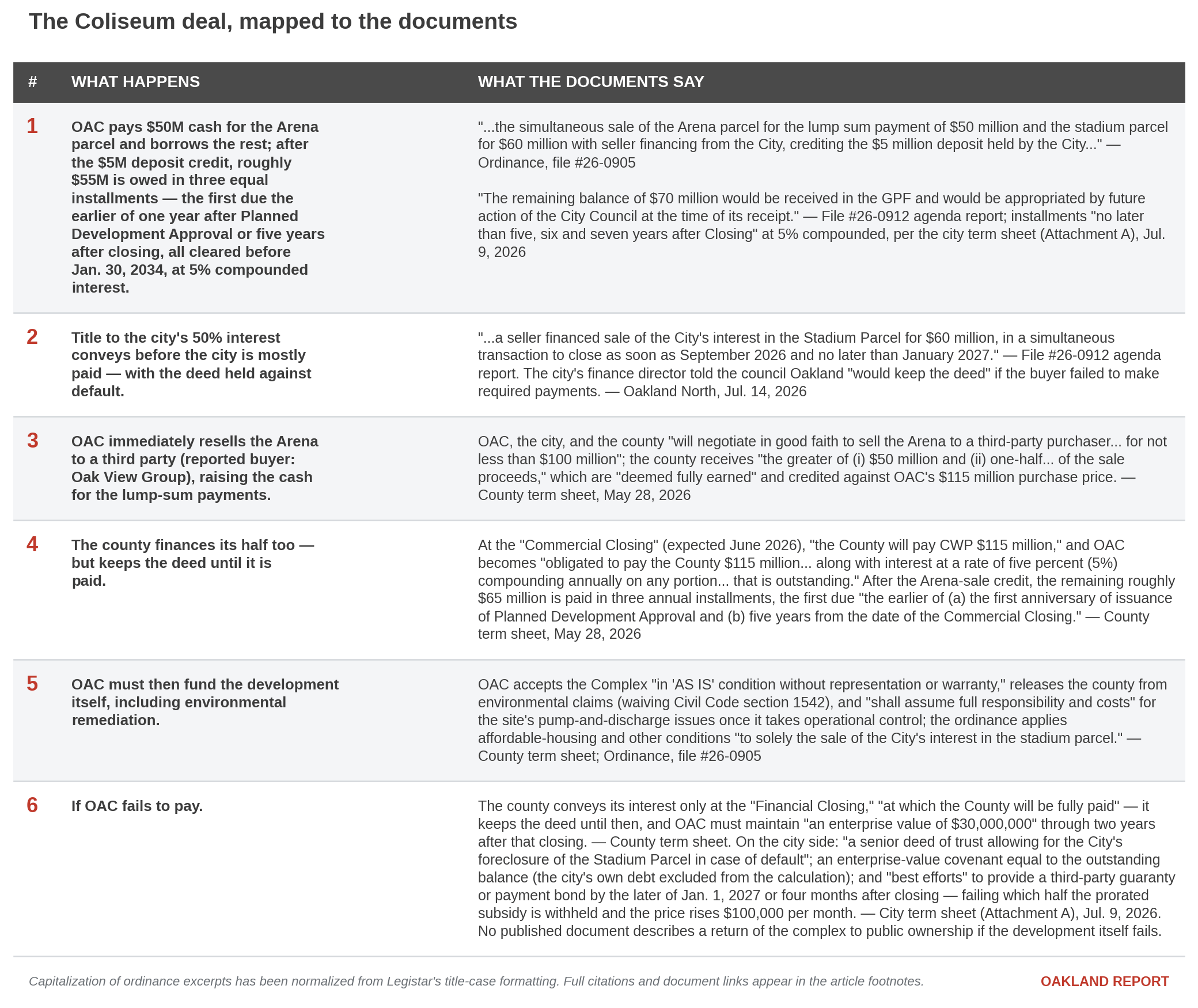
The ordinance before the council today authorizes the sale of the stadium parcel “for $60 million with seller financing from the City.” The city’s own staff report calls it “a seller financed sale of the City’s interest in the stadium parcel.”
An “installment sale” is the tax law term — Internal Revenue Code section 453 — for precisely the arrangement currently proposed: a sale in which the seller receives payments over time (in this case, the payments would be deferred up to five years) and reports interest on the deferred balance.13
Calling the deal an installment sale concedes that it is seller financed.
Similarly, a “land write-down” describes how a property is valued, not how it is paid for. A city can discount a price for public benefit conditions and still finance the discounted price. One is valuation; the other is lending. Both can be true at once.
To be clear, this is not a criticism of this form of loan as a financial practice. It is, however, an observation — supported by the public record — that city officials appear to be using deceptive wordplay to elide the truth about the Coliseum deal and their financial decision-making around it.
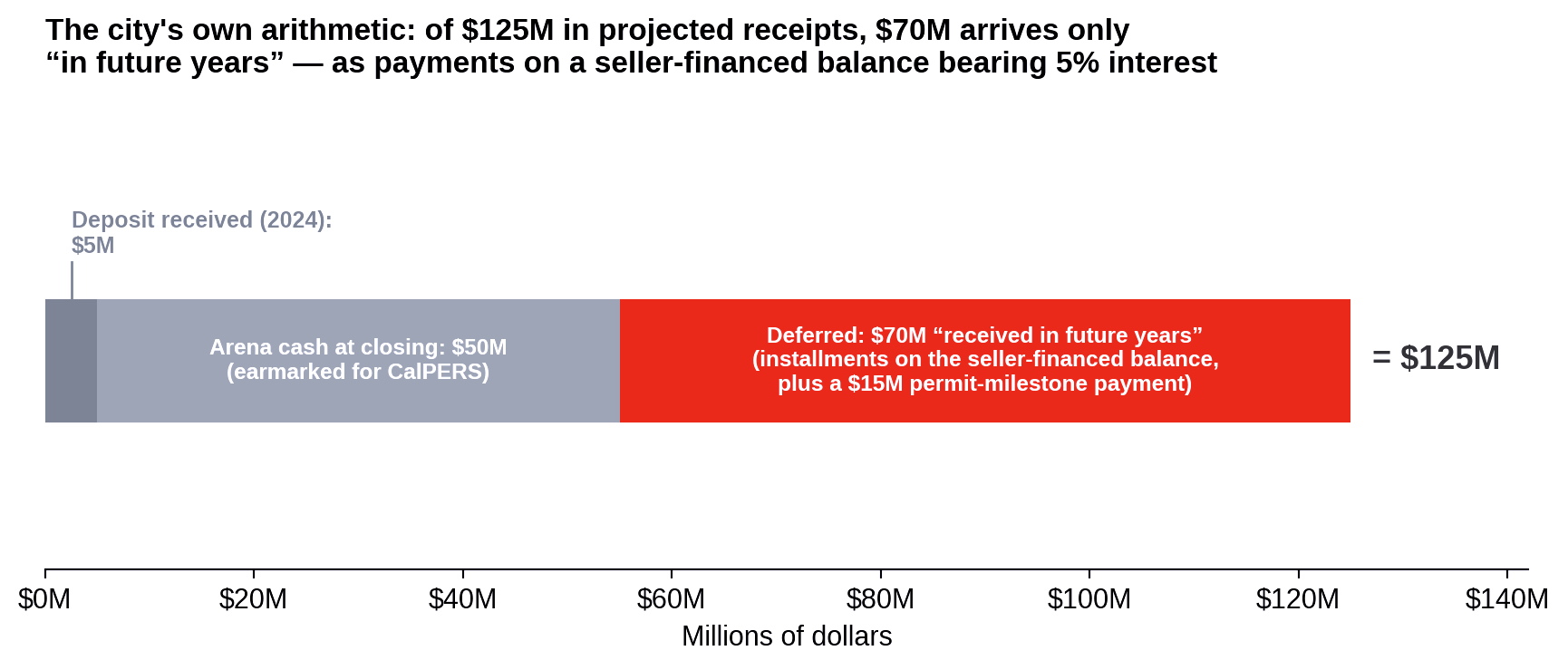
Then there is the city’s arithmetic. The staff report projects $125 million in total receipts from the sale: $5 million already received, $50 million at closing, and “the remaining balance of $70 million... in future years.”
The city’s own term sheet and staff report define what “future years” means: a $55 million “stadium parcel closing purchase price” repaid in three installments — the first due on “the first anniversary of issuance of planned development approval” or five years from closing, whichever comes first.
In other words, the first payment could be deferred to as late as 2032.
The remaining $15 million consists of “additional payments” if OAC secures building permits for future development — these are conditional payments, memorialized as deed covenants, that arrive only if development advances.
The city’s stated $125 million total leaves out the interest itself: roughly $18 million per the new payment schedule.
The sale ordinance’s operative text authorizes the city administrator to “negotiate and execute a loan agreement, promissory note, and deed of trust for the seller financing from the City of the Stadium Parcel sale, with five percent (5%) interest.”
This backstop is weaker than some summaries suggest: the term sheet requires only “best efforts” to obtain a guaranty or payment bond, due by the later of January 1, 2027, or four months after closing — after the deal closes, not as a condition of it.
If the assurance doesn’t materialize, the city retains the outstanding half of the prorated subsidy payment, and the stadium price rises $100,000 for each month it remains outstanding.
The city’s own celebratory materials assert that payments will arrive “on a prescribed schedule without lending any funds to OAC.”14
The city’s statement relies on an unusually narrow definition under which a “loan” means only wiring cash to the borrower.
In fact, the proposed new “seller financed” sale advances the asset to the buyer/borrower before full payment is completed — and what the city ends up holding is the buyer’s debt.
A loan agreement, deferred payments, stated interest rate, a deed of trust, a promissory note, a foreclosure right: whatever officials prefer to call it, the city’s own documents describe a loan.
The facts of the Coliseum Complex deal, according to the city’s own documents
The latest version of the Coliseum transaction has confused many Oaklanders — including, it appears, some of its supporters. City officials have repeatedly stated that the deal is extraordinarily complicated, and it is.
We agree that the documents — and the deal itself — are difficult to understand, which may have contributed to the differing interpretations. To help unwind the confusion, here is each step of the deal, grounded in the language of the public record.
The estimated public subsidy to Ray Bobbitt’s OAC, revised
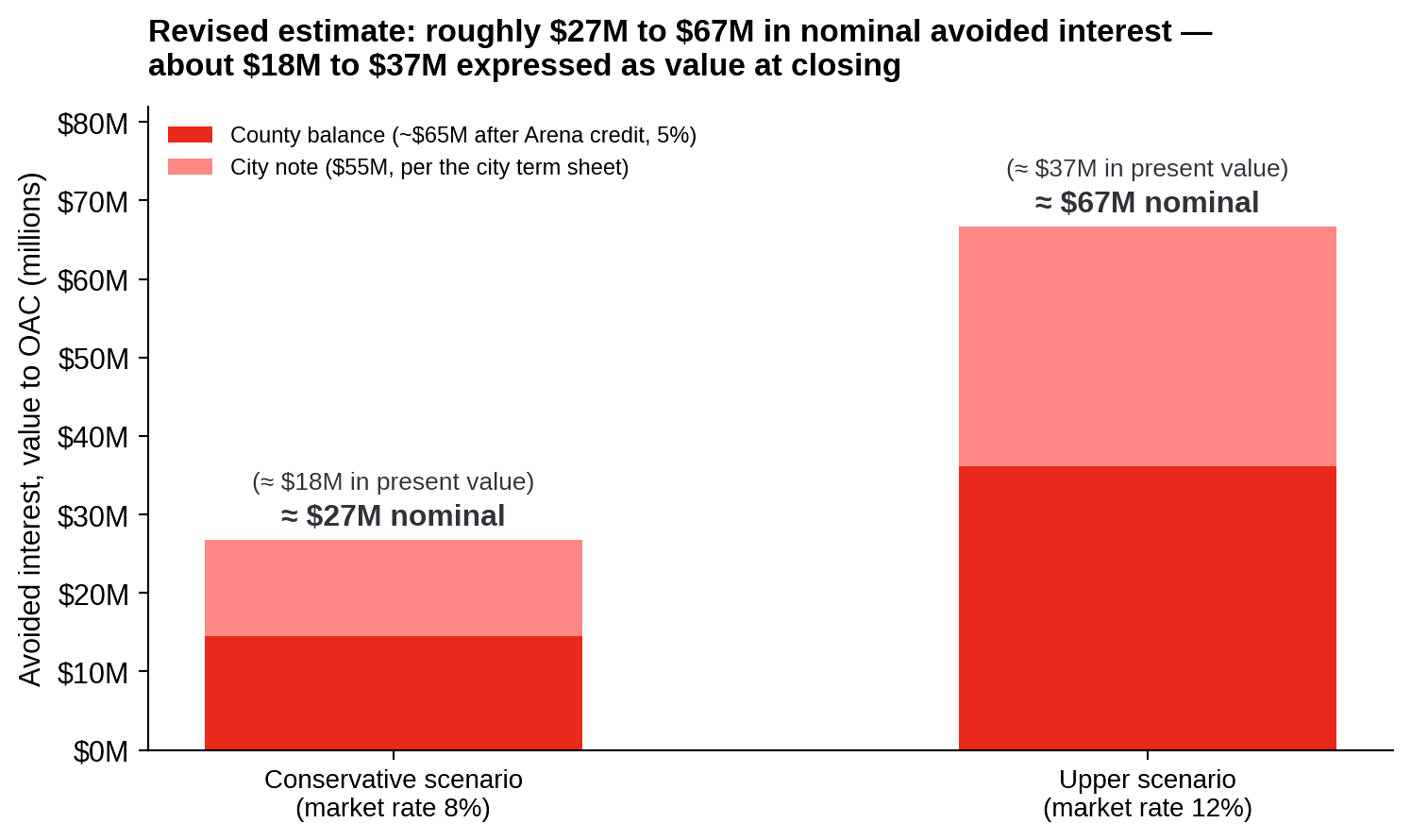
Earlier this month, we estimated how much OAC saves by borrowing from the city and county at 5 percent instead of paying higher interest rates on the commercial lending market. Our first estimate was $45 million to $114 million.15 New documents and information enabled us to refine those numbers downward.
The city’s loan is about $55 million, not $60 million, because OAC’s $5 million deposit counts toward the price.
The county’s loan is about $65 million, not $115 million, because the county gets at least $50 million from the Arena sale right away and credits it against OAC’s bill. The county, in turn, pays the Athletics sports team affiliate that bought the county’s share of the property $115 million plus accrued interest to buy back its half.
The two governments also protect themselves differently. The county keeps its deed until it is fully paid — a protection stronger than collateral — and collects half of any operating profits toward the balance.
The city does the opposite: it hands over its deed at closing and takes back a promissory note, secured by a deed of trust that lets the city foreclose if OAC defaults on the payments.
Both loans work the same way. Interest builds at 5 percent per year until the first payment, which can wait until as late as year five. The last payment can come as late as year seven.
Running the numbers on those terms: if a bank would charge 8 percent for a loan like this, OAC saves about $27 million in interest. If a private lender would charge 12 percent, OAC saves about $67 million.
In today’s dollars — what the discount is worth on the day the deal closes — the total public subsidy comes to roughly $18 million to $37 million, with the city’s share about $8 million to $17 million.
One more payment sits outside the interest math: the city pays OAC about $1.5 million of its stadium operating subsidy — half at closing, and half only after OAC provides a third-party payment guarantee.
The financial realities of the proposed Coliseum deal
Stripped of labels, Tuesday’s two votes, if affirmative, would produce the following:
The city receives $50 million at closing and uses it to pay against a roughly $2 billion unfunded pension liability, per the city’s fiscal policy for the use of one-time revenue.
The city then waits, up to five to seven years, for $70 million more from a buyer whose only payment in the past two years was the $5 million deposit.
The 5 percent the city will earn on that waiting is less than CalPERS’ own assumed rate of return of 6.8 percent — meaning that even by the city’s investment benchmark, every year of deferral loses ground.16
The city also pays the buyer roughly $1.5 million at closing, sheds an annualized $6 million stadium operating subsidy, and gains a 6 percent share of ticket sales that the city estimates at about $3 million per year.
The risk that the $70 million never fully arrives — the risk every lender carries — rests with the city, which is why the word “loan” matters.
There was also an alternative buyer on the table. As we previously reported, Legends Global — the Arena’s longtime operator — made an offer of roughly $102 million for the Arena, which officials turned down. Interested parties were referred to OAC under the city’s exclusive negotiating arrangement with Bobbitt’s company.17
The structure leaves questions the council, as a public agency selling a public asset, ideally will answer before the final vote.
The county term sheet entitles the county to the greater of $50 million or half the Arena sale’s net proceeds, and provides for equal city-county sharing of component sales — yet the city’s staff report describes Oakland’s Arena proceeds as exactly $50 million.
If Bobbitt’s company flips (resells) the Arena to another buyer (reportedly Azoff’s Oak View Group) for more than the $100 million floor, who keeps the difference? The Arena passes through OAC’s hands in a back-to-back escrow on its way to the new buyer. The public documents appear not to commit to what the Arena buyer is actually paying, what expenses come off the top, or whether OAC or its affiliates receive any fee or spread on that leg.
Caveats
The terms reported here are drawn from the ordinance text and the city term sheet attached to the July 13 agenda report.
The term sheet is expressly non-binding, and the final executed version of the agreement may differ — we will update this analysis if they do.
We report the subsidy both as nominal avoided interest and as present value at closing; the former answers how many future dollars the buyer avoids, the latter what the concession is worth today.
Per the city term sheet, the $70 million balance consists of the $55 million note principal and the $15 million in conditional permit milestone payments; the note’s 5 percent interest is in addition to — and not counted in — the $125 million total.
Our estimate remains illustrative: market-rate ranges are national; and the closing payment depends on the closing date.
Our estimate also assumes the county’s Arena share is exactly $50 million (a higher Arena price would shrink the financed balance further) and the latest installment timing (an earlier Planned Development Approval would start payments sooner and shrink the subsidy on both sides).
None of this measures OAC’s ultimate profit for the deal, which by one estimate is potentially in the “billions of dollars.”18
Words matter because the risks matter
The council may well conclude on Tuesday that this deal, loans and all, beats the alternatives and is in the best interest of the city and the public it serves. That is the council’s judgment to make — and ideally the council’s deliberations today will lay out the council’s judgment for the public to hear.
But it is not accurate for city officials to deny that the proposed deal is a loan.
The city’s own ordinance says “seller financing” — by definition, a form of loan. The city’s own staff report counts the interest — the financial hallmark of a loan.
Words matter because financial risks do: Oaklanders cannot weigh a risk their elected officials will not name.
Read these related articles:


WE ARE 100% SUPPORTED BY YOU
Oakland Report is an experiment in a new form of media. If you value our nonprofit work, please donate. All contributions go directly to sustaining and growing our capacity to produce data-driven, deep-dive articles like this one.
City of Oakland. "Second amendment to coliseum complex sale agreement." Oakland city council meeting agenda, Jul. 21, 2026. https://oakland.legistar.com/LegislationDetail.aspx?ID=8130453&GUID=5AFD9A11-F95D-42F4-B396-245C29D5D252
Johnson, Bradley. "Coliseum payment allocation." City of Oakland agenda report, Jul. 21, 2026. https://oakland.legistar.com/LegislationDetail.aspx?ID=8137317&GUID=B85D5978-183F-40EE-85E8-67B249C82045
Wolfe, Eli. “Lucrative Oakland Arena becomes key component of larger Coliseum deal.” The Oaklandside, Jul. 13, 2026. https://oaklandside.org/2026/07/13/lucrative-oakland-arena-becomes-key-component-of-larger-coliseum-deal/
County of Alameda. "Non-binding term sheet — Oakland-Alameda County Coliseum Complex transaction." Alameda County board of supervisors special meeting agenda, May 28, 2026. https://www.acgov.org/board/bos_calendar/documents/DocsAgendaReg_05_28_26%20Spmtg/GENERAL%20ADMINISTRATION/Regular%20Calendar/County_Term_Sheet_Final.pdf
Fuwad, Ahamad. “Oakland Coliseum deal moves forward, with city poised to get a portion of ticket sales.” Oakland North, Jul. 14, 2026. https://oaklandnorth.net/2026/07/14/oakland-coliseum-deal-moves-forward-with-city-poised-to-get-a-portion-of-ticket-sales/
Wolfe, Eli. “Oakland has a big plan to balance its budget: sell the Coliseum.” The Oaklandside, May 22, 2024. https://oaklandside.org/2024/05/22/oakland-to-sell-coliseum-aaseg-sheng-thao-budget/
Tavares, Steve. “Colossal confusion continues to cloud Coliseum deals.” East Bay Insiders, Apr. 14, 2025. https://eastbayinsiders.substack.com/p/colossal-confusion-continues-to-cloud; https://archive.is/Tcd1P
Bay City News Service contributors. “Oakland City Council adjusts timeline for sale of Coliseum.” CBS San Francisco, May 8, 2025. https://www.cbsnews.com/sanfrancisco/news/oakland-coliseum-sale-city-council-adjusts-timeline/
Reinhart, Sean S. “’Oakland deserves better’ — Alameda County approves Coliseum buyback term sheet.” Oakland Report, May 29, 2026. https://www.oaklandreport.org/p/oakland-deserves-better-alameda-county
Lee, Henry. “City Council moves one step closer to selling Oakland Coliseum.” KTVU, Jul. 13, 2026. https://www.ktvu.com/news/oakland-city-council-vote-coliseum-sale
Urbach, Eric. “City Council approves Oakland Coliseum deal, moving its sale toward final approval.” Bay City News / Local News Matters, Jul. 13, 2026. https://localnewsmatters.org/2026/07/13/oakland-city-council-coliseum-arena-sale-approved/
Kagan, Julia et al. "Seller financing: definition and how it's used in real estate." Investopedia, Jul. 20, 2026. https://www.investopedia.com/terms/s/seller-financing.asp
Internal Revenue Service. “Publication 537: Installment Sales.” IRS, accessed Jul. 20, 2026. https://www.irs.gov/publications/p537
Post News Group contributors. "Oakland celebrates $125 million Coliseum sale." Post News Group, Jul. 19, 2026. https://www.postnewsgroup.com/oakland-celebrates-125-million-coliseum-sale/
Montana, Alex. “Oakland set to give Ray Bobbitt’s company public financing at below-market interest rate to buy the Coliseum.” Oakland Report, Jul. 13, 2026. https://www.oaklandreport.org/p/oakland-coliseum-below-market-loans-ray-bobbitt
California Public Employees’ Retirement System. "Discount rate." CalPERS website, accessed Jul. 20, 2026. https://www.calpers.ca.gov/
Montana, Alex. "The Bank of Oakland: City to loan $60 million to developer Ray Bobbitt’s company." Oakland Report, Jul. 9, 2026. https://www.oaklandreport.org/p/the-bank-of-oakland-city-to-loan
Reinhart, Sean S. “‘Oakland deserves better’ — Alameda County approves Coliseum buyback term sheet.” Oakland Report, May 29, 2026. https://www.oaklandreport.org/p/oakland-deserves-better-alameda-county

When a government has an asset of value to be disposed of, but the exact amount of the value is in question, normal practice is to put the deal out to bid. Why did the City not go through a bid or proposal process?
Pop Quiz: Q: What did Trump's Iran ceasefire agreement (aka a memo of understanding) have in common with Oakland's term sheet with Bobbitt’s company, Oakland Acquisition Company (OAC) for the Coliseum purchase?
A: They both relied on the loosey-goosey term "best efforts" to describe the responsibility of the other party.
"Upon the signing of this MOU, the Islamic Republic of Iran will make arrangements using its best efforts for the safe passage of commercial vessels with no charge for 60 days only from the Persian Gulf to the Sea of Oman and vice versa."