


Video clip 1: Former mayor Sheng Thao’s farewell address on her last day in office after being recalled by Oakland voters following her indictment on federal corruption charges. Thao was instrumental in steering the Coliseum deal to first-time developer Ray Bobbitt. (Source: Instagram @mayorshengthao)
Oakland Agenda Watch provides summaries of key items on upcoming public meeting agendas that catch our attention. In this installment, we look at the “Second Amendment to Coliseum Complex Sale Agreement” — the sole agenda item at today’s special Oakland city council meeting — and put a number on what the proposed public financing would be worth to first-time developer Ray Bobbitt’s company.
Tens of millions in public subsidy through low-interest loans
Today the Oakland city council will consider a proposal to sell the city’s 50 percent share of the Oakland Coliseum Complex to first-time developer Ray Bobbitt’s company, Oakland Acquisition Company (OAC), the affiliate of African American Sports and Entertainment Group (AASEG).1
As Oakland Report reported last week, the new deal would sell the city’s share of the indoor Oakland Arena parcel for a $50 million lump sum, and the outdoor Coliseum stadium parcel for $60 million “with seller financing from the City” — meaning, a loan.
The deal would include a $5 million credit for a deposit Bobbitt’s company previously paid, a 6 percent share of gross ticket sales to the city, and a closing payment to the buyer of $16,438.36 per day for the remainder of 2026.2
The other 50 percent share of the property is currently held by Coliseum Way Partners (CWP), an affiliate of the Athletics baseball franchise, which bought it from Alameda County in 2019 for $85 million. CWP has made all required payments since.345
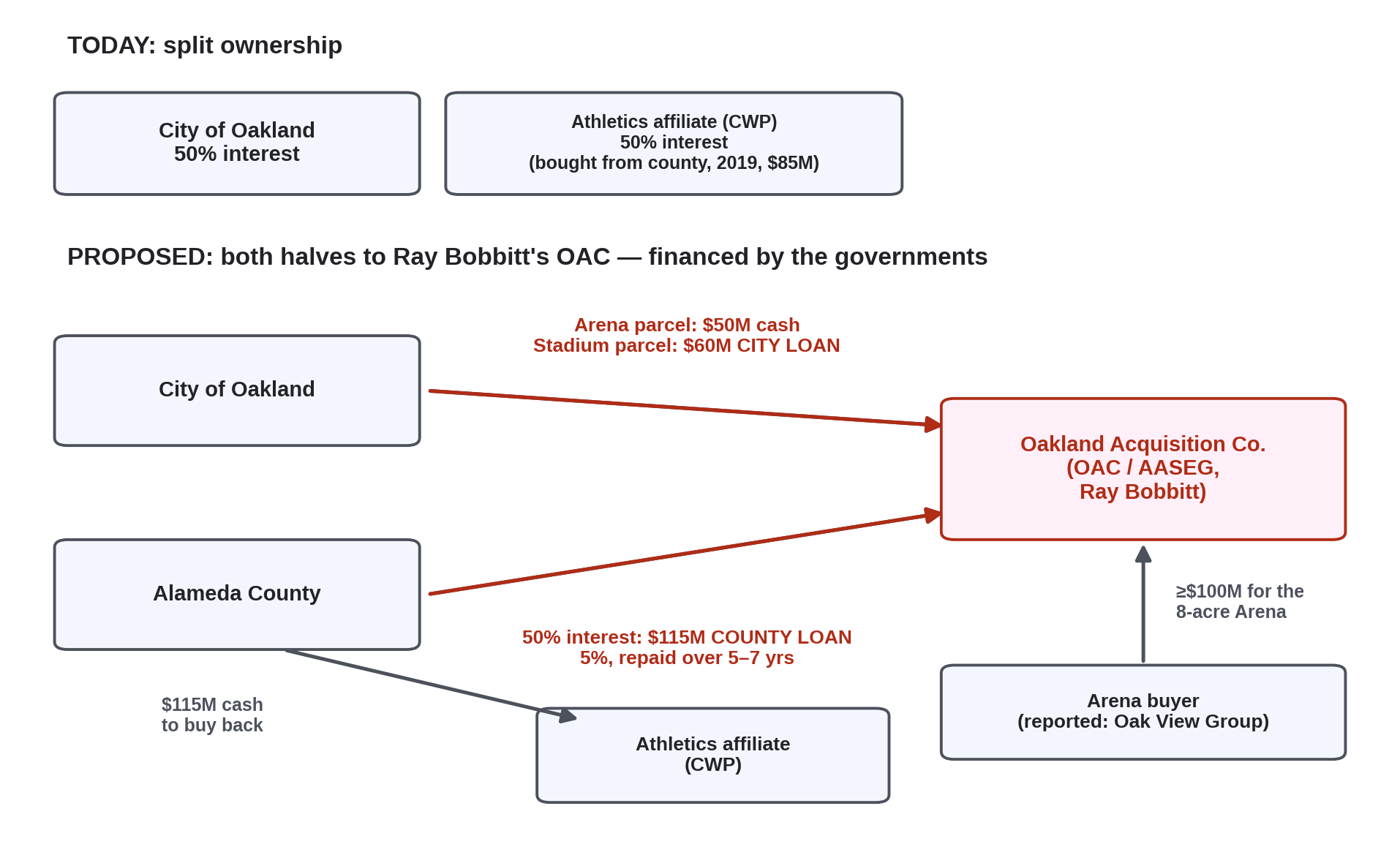
To put the whole complex in Bobbitt’s hands, two transactions must close, and under the proposed terms, both governments would finance their own buyer:
The city’s half: OAC would pay $50 million cash for the Arena parcel and receive a $60 million city loan for the stadium parcel at 5 percent interest, with the first payment potentially not due until 2032.
The county’s half: Alameda County would pay CWP $115 million in cash to buy back the 50 percent share of the property it sold in 2019 — $30 million (35 percent) more than it received — then convey it to OAC in exchange for repayment of $115 million over five to seven years at 5 percent compounding interest. The county’s term sheet requires no collateral and no letter of credit, only that OAC maintain $30 million in “enterprise value” during repayment.
Key findings
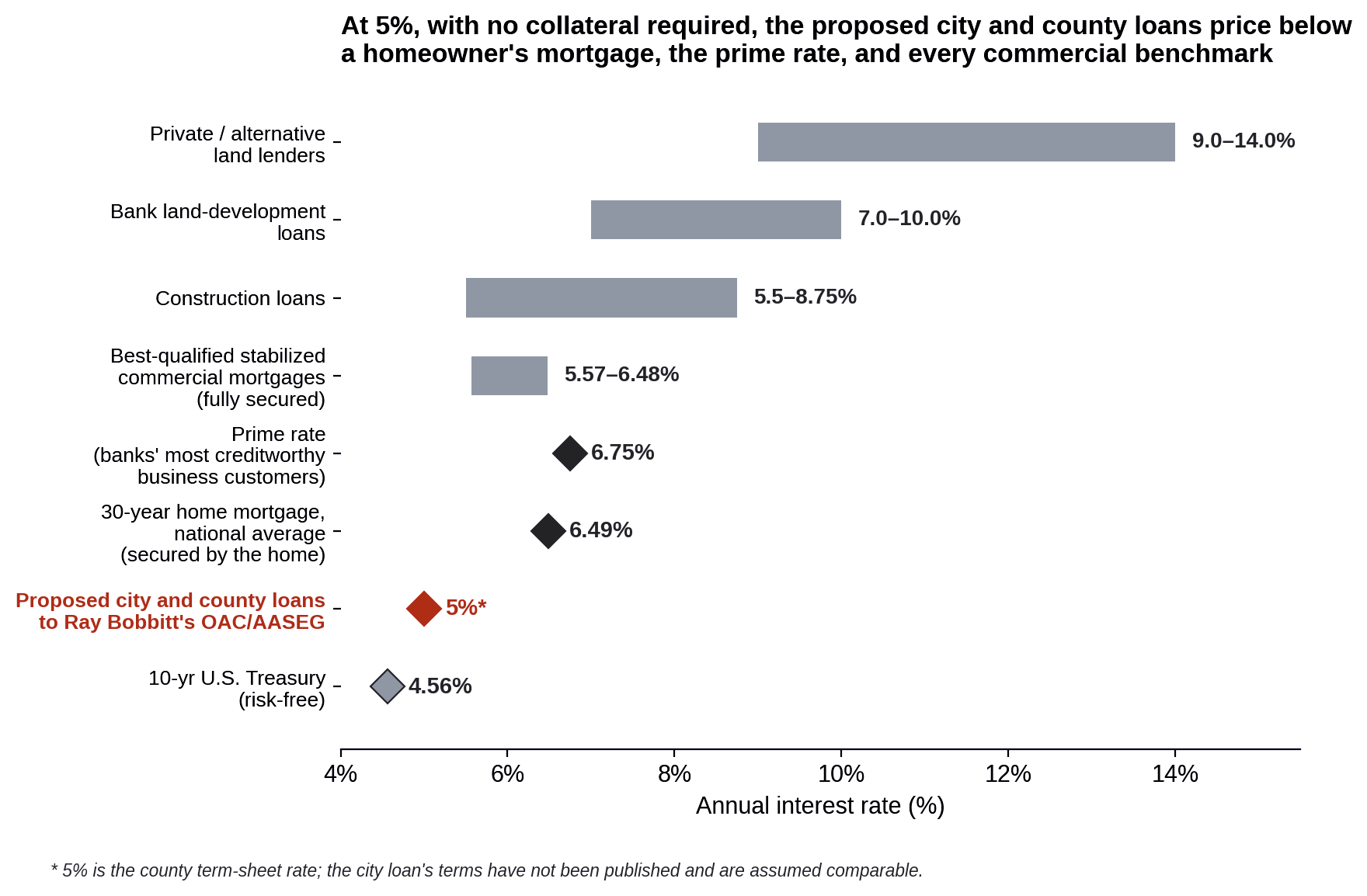
The city’s and county’s 5 percent interest loan rates are lower than every benchmark we could identify — consumer or commercial. It is below the national average 30-year home mortgage (6.49 percent), below the prime rate banks charge their most creditworthy business customers (6.75 percent), and below even the cheapest fully-secured commercial mortgages. The proposed interest rate is 0.44 points above the yield on a risk-free 10-year U.S. Treasury note.678910
Under our illustrative estimate, the below-market financing would subsidize roughly $45 million to $114 million to OAC over the repayment period, depending on what market rate interest the company would otherwise pay — before counting any development profit.
OAC’s demonstrated cash to date — the $5 million deposit — equals 2.2 percent of the $225 million combined purchase price of the property it would come to control.11
How Bobbitt got the deal: from negotiating rights to a budget crisis sale
Bobbitt’s path to the deal ran through fan activism rather than real estate experience.
An East Oakland native and Marine Corps veteran, Bobbitt spent years as a lead organizer of efforts to keep professional sports in Oakland — heading the Oakland Coliseum Economic Impact and Legal Action Committee, which pressed local officials to fight the Raiders’ Las Vegas move — and served on civic bodies including Oakland’s Parks and Recreation Commission.1213
On Juneteenth 2020, Bobbitt announced a proposal to bring the NFL back to Oakland under the league’s first majority-Black ownership group; AASEG grew out of that campaign.
Neither AASEG’s published biography of its founder nor contemporaneous profiles describe prior experience developing large-scale real estate — within AASEG, that track record belongs to partners such as developer Alan Dones, and the capital to Loop Capital.14
The proposal before the council is the latest turn in a six-year arc:
2020: Bobbitt forms AASEG with former city manager Robert Bobb, developer Alan Dones, consultant Shonda Scott, and sports agent Bill Duffy, with financial backing from Chicago-based investment firm Loop Capital.
2021: Oakland city council unanimously grants AASEG exclusive rights to negotiate buying or leasing the city’s half of the Coliseum — over the city administration’s request for more time to vet AASEG and a competing group — on a resolution authored by then-vice mayor Rebecca Kaplan. AASEG pitches a WNBA franchise and a development it prices at more than $5 billion.
2022–2023: The WNBA bid does not materialize, and the A’s rebuff AASEG’s offer to buy their half of the site.15
2023: Two AASEG co-founders — Brien Dixon and Karim Muhammad, who each claim a quarter share of the company they say was founded with Bobbitt and a fourth member-manager in September 2020 — sue Bobbitt, alleging breach of fiduciary duty, side deals over equity in the project, and that Bobbitt substituted his own entity, AASEG Land, for the original company in the negotiating agreement with the city. Their complaint asserts the move “could also be considered as an act of fraud committed against the City of Oakland.” The allegations are still being litigated in court; Bobbitt declined at the time to respond to the complaint.16
May 2024: Mayor Sheng Thao’s administration announces a deal to sell the city’s 50 percent to AASEG for $105 million — presented as the path to balancing a deficit-ridden budget, with $63 million of hoped-for proceeds built into that year’s spending plan. Thao’s office acknowledges the unusually fast transaction “is not without risks.”17
June 2024: On June 20, FBI agents raid Thao’s home and properties of the Duong family, owners of the city’s curbside recycling contractor. Six days later, the council approves the $105 million sale ordinance.18
Late 2024: The sale agreement is finalized in September 2024; a first amendment raises the price to $110 million, due in full by May 30, 2025 — a deadline the buyer does not meet. In November 2024, Thao is recalled by 60 percent of voters, the first successful mayoral recall in Oakland’s history.
January 2025: Federal prosecutors indict Thao, her partner Andre Jones, and the two Duongs on conspiracy, bribery, and honest-services fraud charges in an alleged “pay-to-play” scheme involving the recycling contractor. All four plead not guilty; trial is tentatively set for October 2026.19
Thao’s federal indictment makes no allegation concerning the Coliseum transaction, AASEG, or Bobbitt — and Thao, like every defendant, is presumed innocent.
But the sale’s central terms were negotiated and approved in the months between the raid and the recall, by an administration whose chief executive now stands accused of trading official acts for bribes in an unrelated matter.
That is the context the current council inherits as it weighs extending the same buyer $60 million in low-interest public financing.
What would a market lender charge?
The proposed county loan is, in commercial terms, unusual on three counts at once: the rate, the security, and the borrower’s record.
As of this week, an Oakland homeowner with strong credit and a house pledged as collateral pays a national average of 6.49 percent on a 30-year mortgage.
The prime rate — the benchmark banks reserve for their most creditworthy business customers — stands at 6.75 percent.
The cheapest fully-secured commercial real estate money starts around 5.6 percent, and loans to acquire and develop land — the closest analog to the Coliseum transaction — typically run 7 to 10 percent from banks and 9 to 14 percent or more from private lenders.
The proposed public financing proposes 5 percent interest — 1.49 points below the homeowner’s rate and 1.75 points below the prime rate — with no collateral, no letter of credit, and a borrower that, in its original contract with the city, has paid only $5 million of $110 million that came due in full on May 30, 2025. (The city extended the deadline when it became clear that Bobbitt’s company would not timely come through with the agreed-upon payments.)
What the financing is worth to Bobbitt’s company: an illustrative estimate
We cannot calculate OAC’s ultimate profit from the Coliseum deal — that depends on development costs, land values, and entitlements that do not yet exist, on remediation costs that have never been publicly priced, and on a city loan whose terms have not been finalized.
AASEG has described a multi-billion-dollar development vision for the site; supervisor Elisa Márquez put it more bluntly in May: “People are going to make billions of dollars off this transaction.”
Video clip 2: “Oakland deserves better.” Supervisor Elisa Márquez calls developer Ray Bobbitt’s eleventh-hour proposal to avoid liability for environmental issues “unconscionable” ahead of the board rejecting his proposal. The board approved the term sheet as originally proposed. May 28, 2026. (Source: County of Alameda.)
What we can estimate is the value of the below-market financing itself — the interest OAC would avoid paying by borrowing from the two governments instead of the market.
Our method: We modeled the county’s published repayment schedule — the full $115 million outstanding for five years, then three equal installments in years five through seven — and assumed that the city’s $60 million loan mirrors that structure.
We then calculated the interest difference between the proposed 5 percent and two market scenarios: a conservative 8 percent (mid-range bank land-development pricing) and an upper 12 percent (private-credit pricing, arguably the realistic comparable for an uncollateralized borrower with missed payments).
We used compounding interest on the outstanding balance, and added the closing payment of $16,438.36 per day, roughly $1.5 million for an October 1 closing.
The result: roughly $45 million under the conservative scenario, and roughly $114 million under the upper scenario — value that flows to OAC in the form of avoided interest, plus the closing payment, before any redevelopment occurs.
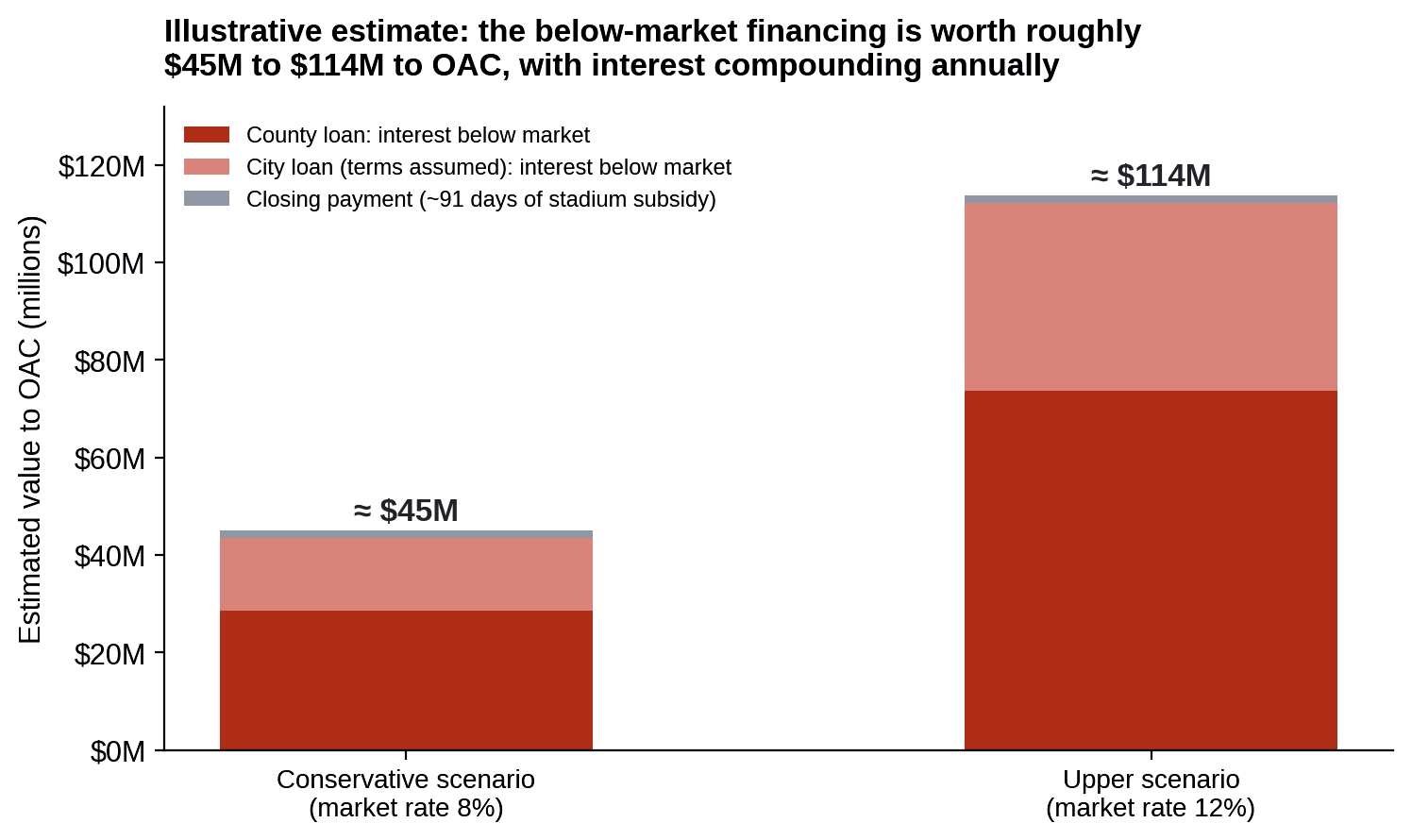
These are estimates, not precise figures, and we state the assumptions so readers — and the parties — can check them and decide for themselves what to think about them.
Two cents on the dollar
The structure’s other notable feature is how little of OAC’s own cash it appears to require.
The combined price of both halves of the property is $225 million. Of that, $115 million would be a county loan and $60 million a city loan.
The $50 million Arena lump sum payment coincides with a third-party Arena sale — the county term sheet anticipates an unnamed buyer, reported to be Oak View Group, paying at least $100 million for the eight-acre Arena, with at least $50 million flowing to the county.20
It stands to reason that the Arena buyer’s money, not OAC’s, would fund the cash portions of both government deals — though the final deal terms ultimately may require more from OAC than the record shows.
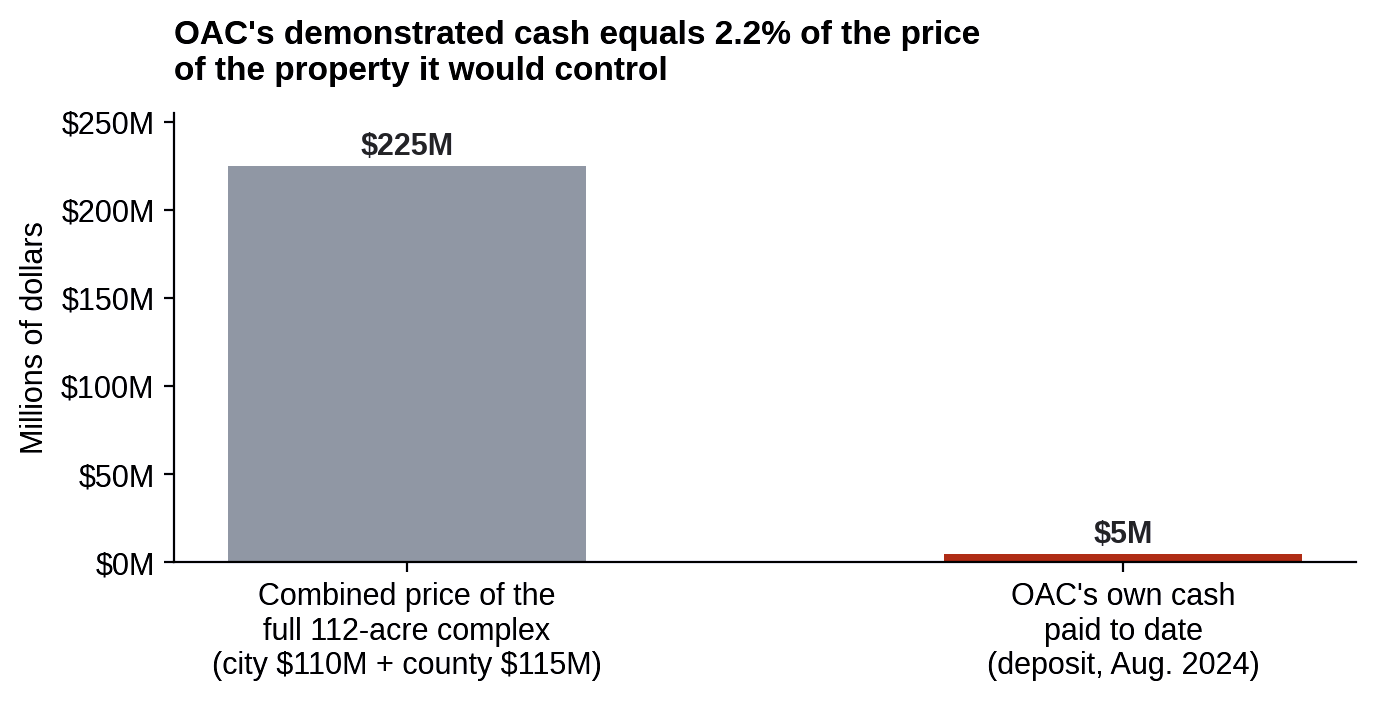
On the published record, OAC’s own demonstrated cash remains limited to the $5 million deposit paid in August 2024 — 2.2 percent of the purchase price of a 112-acre complex it would come to control.
When a buyer contributes little equity, percentage returns on that equity become extraordinarily large if the project succeeds — and the losses, if it fails, fall mostly on the lenders. Here, the lenders would be the city and the county, meaning the public.
Don’t miss a beat. Donate to support our nonprofit work.
Other considerations and counterpoints
There are fair arguments made by the deal’s supporters, which we present for readers to consider:
OAC takes on real costs and liabilities. It would accept the county’s interest “as is,” waiving the right to sue over environmental conditions at a site with documented solvent contamination. It would assume operating costs the governments now carry; pay the city 6 percent of gross ticket sales at both parcels; and remain bound by affordable-housing conditions on the stadium parcel. It also would remain bound by the terms of a settlement of a lawsuit filed by Communities for a Better Environment over environmental issues at the property.
Below-market public lending is a legal, commonly used tool when a government concludes a project’s public benefits — here, the redevelopment of a major East Oakland property — sufficiently justifies the subsidy. The question is whether that judgment is being made openly, with the subsidy’s size acknowledged.
Closing delivers real money and ends real costs to the city: roughly $50 million or more in near-term cash to the city, the end of the city’s stadium subsidy (around $6 million per year), and the simultaneous two-government closing that has been the stated obstacle since 2024.
Caveats
Our estimate of the public loan’s value to Bobbitt’s company is illustrative, not an audit. Market-rate ranges are national averages, not a quote for this specific borrower. (Neither the city nor the county have indicated that they conducted an in-depth assessment of Bobbitt’s company’s creditworthiness to arrive at the proposed 5 percent interest rate.)
Our model assumes each loan is repaid in three equal principal installments at years five through seven, with interest compounding annually until repayment; a different amortization schedule would change the totals on both sides.
The closing payment depends on the actual closing date. (Last week, a city staff person told a council committee they estimated the deal would close by September.)
None of these figures is a profit estimate — they measure the public financing subsidy only. This remains a proposal; terms may change before or on July 14.
The record supports this much: to close a sale first approved in 2024 under the leadership of a federally indicted and then recalled mayor, two governments now propose to lend the buyer $175 million at a rate below what any lender we can identify would charge — below a homeowner’s mortgage, below the prime rate — a subsidy we estimate at $45 million to $114 million, while the buyer’s own cash in the deal stands at two cents on the dollar.
Whether the promised redevelopment of East Oakland justifies that public subsidy is a policy judgment for the council and the board of supervisors.
Making the size of the public subsidy visible seems like a reasonable step which neither board has voluntarily taken as far as we can tell.
Read these related articles:


WE ARE 100% SUPPORTED BY YOU
Oakland Report provides accurate, deep-dive, data-driven reporting and analysis that you will find nowhere else. If you value our work, please donate. All contributions go directly to sustaining and growing our 501(c)(3) nonprofit work:
City of Oakland. “Second amendment to Coliseum Complex sale agreement.” Special city council meeting agenda, Jul. 14, 2026. https://oakland.legistar.com/LegislationDetail.aspx?ID=8130453&GUID=5AFD9A11-F95D-42F4-B396-245C29D5D252
Montana, Alex. “The Bank of Oakland: City to loan $60 million to developer Ray Bobbitt’s company.” Oakland Report, Jul. 9, 2026. https://www.oaklandreport.org/p/the-bank-of-oakland-city-to-loan
Reinhart, Sean S. “’Oakland deserves better’ — Alameda County approves Coliseum buyback term sheet.” Oakland Report, May 29, 2026. https://www.oaklandreport.org/p/oakland-deserves-better-alameda-county
Oakland Report contributors. “Alameda County is back in the Oakland Coliseum business — set to buy back from A’s, sell to developer.” Oakland Report, May 28, 2026. https://www.oaklandreport.org/p/alameda-county-is-back-in-the-coliseum-business
Wolfe, Eli. “Oakland Coliseum sale to Black-led developer group inches forward.” The Oaklandside, May 28, 2026. https://oaklandside.org/2026/05/28/oakland-coliseum-sale-to-black-led-developer-group-inches-forward/
Board of Governors of the Federal Reserve System. "market yield on U.S. Treasury securities at 10-year constant maturity (DGS10)." FRED, Federal Reserve Bank of St. Louis, accessed Jul. 12, 2026. https://fred.stlouisfed.org/series/DGS10
Crestmont Capital. “Land development loans: the complete financing guide for developers and builders.” Crestmont Capital, May 27, 2026. https://www.crestmontcapital.com/blog/land-development-loans
Select Commercial. “Commercial mortgage rates start at 5.57%.” Select Commercial, accessed Jul. 9, 2026. https://selectcommercial.com/commercial-mortgage-rates.php
Freddie Mac. "Primary mortgage market survey: U.S. weekly mortgage rate averages." Freddie Mac, Jul. 9, 2026. https://www.freddiemac.com/pmms
HSH Associates. "Prime rate — current and historical." HSH website, accessed Jul. 12, 2026. https://www.hsh.com/indices/prime-rate.html
Mukherjee, Shomik. “Key deadlines in 2026 may bring complicated Oakland Coliseum sale to a head.” The Mercury News, Dec. 31, 2025. https://www.mercurynews.com/2025/12/31/oakland-coliseum-sale-2026-deadlines/; https://archive.is/aPCLE
De Benedetti, Chris. "The Arena: Oakland group adds key players in push for NFL's first Black-owned team." Local News Matters / Bay City News, Oct. 2, 2020. https://localnewsmatters.org/2020/10/02/arena-oakland-group-adds-key-players-in-push-for-nfls-first-black-owned-team/
African American Sports and Entertainment Group contributors. “Members.” AASEG website, accessed Jul. 12, 2026. https://www.aasegoakland.com/members
DeBolt, David. "Oakland selects Black-led group for exclusive Coliseum development negotiations." The Oaklandside, Nov. 17, 2021. https://oaklandside.org/2021/11/17/oakland-black-led-group-coliseum-development-negotiations/
Wolfe, Eli. “Oakland has a big plan to balance its budget: sell the Coliseum.” The Oaklandside, May 22, 2024. https://oaklandside.org/2024/05/22/oakland-to-sell-coliseum-aaseg-sheng-thao-budget/
The Real Deal contributors. "Members sue Black-led group behind Oakland Coliseum revamp." The Real Deal, Oct. 20, 2023. https://therealdeal.com/san-francisco/2023/10/20/members-sue-black-led-group-behind-oakland-coliseum-revamp/
Wolfe, Eli. "Oakland has a big plan to balance its budget: sell the Coliseum." The Oaklandside, May 22, 2024. https://oaklandside.org/2024/05/22/oakland-to-sell-coliseum-aaseg-sheng-thao-budget/
Orenstein, Natalie and Darwin Bondgraham. "Sheng Thao and partner Andre Jones sought more than $300,000 in bribes, feds allege." The Oaklandside, Jan. 17, 2025. https://oaklandside.org/2025/01/17/oakland-fbi-corruption-mayor-sheng-thao-andre-jones-duong-family-bribes/
Hall, Alex. "Judge sets 2026 trial date in bribery case of former Oakland mayor Sheng Thao." KQED, Nov. 20, 2025. https://www.kqed.org/news/12064908/judge-sets-2026-trial-date-in-bribery-case-of-former-oakland-mayor-sheng-thao
Talerico, Kate. “Private equity-backed developer in talks to buy Oakland Arena from community group in Coliseum deal.” San Francisco Chronicle, May 27, 2026. https://www.sfchronicle.com/eastbay/article/private-equity-buyer-oakland-arena-22274221.php; https://archive.is/5LxtY

Thank you for this article. Oakland should not be providing seller financing. It’s likely that the current buyer will flip the property to another buyer for a much higher price and keep the proceeds - acting as a broker not a developer but keeping all of the profits. That would be wrong. Oakland should only pay a broker a market rate fee - 5-6% of purchase price, not millions in profit.
If they don’t have the money to buy the property, they don’t have the money or experience to develop the property.
Oakland city council has a fiduciary duty to its citizens (who all pay taxes) to not enter into transactions that are below market. And if the transaction contract is in default due to non-payment it should be terminated.
Sounds like a Developer with bad credit history is “buying” the public property with zero down payment and below market public financing - what a great deal for Oaklanders!