


Video clip 1: Supervisor Nate Miley expressing that it is in the county’s best interest to, “get out of the sports business… in a responsible way” on Dec. 23, 2019. (Source: County of Alameda)
Oakland Agenda Watch provides short summaries of key items on upcoming public meeting agendas that catch our attention.
BY SENECA SCOTT
County is back in the sports arena business, apparently to save the faltering Oakland Coliseum deal
Alameda County board of supervisors special meeting, May 28, 2026.1
“None of us were here when the decision was made with the city and the county to jointly have that property and have sports out there. That decision was made more than 50 years ago. Now we’re at this juncture in time, and we think it’s in the best interest of the county to get out of the sports business and get out of it in a responsible way.”
— Supervisor Nate Miley, voting to sell Alameda County’s 50 percent stake in the Oakland Coliseum Complex to the Oakland A’s for $85 million in 2019.2
In December 2019, the Alameda County board of supervisors voted unanimously to sell the county’s 50 percent stake in the Coliseum to the A’s affiliate Coliseum Way Partners for $85 million.
At the time, supervisors framed the deal as a chance to “get out of the sports business” and refocus on core services such as health, housing, and human services.3
On May 28 (today), the board of supervisors will vote on a term sheet that lays out a structure for buying back the county’s 50 percent interest in the Oakland Coliseum complex from the Athletics (A’s) baseball franchise, then selling it to a firm led by developer Ray Bobbitt.4
Under the proposed structure, the county would pay $115 million in cash to Coliseum Way Partners (CWP) — the A’s affiliate that bought the county’s stake in 2019.
The county would then be repaid $115 million by the developer, Oakland Acquisition Company (OAC), over five to seven years at 5% compounding interest.
OAC is the affiliate of the African American Sports and Entertainment Group (AASEG), led by developer Ray Bobbitt.
Bobbitt’s AASEG is also under contract to buy the City of Oakland’s 50 percent interest in the Oakland Coliseum.
AASEG has missed or delayed nearly every major payment owed to the city since the city’s deal was signed in 2024.
The city’s reliance on AASEG payments to plug a budget hole — before the cash was in hand — under former Mayor Sheng Thao forced Oakland into a “contingency budget” with cuts to police, fire, and other services after the developer failed to pay on time.
Per the new term sheet, Bobbitt’s OAC is required to maintain only $30 million in enterprise value during the entire repayment period. The county would convey its interest “as is,” with OAC waiving the right to sue the county over environmental or other property conditions.
A sale of the Oakland Arena (the indoor arena next to the outdoor Coliseum) to an unnamed third-party buyer for at least $100 million is a condition of closing.
According to news reports, that buyer is Oak View Group — see below.
The county has held closed-session discussions on this latest iteration of the Oakland Coliseum deal for more than a year without issuing public statements.
Notably, on May 27, the San Francisco Chronicle reported that Oak View Group — co-founded by concert promoter Irving Azoff and owned by private equity firm Silver Lake — is in talks to buy the Arena.5
The first detailed public account of the new term sheet appeared in news coverage on the eve of the board of supervisors’ vote, one day after a celebratory feature about the Oakland Arena’s concert lineup published in SFGate, a sister publication of the Chronicle.6

Flashback: How the county got out of the Oakland Coliseum deal — and why it’s getting back in
To understand today’s vote, it helps to go back to Dec. 23, 2019, when the Alameda County board of supervisors voted unanimously to sell the county’s 50 percent stake in the Oakland Coliseum Complex to Coliseum Way Partners, an affiliate of the Oakland A’s, for $85 million.
At the time, supervisors cast the sale as a responsible exit from a business the county no longer wanted to be in.
“None of us were here when the decision was made with the city and the county to jointly have that property and have sports out there,” supervisor Nate Miley said.
“That decision was made more than 50 years ago. Now we’re at this juncture in time, and we think it’s in the best interest of the county to get out of the sports business and get out of it in a responsible way.”
Miley argued the deal would let the county retire its bond debt on the property and still have proceeds left over “that can be utilized for other services.”
Don’t miss a beat. Donate to support our nonprofit work.
An economic analysis by Economic & Planning Systems put the county’s half of the complex at roughly $82 million, meaning that the $85 million price came in about $3 million above appraised value.
Additionally, the sale was projected to convert tax-exempt public land into taxable private property, thus increasing property tax revenue to the county.
Supervisor Wilma Chan called the sale “a gift to the residents of Alameda County and Oakland,” adding: “We don’t really want to be in the sports business. We have so many other things that we have to cover — housing, homeless, mental health and food.”
Supervisor Scott Haggerty emphasized that the county would save roughly $5 million a year in operating costs it had been absorbing.
Read this related article:

Under the 2019 agreement, CWP (the A’s) was to pay the $85 million to the county in cash installments through January 2026, take over the county’s share of operating costs, and receive the deed once bond conditions were met — a timeline that had the county fully exiting its ownership in 2026.
That deadline is almost exactly when the county now proposes to buy the stake back.
Rather than completing its exit now, the county is proposing to pay the A’s $115 million — $30 million more than it received in 2019 — to reacquire the same interest and then resell it to Ray Bobbitt’s AASEG/OAC.
Background: How the city’s deal with Ray Bobbitt’s AASEG fell apart
To understand why the county is now considering paying $115 million to essentially buy back the property interest it sold in 2019 for $85 million, it helps to understand what happened on the city’s side of the same deal.
In May 2024, Oakland mayor Sheng Thao announced a plan to sell the city’s 50 percent interest in the Oakland Coliseum Complex (which includes the Oakland Arena) to Ray Bobbitt’s AASEG for $105 million.
Thao’s announcement came after city staff had warned that Oakland was facing roughly $360 million in cumulative deficits and was preparing substantial budget cuts — including the closure of four fire stations and shrinking the police force into the low 600s.7
On July 2, 2024, Oakland city council approved Thao’s budget proposal on a 5-3 vote. The budget irresponsibly assumed the city would receive $63 million from the not-yet-signed Coliseum sale.
Council members Janani Ramachandran, Noel Gallo, and Treva Reid voted no. The city’s own financial advisor warned that tying the budget to the sale could have “catastrophic” consequences if it failed.8
The city council formally approved the sale ordinance on June 26, 2024, authorizing the city administrator to negotiate and execute a Purchase and Sale Agreement with AASEG for the city’s 50 percent interest at $105 million, payable in installments.
What followed was a series of missed and renegotiated payments:
September 1, 2024 — A scheduled $15 million payment did not arrive. Bobbitt’s AASEG had paid only the initial $5 million non-refundable deposit at the August 31 signing. Council members Ramachandran, Gallo, and Reid demanded that the city’s “contingency budget” — a backup plan that would cut $48 million across departments — be triggered immediately.
October 7, 2024 — In response to the criticism, Thao announced an amended agreement that raised the total price from $110 million to $125 million but pushed $95 million of the payments out to May 30, 2025. The amendment was billed as a “win-win” by the mayor’s office. Three council members called for greater transparency about the schedule’s impact on the city’s budget.
November 2024 — A post-election payment was missed. The contingency budget went into effect. By December, the city council had approved cuts including reducing police overtime by $25 million, temporarily closing two fire stations, and cutting arts programs and social services.
April 14, 2025 — The city council voted to push closing of the Coliseum sale to align with the county’s process, with the new closing deadline set at June 30, 2026. Then-interim mayor Kevin Jenkins told the council the Coliseum was “absolutely divorced from the budget process.”
December 31, 2025 — More than 16 months after signing the original Purchase and Sale Agreement, Bobbitt’s AASEG/OAC had still paid only the initial $5 million non-refundable deposit, according to The Mercury News.9
The pattern of missed payments under the city’s contract is notable context for the county’s proposed new deal.
Rather than waiting any longer for Bobbitt’s AASEG/OAC to come up with $115 million in cash to buy CWP’s (the A’s) interest, the county is proposing to pay CWP itself — and then accept a five-to-seven-year IOU from AASEG/OAC at 5%, secured only by a $30 million enterprise-value covenant.
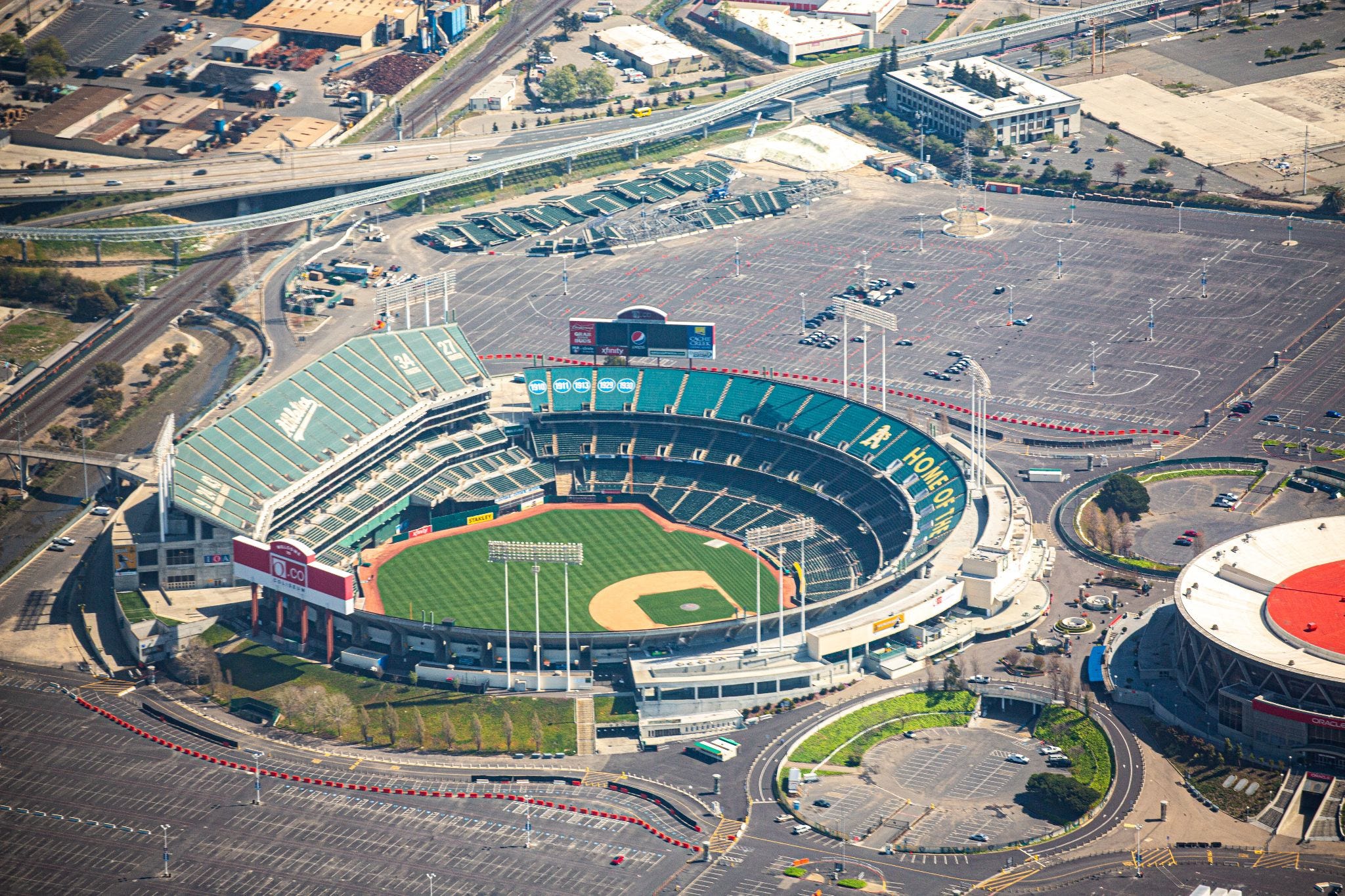
A favorable press rollout, on the eve of the county supervisors’ vote
The county itself has produced no press release, briefing, or public statement announcing the term sheet.
This new iteration of the Coliseum deal has appeared on the board of supervisors’ agenda repeatedly over the past 17 months — almost always in closed session, with no details of the deal, listed as a “Conference with Real Property Negotiators.”
Fast-forward to today, and the May 28 special meeting agenda lists three closed-session real-property items (one each on OAC, CWP, and the City of Oakland as negotiating parties) before today’s open-session vote.
Read this related article:

The term sheet’s release comes after two stories in Hearst-owned Bay Area media outlets focused on the Oakland Arena portion of the deal, both published in the same 48-hour window:
On May 26, SFGate published a culture-section feature headlined “Left for dead, Oakland Arena has become a pop music mecca,” celebrating the arena’s bookings of stars like Ariana Grande and Olivia Rodrigo, and quoting Oakland Arena vice president of booking Gretchen Claffey and Visit Oakland CEO Peter Gamez. The story does not mention the pending sale of the Arena or the county term sheet.
On May 27, the San Francisco Chronicle published a story identifying Oak View Group as the buyer in talks for the Oakland Arena. The story confirms key financial details that match the term sheet — including the county’s $115 million payment to the A’s CWP and the 5% compounding-interest repayment from Bobbitt’s AASEG — and reports that “two people familiar with the agreement told the Chronicle that Oak View was in discussions to buy the arena.”
Both outlets are owned by Hearst Communications. SFGate’s piece, in particular, contains none of the financial-structure detail in the term sheet — instead positioning the Oakland Arena as a thriving cultural asset on the eve of a public vote that determines who controls it.
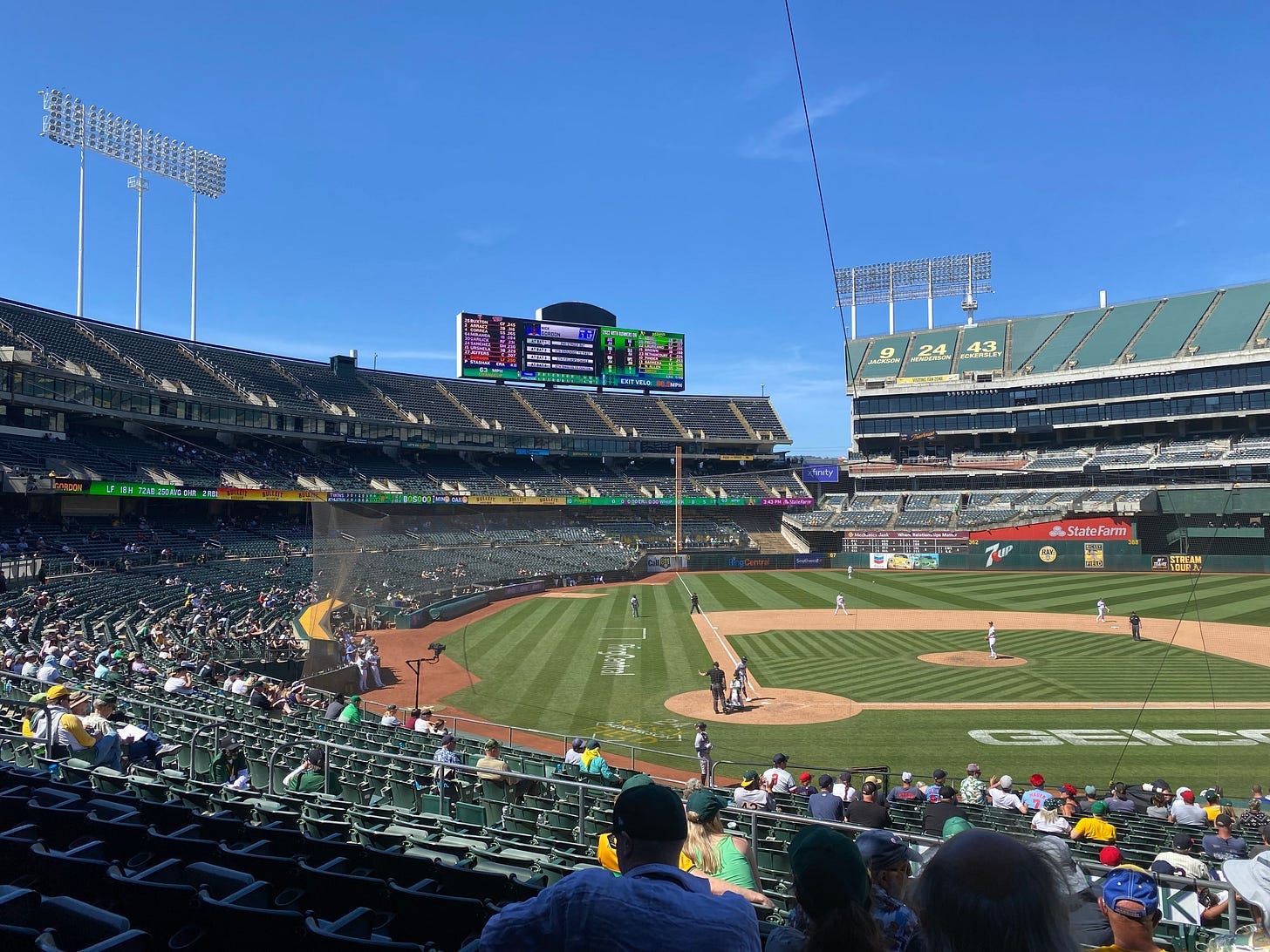
Timeline: key milestones in the Oakland Coliseum deal, 2019–2026
Dec. 23, 2019 — The county votes unanimously to exit “the sports business,” selling its 50 percent stake to the A’s affiliate CWP for $85 million ($3 million above appraisal), paid in installments through January 2026.
Oct. 2021 — The City of Oakland signs an exclusive negotiating agreement with Ray Bobbitt’s AASEG for the city’s 50 percent interest, with no competitive bidding.
May 2024 — Mayor Sheng Thao proposes selling the city’s 50 percent share to AASEG for $105 million, tying the proceeds to closing a roughly $177 million city budget deficit.
June 26, 2024 — The city council approves the sale ordinance; the 2024–25 budget passes 5-3, counting $63 million in not-yet-received sale revenue.
Aug. 5, 2024 — CWP and AASEG announce a $125 million sale agreement, subject to board of supervisors approval.
Sept. 1, 2024 — AASEG misses a scheduled $15 million payment to the city, having paid only the initial $5 million deposit.
Oct. 7, 2024 — An amended agreement raises the price to $125 million but pushes payments out; the city’s contingency budget is triggered.
Nov. 2024 — AASEG misses another payment after the election; the contingency budget takes effect, with cuts to police, fire, and services.
Jan. 14, 2025 — The county approves a first non-binding term sheet with a 30-day window to finalize the CWP-to-OAC assignment; the deadline is missed.
Apr. 14, 2025 — The city council pushes the sale to align with the county, targeting a 2026 close; AASEG has still paid only the original $5 million deposit.
July 22, 2025 — The county approves a Conditional Consent to Assignment, reassigning CWP’s purchase rights to OAC and authorizing a Second Amendment.
Jan. 27, 2026 — A joint city-county public meeting is held on the deal’s status; interim mayor Jenkins says a June 30, 2026 closing is still achievable.
Feb. 6, 2026 — The county drafts proposed amendments incorporating the “as is” release language and waiver into the term sheet.
May 26, 2026 — SFGate publishes a feature celebrating the Oakland Arena as a “pop music mecca,” with no mention of the pending sale, two days before the vote.
May 27, 2026 — San Francisco Chronicle names Oak View Group as the buyer “in talks” for the Oakland Arena, the same day the term sheet is released.
May 28, 2026 — A special board of supervisors meeting is set to vote on the new term sheet: the county pays CWP $115 million; OAC repays the county over five to seven years at 5%.
June 2026 (target) — Commercial closing, contingent on the Oakland Arena sale, settlement of litigation (see below), and City of Oakland concurrence.
Four to seven years out — OAC’s installment payments to the county begin, the first due one year after Planned Development Approval or five years after closing, whichever is earlier.
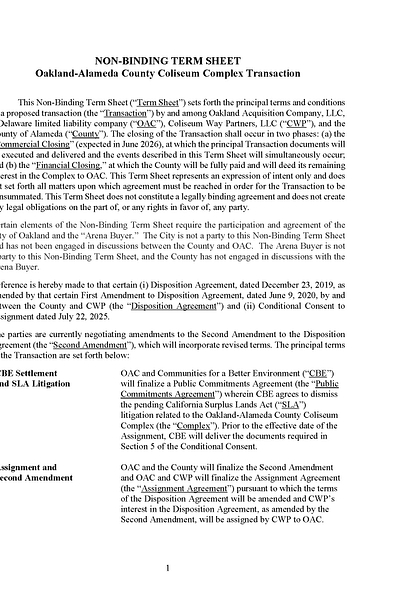
The term sheet: what’s on the county’s agenda today
The May 28 special meeting agenda lists one open-session item: approval of a non-binding term sheet that would renegotiate the “Conditional Consent to Assignment” the board of supervisors approved on July 22, 2025.10
That July 2025 vote was supposed to clear the way for the developer to take the county’s 50 percent stake from the A’s affiliate. Almost a year later, that deal has not closed.
The new term sheet, attached to the agenda, splits the transaction into two parts. At a “Commercial Closing” expected in June 2026, the county would pay the A’s CWP $115 million in cash. CWP would hand off its rights under the original 2019 Disposition Agreement to Ray Bobbitt’s OAC.
OAC would then owe the county $115 million, payable on a delayed schedule. A “Financial Closing” follows once OAC has paid the county in full.
The document itself says it is “an expression of intent only” and “does not constitute a legally binding agreement.”
A pending lawsuit must be settled before closing
The community group, Communities for a Better Environment has been suing the county since 2024 over whether the original 2019 sale complied with the California Surplus Land Act. Settling that lawsuit — through a “Public Commitments Agreement” — is one of several conditions to closing the new deal.11
The May 28 special meeting is scheduled for 10 a.m. in the Board of Supervisors’ chambers at 1221 Oak Street, fifth floor, Oakland.
WE ARE 100% SUPPORTED BY YOU
Oakland Report provides accurate, unflinching, data-driven reporting and analysis that you will find nowhere else. If you value our work, please donate. All contributions go directly to sustaining and growing our 501(c)(3) nonprofit work:
County of Alameda. “Approve a non-binding term sheet setting forth terms for renegotiation of the conditional consent to assignment of the disposition agreement among the County of Alameda, Coliseum Way Partners, LLC, and Oakland Acquisition Company, LLC (OAC) and the second amendment to the disposition agreement with OAC for the sale of the County’s half undivided interest in the Oakland-Alameda County Coliseum Complex (7000 Coliseum Way, Oakland, CA; APNs 41-3901-8 and 41-3901-9).” Board of Supervisors special meeting agenda, May 28, 2026. https://alamedacounty.granicus.com/DocumentViewer.php?file=alamedacounty_22852b4152ce6fa9b481a7de97b3aa35.pdf&view=1
Oakland Report contributors. “Flashback: Alameda County sells its stake in the Oakland Coliseum for $85 million (2019).” Oakland Report, Jan. 16, 2026 https://www.oaklandreport.org/p/20191223-flashback-alameda-county-sells-coliseum
County of Alameda, “Disposition agreement between the County of Alameda and Coliseum Way Partners LLC,” Dec. 23, 2019. https://www.acgov.org/board/bos_calendar/documents/DocsAgendaReg_12_23_19%20spmtg/GENERAL%20ADMINISTRATION/Regular%20Calendar/CAO%20Board%20Letter%20Disposition%20Agreement%20Coliseum%20Way%20Partners.pdf
County of Alameda. “Non-binding term sheet — Oakland-Alameda County Coliseum Complex transaction.” Board of Supervisors special meeting agenda, attachment 1. May 28, 2026. https://www.acgov.org/board/bos_calendar/documents/DocsAgendaReg_05_28_26%20Spmtg/GENERAL%20ADMINISTRATION/Regular%20Calendar/County_Term_Sheet_Final.pdf
Talerico, Kate. “Private equity-backed developer in talks to buy Oakland Arena from community group in Coliseum deal.” San Francisco Chronicle, May 27, 2026. https://www.sfchronicle.com/eastbay/article/private-equity-buyer-oakland-arena-22274221.php; https://archive.is/5LxtY
Lehman, Gabe. “Left for dead, Oakland Arena has become a pop music mecca.” SFGate, May 26, 2026. https://www.sfgate.com/sf-culture/article/oakland-arena-pop-music-mecca-22267168.php
Yu, Betty. “Oakland Coliseum sale payment dispute triggers concern of public safety cuts.” KTVU, Oct. 2, 2024. https://www.ktvu.com/news/dispute-over-oakland-coliseum-sale-payments)
Bahn, Eric. “Oakland’s Finances at ‘Significant Risk,’ Report Warns, as Coliseum Sale Raises Questions.” KQED, Oct. 16, 2024. https://www.kqed.org/news/12009486/oaklands-finances-significant-risk-report-warns-coliseum-sale-raises-questions
Mukherjee, Shomik. “Key deadlines in 2026 may bring complicated Oakland Coliseum sale to a head.” The Mercury News, Dec. 31, 2025. https://www.mercurynews.com/2025/12/31/oakland-coliseum-sale-2026-deadlines/
County of Alameda. “Conditional consent to assignment of the disposition agreement, as amended, between the County of Alameda and Coliseum Way Partners, LLC to the Oakland Acquisition Company, LLC (OAC).” Alameda County Board of Supervisors meeting, July 22, 2025. https://www.acgov.org/board/bos_calendar/documents/DocsAgendaReg_07_22_25/GENERAL%20ADMINISTRATION/Set%20Matter%20Calendar/CAO_390568.pdf
Seldon, Aja. "Oakland Coliseum sale moves forward with final vote to come down in 30 days." KTVU, Jan. 15, 2025. https://www.ktvu.com/news/oakland-coliseum-sale-moves-forward-final-vote-come-down-30-days
Sorry. Unless the local government has an ownership stake in the teams, they shouldn’t be in the sports business.
I look at that huge chunk of land that already has a BART stop and all I can think is that development would solve the Oakland housing shortage. We could put a park, a school, shopping. Put the shopping closet to the freeway to help with the noise. It could be fabulous.
The model seems to be the Battery in Smyrna, GA. It was a really fun place - baseball stadium, music venue, restaurants, retail, residential. The missing link is the transit piece. The coliseum has both BART and Amtrak. It is an ideal location from a transportation connectivity perspective. Then get on the other side of the BART station and build housing instead of having a big parking lot. This could be a mini city.