


Oakland Report examines the data behind the headlines. In this installment, we look at the field for Oakland’s upcoming mayoral election — and what election data and research on uncontested races suggest is at stake.
Oakland deserves a win by competition
On June 6, mayor Barbara Lee launched her campaign for a full four-year term as mayor.
Lee announcement came just over a year after winning the mayor’s seat in the April 2025 special election that followed the recall of former mayor Sheng Thao.
Lee was among those who opposed Thao’s recall, saying at the time, “I’ve always opposed recalls.”1
The city clerk’s candidate list, updated August 3, shows roughly fifteen other people who have filed intention statements or pulled nomination papers to run for mayor — this time for a full term — in November.2
One local media outlet’s assessment of the early field was blunt: “None of them have ever held elected office in Oakland.”3
The window to challenge Lee is nearly shut: prospective candidates have two days left, until 5:00 p.m. Friday, August 7, to qualify for the November ballot.4
Key findings
Mayoral turnout has fallen — and reached a historic low (37.9%) in 2025. A study of 340 mayoral elections in 144 large U.S. cities found competition and challenger campaign efforts are among the strongest drivers of local turnout.
Oakland’s 2022 mayor’s race was decided by only 682 votes. Oakland’s last election for a full term was won by a less-than-one-point margin in the final ranked-choice round. The 2025 special mayoral election for a partial term was decided by a 5.6 point margin — a close victory, not a mandate.
The 2026 mayor’s race currently has no challenger who has previously held elected office, and only one who reported raising campaign money.
One-horse races are not uncommon in American local government — an estimated 34% of local general elections drew no opposition in 2022, and in more than 50,000 school board races studied, incumbents who ran were re-elected over 80% of the time.
A century of research on U.S. cities finds that entrenched, unchallenged governing coalitions grow measurably less responsive — and strong incumbents win many races before they begin, by deterring qualified challengers from entering at all.
Subscribe to Oakland Report.
What is lost when elections go uncontested
One-horse races are fairly common in American local government.
One study estimated 34% of county, township, and municipal general elections for governing boards and top executives drew no opposition in 2022.5
A study of more than 50,000 school-board elections found nearly half uncontested, with incumbents re-elected more than 80% of the time when they ran.6
Research on American cities suggests what is lost when no one credible challenges the incumbent.
Responsiveness and participation. A study of more than 240 U.S. cities across a century found that entrenched governing coalitions — machine and ‘reform’ regimes alike — build “political monopolies” that bias elections toward incumbents, restrict the entry of challengers, and grow measurably less responsive, with groups outside the coalition ceasing to participate.7
A prospective challenger weighing a run against such a coalition — its donors, endorsers, and allied organizations — faces exactly the entry costs that the political science literature finds deter otherwise qualified people from running.89
Turnout and public debate. A study that analyzed 340 mayoral elections across 144 large U.S. cities found that competition and campaign effort — challenger spending in particular — are among the strongest drivers of local turnout.10
Another study of America’s municipal contests describes them as low-information affairs in which incumbents usually win.11
It stands to reason that when no serious challenger files, the campaign that would force a sustained public debate over crime, housing, and the budget simply never happens.
The re-election incentive. Analyzing U.S. governors from 1950 to 1986, economists found that governors barred by term limits from facing voters again made systematically different tax and spending choices than those still seeking re-election — consistent with their model in which “the possibility of being re-elected may curtail opportunistic behavior” by incumbents.12
Oakland’s mayoral turnout has fallen — and reached a historic low (37.9%) in 2025
The numbers of people voting in any given election has swung with the electoral calendar.
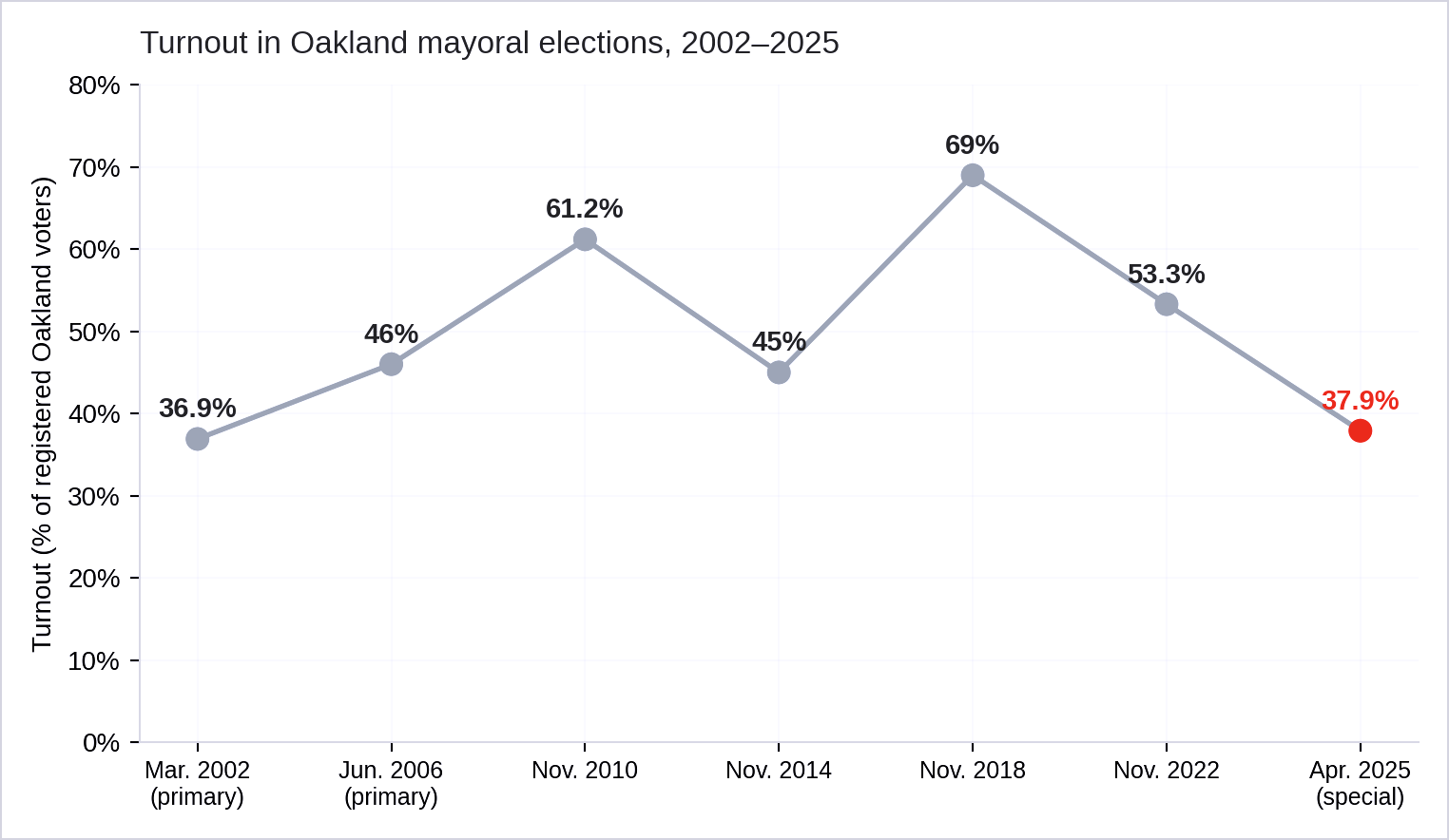
The April 2025 special election won by Lee had the lowest mayoral turnout in 23 years — roughly 38% of the city’s 250,000 registered voters.
A local media outlet reported at the time that turnout in that election skewed toward the city’s wealthier hill neighborhoods relative to the flatlands.13
Turnout in the March 2002 primary that re-elected Jerry Brown was 36.9%.
The June 2006 primary when Ron Dellums was elected mayor saw 46.0% turnout.
When the mayor’s race moved to November starting in 2010, turnout increased to 61.2%.
After peaking in 2018 when 69% of Oakland voters cast ballots, mayoral election turnouts experienced a steady decline: about 53% in 2022, and roughly 38% in 2025.
Two recent mayoral races were decided by narrow margins
Oakland’s electoral record shows what is at stake, because its recent mayoral history is notably competitive.
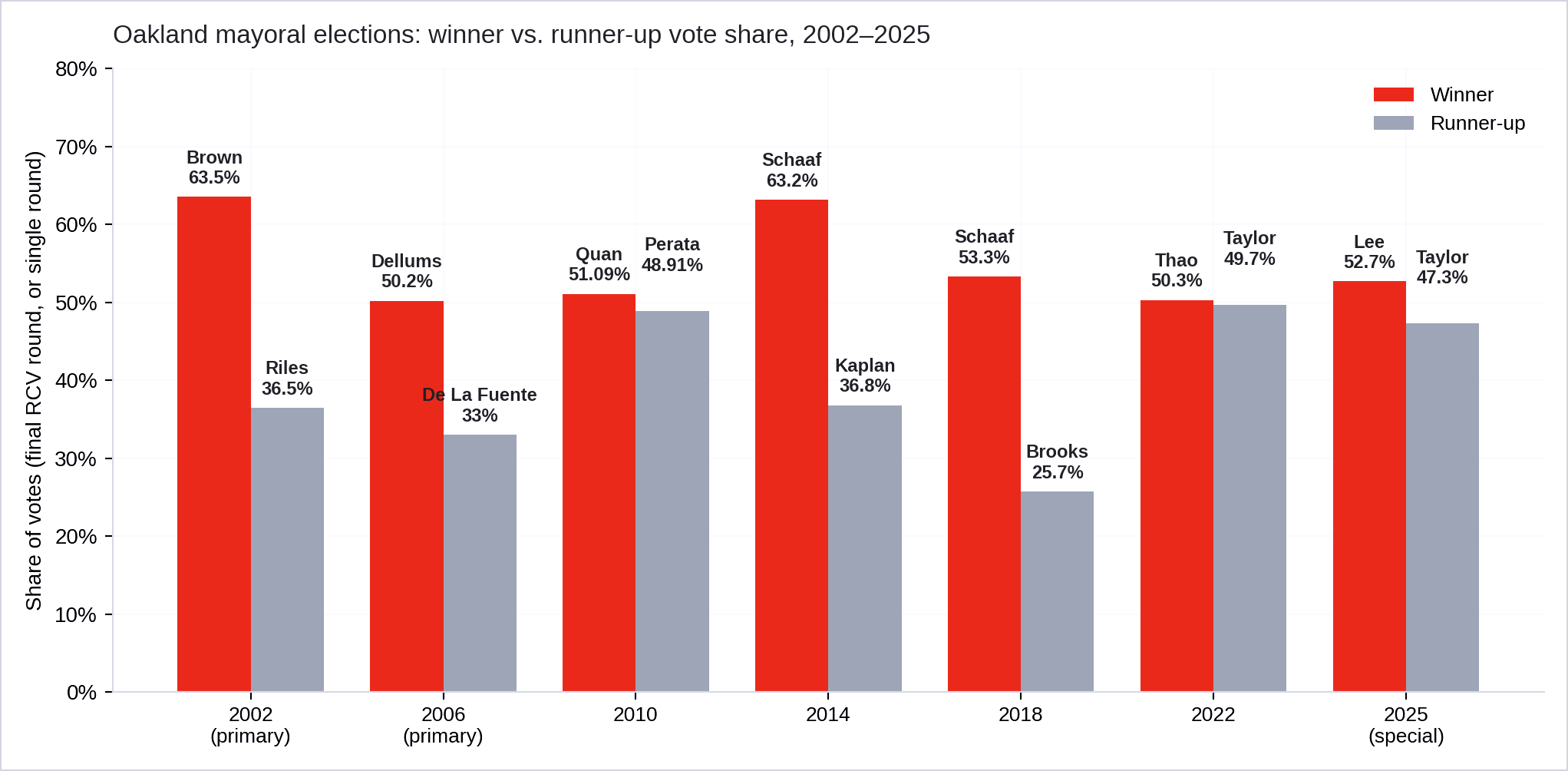
In 2014, Libby Schaaf unseated incumbent Jean Quan from a 15-candidate field — the first defeat of a sitting Oakland mayor since 1990 — winning roughly 62.8% after 15 rounds of ranked-choice tabulation.14
In 2018, Schaaf won re-election outright with 53.3% of first-choice votes against nine challengers.15
In other mayoral elections, the margins were far narrower.
Jean Quan’s 2010 upset of Don Perata was a two-point race.16
In 2022, council member Loren Taylor led council member Sheng Thao on first-choice votes, but Thao won the ninth and final ranked-choice round by a margin of just 682 (0.6%) votes out of 113,735 total.
In 2024, voters recalled mayor Thao after an FBI raid on her home; she was indicted soon after on federal bribery and conspiracy charges and is set to stand trial in October.
In the April 2025 special mayoral election to fill the partial term vacated by Thao’s recall, Lee defeated Taylor in the ninth ranked-choice round of a 10-candidate race, 52.7% to 47.3% .
Ranked-choice voting rounds have twice reversed the first-choice vote leader
Oakland has elected its mayor by ranked-choice voting (RCV) since 2010, and in two of the five RCV mayoral elections the candidate who led on first choices did not win.
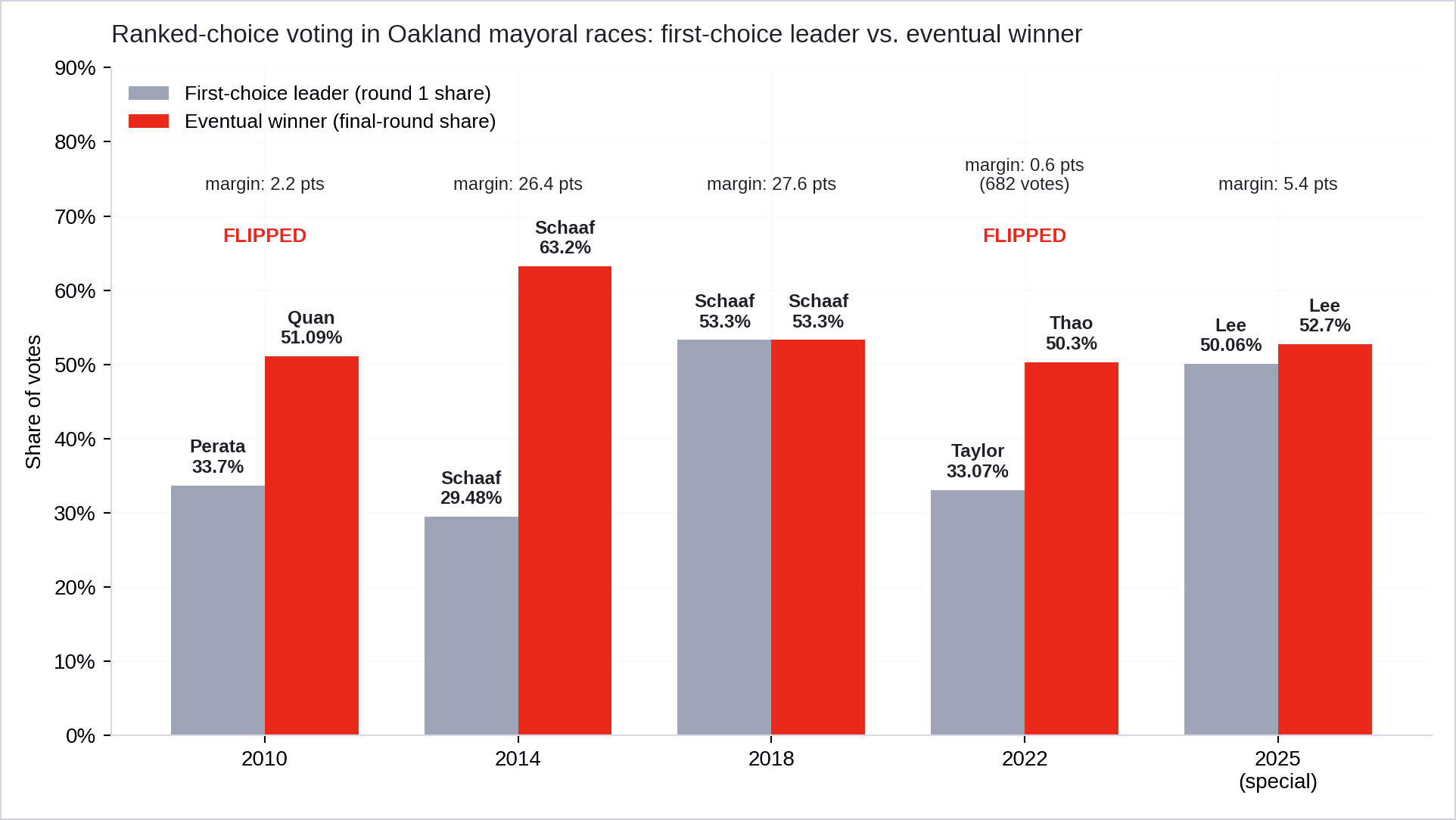
In some races, the first-choice vote leader prevailed: Schaaf converted a 29.48% first-choice plurality into a 63.20% final-round win in 2014. She then won re-election outright on first-choice votes with 53.3% in 2018.
In 2025, Lee led from the first round (50.06%) through the finish (52.70%).
In 2010, Don Perata led with 33.7% of first-choice votes but lost the tenth round of ranked-choice voting to Jean Quan, 51.09% to 48.91% — about a two-point margin.17
In 2022, Taylor led in first-choice votes by a narrow 33.07% to 31.79%, but lost the ninth round of ranked-choice voting to Thao by 682 votes.
Both ranked-choice reversals produced the era’s closest margins, and both losing first-choice leaders publicly criticized RCV afterward.1819
Oakland’s mayoral field, two days before the filing deadline
Per the most recent list issued by the city clerk, 16 people have filed intention statements or pulled nomination papers for mayor.
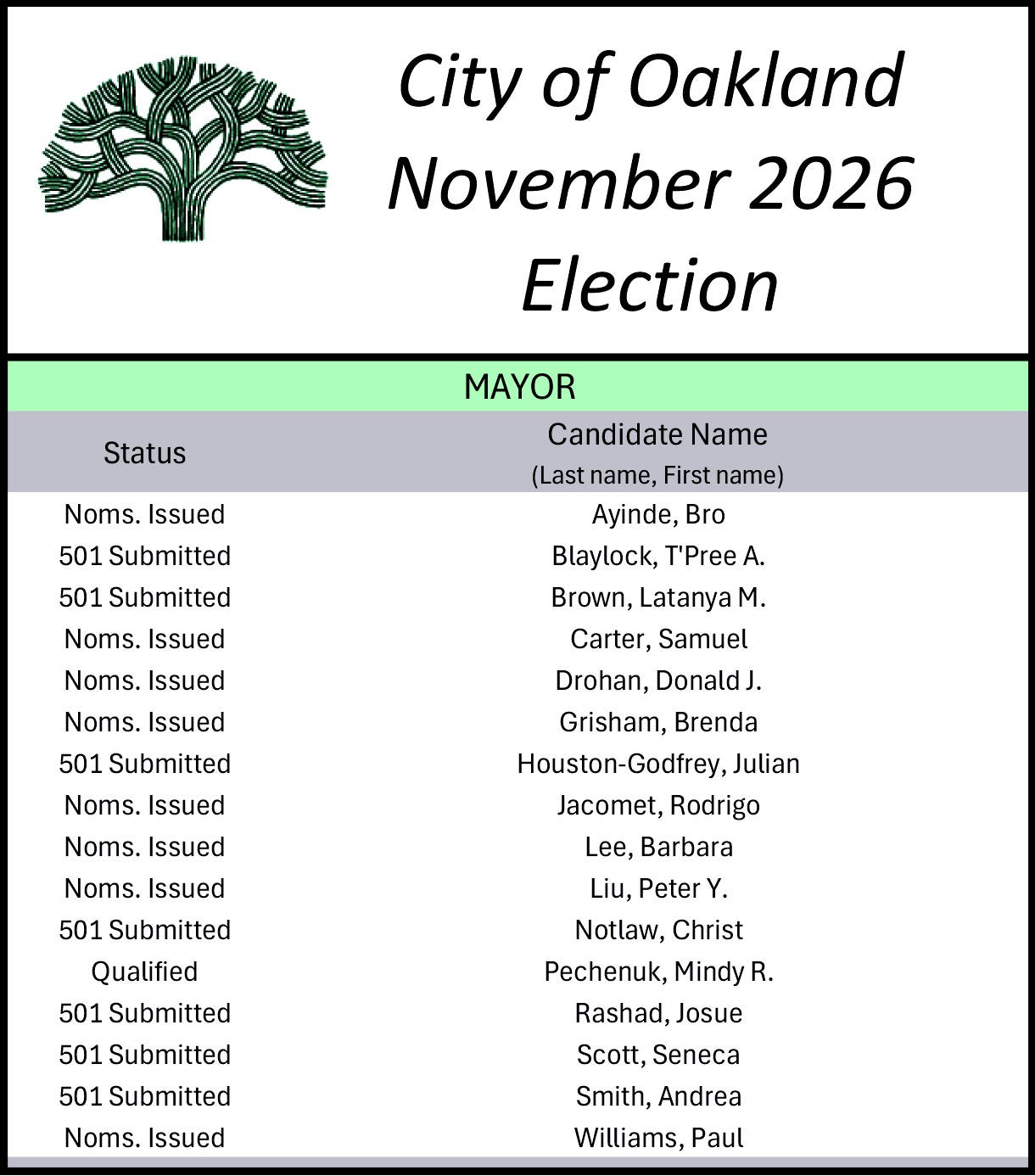
Filing statuses vary, and not all will qualify for the ballot.
The most prominent names among the challengers are candidates who have run before but have not held elected office: Seneca Scott, a community activist who ran for mayor in 2022; Mindy Pechenuk, who ran for state assembly (2022), city council (2024), and mayor (2025); and perennial candidate Peter Liu.2021
Brenda Grisham, an anti-gun-violence advocate and a leader of the 2024 recall of former district attorney Pamela Price, announced her candidacy in July 2025.22
Loren Taylor, former Oakland city council member — and the mayoral runner-up in 2022 and 2025 — does not appear on the clerk’s list as of August 3.
Barbara Lee, who turned 80 in July, was the oldest person to become Oakland’s mayor when she was sworn in at 78, after a long career in Congress.2324
If re-elected, Lee will be 84 by the end of the full four-year term in January 2031.
By comparison, Oakland’s last congressional member-turned-mayor, Ron Dellums, was 71 years old when he was sworn in as mayor.
No challenger has significant campaign money in this race — so far
In each of the last four mayoral races, the top-funded rival collected six-figure sums — from $110,324 (Cat Brooks, 2018) to $618,527 (Loren Taylor, 2025).
In both 2022 and 2025, Taylor out-raised the eventual winner.2526
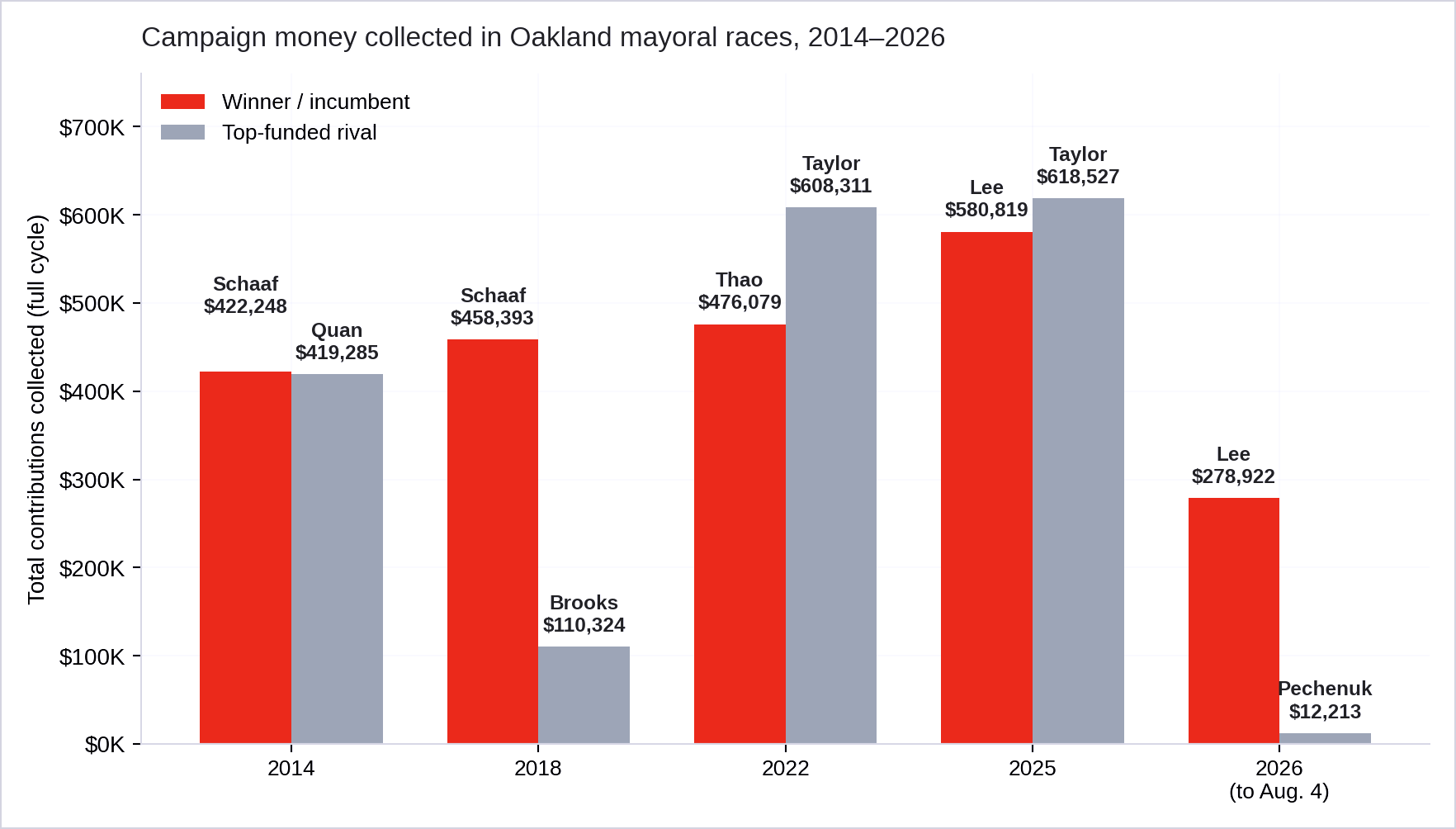
As of August 4, Lee's re-election committee reported roughly $279,000 in campaign funding. Pechenuk is the only challenger to report raising any campaign funding: around $12,000.27
Share this article with someone you know.
Counterpoints and caveats
As the incumbent, Lee can point to results. For example, Oakland reported 67 homicides in 2025, down 22% from 2024, and violent crime down 25% — part of a nationwide trend.2829
A thin field of challengers may partly reflect a popular and formidable incumbent.
Challenger deterrence by the incumbent is common in politics, and is not necessarily a sign of dysfunction. The 2018 mayor’s race offers precedent: Schaaf also faced no sitting officeholders and won outright.
Some research offers a benign reading of uncontested local races: incumbents are mostly re-elected by satisfied voters, and a small field is not automatically a captured one.30
The clerk’s list is a snapshot; filings remain open until Aug. 7, and filing statuses vary by candidate.
There is no choice when there is no contest
Research suggests, but cannot prove, that a contested 2026 mayor’s race would produce better governance, higher turnout, or a different winner.
But the research does appear to point mostly in one direction:
Unchallenged governing coalitions tend to grow less responsive.
Competition and challenger efforts draw voters to the polls.
Officials answerable to voters in the future tend to behave differently from those who are not.
Strong incumbents win many races before they begin by deterring qualified challengers from running at all.
The record shows that twice in four years, Oaklanders chose their mayor by close margins — and once, by recall, removed a mayor later indicted for corruption.
The data suggests that competitive elections are among Oakland’s primary accountability mechanisms.
There is no doubt that Oakland — a city of nearly half-a-million extraordinary people — is home to thousands of talented, smart, ambitious, and accomplished leaders who could capably serve as mayor.
Some of these extraordinary people may even be more capable and better qualified for the job than the current incumbent.
It is reasonable to consider the possibility that a one-horse race with no major challengers leaves voters in November with a ratification, not a choice — and essentially circumvents the accountability mechanism of a contested election.
Oakland Report is an experiment in a new form of media: reasoned, data-driven, well-sourced analysis focused on observable and verifiable evidence. We present the facts and let the reader decide.
KTVU contributors. "Congresswoman, California senator oppose recalls of Oakland mayor, DA." KTVU, Oct. 11, 2024. https://www.ktvu.com/news/congresswoman-california-senator-oppose-recalls-oakland-mayor-da
City of Oakland. “November 3, 2026 general municipal election — candidate list.” Office of the City Clerk, updated Aug. 3, 2026. https://www.oaklandca.gov/files/assets/city/v/13/city-clerk/documents/elections/nov-2026-election-candidate-list.pdf
Bondgraham, Darwin. “Oakland Mayor Barbara Lee launches campaign for re-election.” The Oaklandside, Jun. 8, 2026. https://oaklandside.org/2026/06/08/oakland-mayor-barbara-lee-launches-campaign-for-re-election/
Ballotpedia contributors. "City elections in Oakland, California (2026)." Ballotpedia, accessed Aug. 4, 2026. https://ballotpedia.org/City_elections_in_Oakland,_California_(2026)
CivicPulse contributors. "How many local elections are uncontested?" CivicPulse, May 31, 2024. https://www.civicpulse.org/post/how-many-local-elections-are-uncontested
Kogan, Vladimir et al. "High Turnover with Low Accountability: Local School Board Elections in 16 States." EdWorkingPaper 25-1213, Annenberg Institute at Brown University, Jun. 2025. https://edworkingpapers.com/ai25-1213
Trounstine, Jessica. "Political monopolies in American cities: the rise and fall of bosses and reformers." University of Chicago Press, 2008. https://press.uchicago.edu/ucp/books/book/chicago/P/bo5921610.html; https://search.worldcat.org/title/855524887
Ashworth, Scott, and Ethan Bueno de Mesquita. “Electoral selection, strategic challenger entry, and the incumbency advantage.” Journal of Politics 70, no. 4 (2008): 1006–1025. https://doi.org/10.1017/S0022381608081024; https://home.uchicago.edu/~sashwort/inc_adv.pdf
Lawless, Jennifer and Richard Fox. “It still takes a candidate: why women don’t run for office.” Cambridge University Press, 2010. https://www.cambridge.org/core/books/it-still-takes-a-candidate/7BEAE647EF1B86EC62521AAFC159020B; https://archive.org/details/itstilltakescand0000lawl
Holbrook, Thomas and Aaron Weinschenk. “Campaigns, mobilization, and turnout in mayoral elections.” Political Research Quarterly, March 2014. https://journals.sagepub.com/doi/abs/10.1177/1065912913494018; https://www.ifs.org/wp-content/uploads/2015/05/Holbrook-Weinschenk-2013-Mayoral-Turnout.pdf
Oliver, J. Eric et al. “Local elections and the politics of small-scale democracy.” Princeton University Press, 2012. https://press.princeton.edu/books/paperback/9780691143569/local-elections-and-the-politics-of-small-scale-democracy; https://search.worldcat.org/title/761850874
Besley, Timothy and Anne Case. “Does electoral accountability affect economic policy choices? Evidence from gubernatorial term limits.” Quarterly Journal of Economics, Aug. 2, 1995. https://doi.org/10.2307/2946699; https://www.princeton.edu/~accase/downloads/Does_Electoral_Accountability_Affect_Economic_Policy_Choices.pdf
Fermoso, Jose and Roselyn Romero. “Turnout was low for Oakland’s mayoral election. What could change that?” The Oaklandside, Apr. 18, 2025. https://oaklandside.org/2025/04/18/turnout-was-low-for-oaklands-mayoral-election-what-could-change-that/
Alameda County Registrar of Voters. "Certified final results, Nov. 4, 2014 general election —." Certified Dec. 4, 2014. https://acvote.alamedacountyca.gov/acvote-assets/pdf/elections/2014/11042014/results/nov-4-2014-summary-results-report.pdf
Ibid. Ballotpedia. “Mayoral election in Oakland, California (2018).”
CBS San Francisco contributors. “Quan edging Perata in Oakland mayor’s race.” CBS San Francisco / KCBS, Nov. 6, 2010. https://www.cbsnews.com/sanfrancisco/news/quan-edging-perata-in-oakland-mayors-race/
FairVote contributors. "The real story on ranked choice voting in Oakland's mayoral election, 2010." FairVote, Nov. 11, 2010. https://archive3.fairvote.org/press/oakland-rcv-response/
Muir, Bailey. "Perata concedes Oakland mayoral race, faults ranked-choice voting for loss." California Beat, Nov. 11, 2010. https://www.californiabeat.org/perata-concedes-oakland-mayoral-race-faults-ranked-choice-voting-for-loss/
Howland, Lena. "Oakland mayoral candidate Loren Taylor concedes to Sheng Thao, slams ranked-choice voting." ABC7 San Francisco, Nov. 22, 2022. https://abc7news.com/oakland-mayor-sheng-thao-loren-taylor-2022-election-results/12481773/
Ballotpedia contributors. “Seneca Scott (California).” Ballotpedia, accessed Aug. 4, 2026. https://ballotpedia.org/Seneca_Scott_(California)
Wolfe, Eli. “Oakland mayor candidates: a close look.” The Oaklandside, Mar. 7, 2025. https://oaklandside.org/2025/03/07/oakland-mayor-candidates-a-close-look/
NBC Bay Area contributors. “Community advocate Brenda Grisham announces plans to run for Oakland mayor.” NBC Bay Area, Aug. 25, 2025. https://www.nbcbayarea.com/news/local/brenda-grisham-plans-to-run-for-oakland-mayor/3938526/
Baker, Alex and Dan Kerman. “Barbara Lee sworn in as Oakland mayor.” KRON4, May 20, 2025. https://www.kron4.com/news/bay-area/barbara-lee-sworn-in-as-oakland-mayor/
BlackNews.com contributors. “78-Year-old Black woman makes history as the oldest person to become mayor of Oakland.” BlackNews.com, Apr. 21, 2025. https://blacknews.com/news/barbara-lee-black-woman-oldest-person-mayor-oakland/
Gammon, Robert. “Outside money absent in mayor’s race.” East Bay Express, Nov. 5, 2014. https://www.eastbayexpress.com/oakland/outside-money-absent-in-mayors-race/Content?oid=4115960
Oakland Public Ethics Commission. "Mayor — April 15, 2025" Open Disclosure Oakland, accessed Aug. 5, 2026. https://www.opendisclosure.io/office/oakland/2025-04-15/mayor/
Ibid. Oakland Public Ethics Commission. “Mayor — November 3, 2026.”
Carlos Lara, Juan. "Oakland's violent crime dropped significantly in 2025, police data shows. What happened?" KQED, Jan. 8, 2026. https://www.kqed.org/news/12068975/oaklands-violent-crime-dropped-significantly-in-2025-police-data-shows-what-happened
Galloway, Kayla and Jana Katsuyama. “Oakland mayor, city leaders tout lower crime rates in 2025.” KTVU, Jan. 7, 2026. https://www.ktvu.com/news/oakland-crime-statistics-2025
Ibid. Oliver.
Sigh. Seems like Oakland has become kryptonite for viable candidates. Sean, why don’t you run?
Sorry, I cannot run. But agree with this 100%