


Video clip 1. Mayor Barbara Lee stated about the Measure NN promise of 700 police officers, “The promises are being kept… We have a Measure NN committee that is in the process now, of just putting that plan together. And in fact we have in Measure E the continuation of the funding strategy.” Measure NN was approved by Oakland voters in 2024 with a legally binding promise of 700 police officers. The city currently has around 610 officers on payroll. (Video courtesy of NBC Bay Area, May 21, 2026)1
Editor’s note
Oakland Report is examining the misleading political statements made by local leaders and advocates. Today we look at some of the campaign statements supporting Oakland Measure E, the $34-million-per-year parcel tax on the June 2 ballot. Future installments will look at misleading statements made by elected leaders and special interest groups on other issues that affect Oaklanders’ lives.
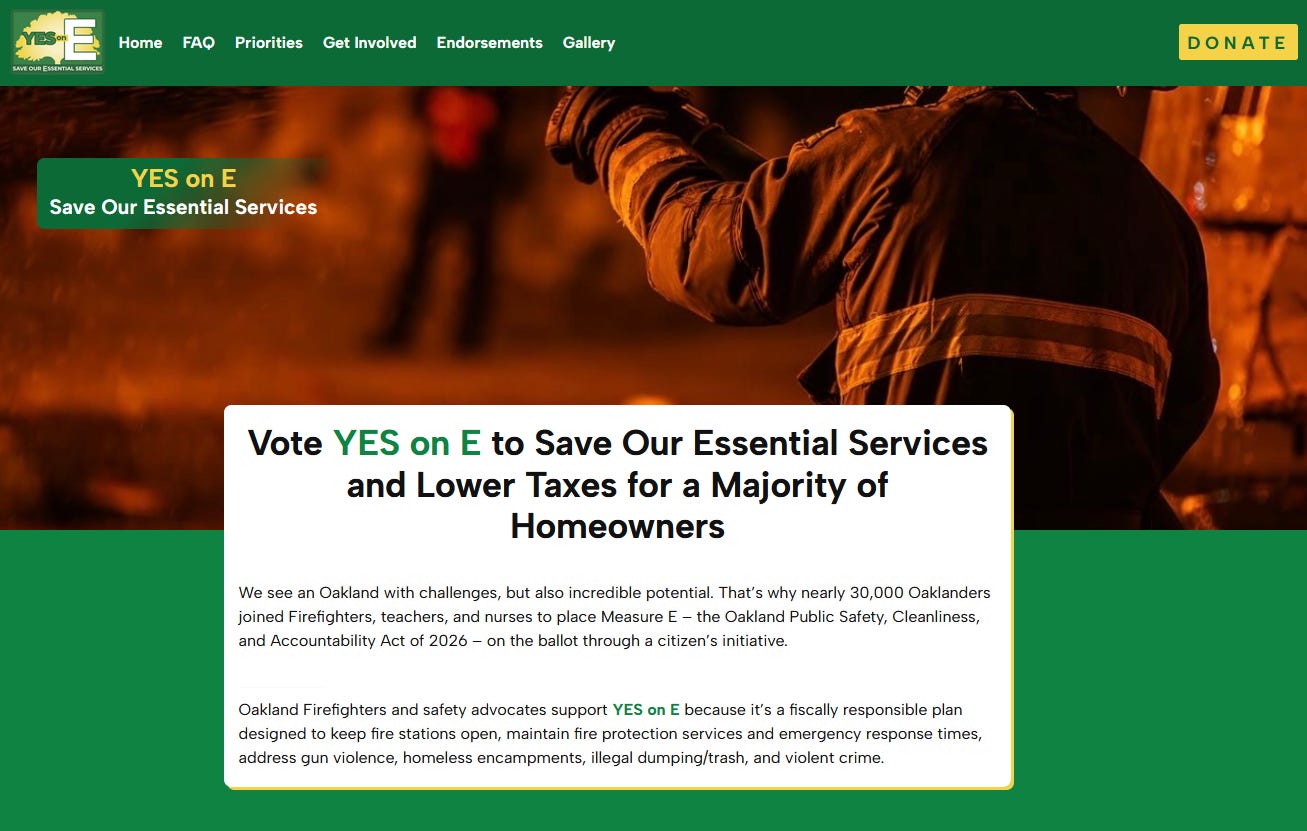
Campaign statement that Measure E results in “lower tax rates for most homeowners” is a lie, as the term is commonly understood.
The “Yes on E” campaign website homepage claims that Measure E, a new, $34-million-per-year parcel tax would “lower taxes for a majority of homeowners.”
But there is no language in the actual text of Measure E that specifies which tax is “expiring” or being replaced, nor is there any language in the measure’s text that offers any legally binding specifics that the measure would, in fact, “lower tax rates for most homeowners.”2
So far, no one in the campaign or elsewhere has offered proof that this claim is true.
In reality, Measure E’s estimated $34 million per year in new parcel taxes would be in addition to, not replacing Oakland’s existing ‘public safety’ parcel tax, Measure NN, approved by voters in 2024, also on promises that the money would be used to save and enhance ‘public safety.’
By all appearances, the campaign message that Measure E would “lower tax rates for most homeowners” is a lie, as the term is commonly understood.
Read this related article:

The public unions who put the measure on the ballot were careful not to make the “lower taxes” statement legally binding in the text of the measure itself. But it is, in fact, legal to make misleading statements in campaign messaging.
This may explain why the “lower tax rates” promise is primarily being made through the campaign channel instead of in the legally binding language of the measure itself.
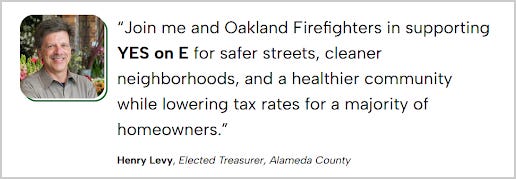
The elected Alameda County treasurer Henry Levy endorsed Measure E, including in his statement in the Argument in Favor of the measure that was published in the official Voter Information Guide.
Levy’s endorsement claim of “lowering tax rates” also was included in campaign mailers paid for by the public employee unions and their backers who are supporting the measure.3
Levy later admitted in writing that he did not even know if the so-called “expiring” tax the campaign alludes to, the Police and Fire Retirement System (PFRS) tax, actually is expiring, as he claims in his endorsement.4
Read this related article:

Promises made, promises broken
Additionally, Mayor Barbara Lee recently released her budget proposal and spending plan for Measure E, if voters approve it on June 2.
In her own words, the mayor admits that the city has no plan to keep the promises it made to voters in the last tax, the $47-million-per-year Measure NN (2024), unless voters approve another tax, the $34-million-per-year Measure E.
Measure NN was approved by Oakland voters in 2024 with a legally binding promise of 700 police officers. The city currently has only 678 officers budgeted, and only around 610 officers on payroll.
A few days after she released her Measure E spending plan, mayor Lee offered new promises for Measure E spending that are not listed in the Measure E text at all. (More on that below.)
‘Repeat a lie often enough, and it becomes the truth’
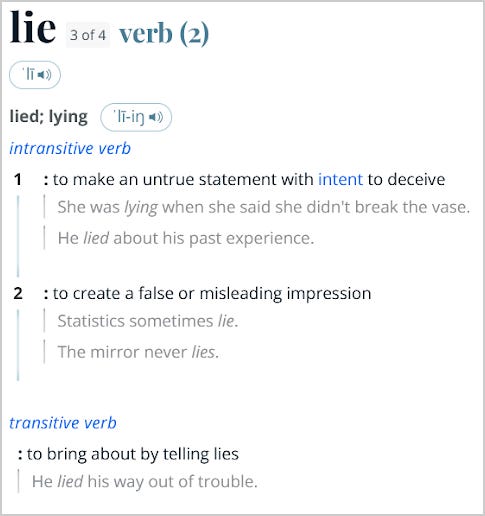
According to the Merriam-Webster dictionary, the word “lie,” meaning to make a false or misleading statement, carries three relevant definitions in this context:5
“To make an untrue statement with intent to deceive.”
“To create a false or misleading impression.”
“Something that misleads or deceives.”
These definitions share a common thread — deception — whether through making an outright false statement or by giving a misleading impression through cleverly-worded political rhetoric.
The legal question that follows is whether speech fitting these definitions can be prosecuted when it occurs in a political campaign.
(Spoiler: More often than not, it can’t.)
The difference between the commonly understood definition of a “lie” and the legally enforceable one
The word “lie” in ordinary use is broader than the definition the law can prosecute in the context of political campaigns. The dictionary definition is fairly clear about what constitutes misleading impressions, gaslighting, and false statements — i.e., lies — but the law is far more narrowly defined.
First, only false statements of fact are actionable; opinion, hyperbole, and misleading rhetoric are not. Within defamation law, there is a gray area occupied by misleading political statements that may not meet the threshold of falsehood required for defamation.6
Much of what honest people would call a campaign “lie” — a misleading impression, a selectively framed claim, a rhetorical sleight-of-hand — falls into this gray area.
Second, even a provably false factual statement about a political opponent is rarely enforceable, because political candidates are public figures.
Under the standard set in the 1964 Supreme Court case New York Times Co. v. Sullivan, public figures must prove that the defendant made the defamatory statement with knowledge of its falsity or with reckless disregard for its truth — the “actual malice” standard.7
This is a subjective and demanding test: there must be clear and convincing evidence, and the plaintiff needs to show that the speaker seriously doubted the truth of what they were about to say before they said it — a very high bar, because it is not possible to read people’s minds.8
Third, the practical result is that the standard can make it very difficult to prevail in a defamation case, even when allegations against a public figure are unfair or proven false.9
Legal practitioners observe that courts continue to apply a high bar for proving defamation, especially when challenged statements are part of political ad campaigns.10
In short: the commonly understood “lie” — a statement made with intent to deceive or mislead — is mostly not legally enforceable in a campaign. The legally enforceable category is far narrower: a false assertion of fact, about an identifiable person, made with actual malice, causing reputational harm.
It’s legal to lie in campaigns
With that distinction in mind, the fact that lying in political campaigns is generally legal in the United States rests on well-documented constitutional law.
For example, the Supreme Court’s 2012 decision in United States v. Alvarez establishes the foundational principle: there is no general exception to the First Amendment for false statements, and the Court reasoned that some false statements are inevitable if there is to be an open and vigorous expression of views in public discourse.11
Although that case concerned false claims of military honors, it makes clear that the Court has not endorsed a general rule that false statements receive no First Amendment protection.12
In addition, lower courts have applied this reasoning directly to campaign speech. In the 2016 case Susan B. Anthony List v. Driehaus, the Sixth Circuit affirmed the district court’s judgment finding Ohio’s law concerning political false statements unconstitutional, concluding they were content-based restrictions that fail strict scrutiny review.13
The trial judge reasoned that the answer to false statements in politics is not to force silence, but to encourage truthful speech in response, and to let the voters, not the judiciary, decide what the political truth is.14
Other scholarly legal analysis confirms this trend, noting that the Alvarez ruling suggests false speech is a protected class, and that other courts evaluating similar laws afterward have reached the same conclusion.15
Together, this body of law shows campaign lies are largely shielded from legal sanction — though, as the caveats above make clear, “legal” here means largely immune from judicial penalty, not free of all consequence.
Mayor Barbara Lee is changing the Measure E promises in real time
Measure E — the “Oakland Public Safety, Cleanliness and Community Accountability Act of 2026” — would levy a nine-year special parcel tax raising roughly $34 million annually, promised to fund five priority areas:
911 response and fire services (improving emergency response times and keeping fire stations open)
crime prevention
homelessness solutions
cleanliness (illegal dumping, litter, graffiti)
administrative support.
The measure itself does not fund specific line items within those categories. Per the language of the measure, which includes the disclaimer “such as, but not limited to,” the city council may allocate the Measure E money at their discretion through the budget process.
The supporters’ campaign and the official Argument in Favor stress the same broad themes — keeping fire stations open, faster 911 response, cleaner streets, and homelessness response — rather than itemized purchases, while emphasizing oversight and a biennial audit.
Mayor Barbara Lee’s more specific promises came later and separately — and they are materially different from the promises made in the text of Measure E and the associated Yes campaign.
Read this related article:

On May 15, mayor Lee released a Measure E spending plan stating the revenue would support additions like 22 police officers (the number of budgeted officers the city needs to add in order to meet Measure NN’s promised 700-officer minimum in terms of budgeted officers), a police academy, replacements for older city vehicles like fire engines, and new shelter beds.16
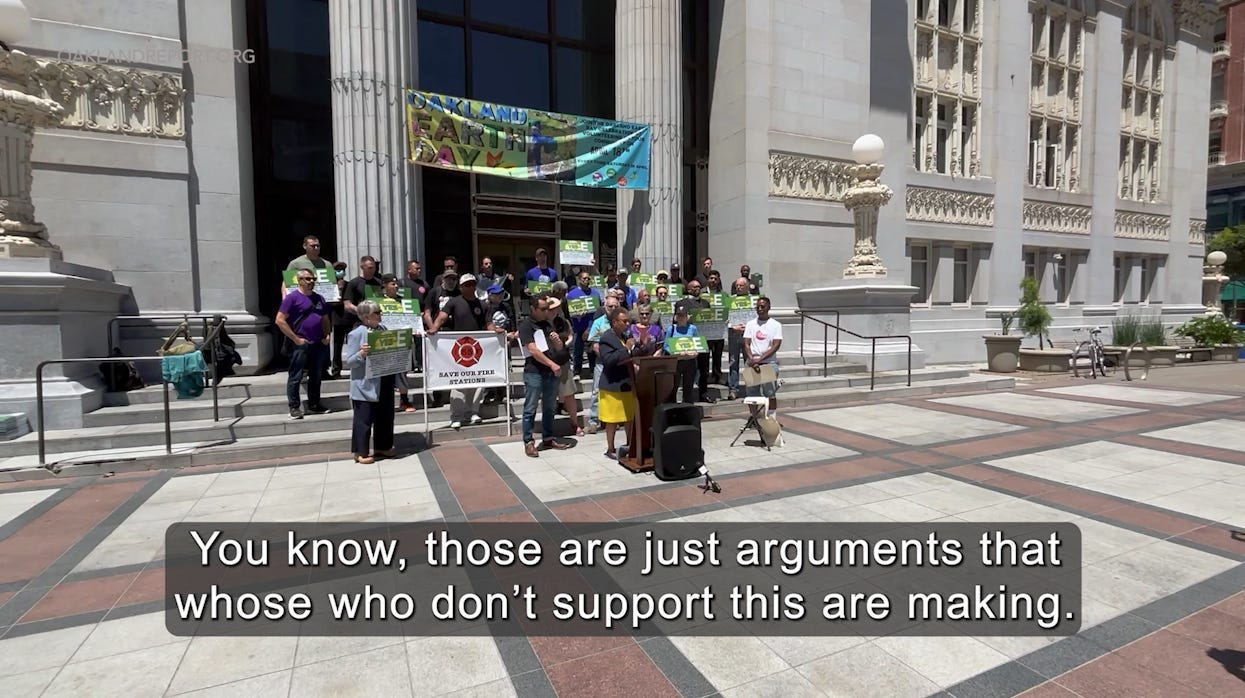
Then at a May 21 campaign rally, mayor Lee said, “Under the mayor’s budget plan, where we have our senior centers, for example, open four days. If we pass the [Measure E] parcel tax, they’ll be open five days, you know?”17
However, the text of Measure E does not directly include Lee’s campaign promises. The campaign’s recent fire-truck/equipment promise has a plausible but stretch home in the measure’s first category (911 and fire services), but capital purchases of vehicles are not named in the text. Notably, capital purchases like fire trucks are one-time expenditures, not ongoing ones like “services.” Treating the money as available for fire engines under the banner of “services” is Lee’s political interpretation, made after the measure was finalized.
The senior centers promise is not among the five priority areas listed in Measure E at all. The connection is indirect — the mayor’s intention presumably is that the Measure E revenue would backfill services normally covered by the General Purpose Fund, and that passing the measure would free up other money so senior centers can stay open an extra day. That is a downstream budget effect she attributes to the measure, not a service the measure directly funds or guarantees.
The mayor’s statements, if they are to be taken at face value, confirm that there is no guarantee as to how Measure E funds will be spent. The measure’s “such as, but not limited to” language gives officials broad discretion over spending the funds on essentially anything at all — and to make any promises the campaign feels necessary to convince voters to approve the measure.
Read this related article:

WE ARE 100% SUPPORTED BY YOU
Oakland Report provides accurate, unflinching, data-driven reporting and analysis that you will find nowhere else. If you value our work, please donate. All contributions go directly to sustaining and growing our nonprofit work:
NBC Bay Area, “Oakland Measure E: annual parcel tax on the ballot.” https://www.nbcbayarea.com/news/local/oakland-measure-e/4088267/
County of Alameda. “Voter information guide: statewide direct primary election, Tuesday, June 2, 2026.” Alameda County Registrar of Voters, May 2026. https://acvote.alamedacountyca.gov/acvote-assets/02_election_information/PDFs/20260602/VIG/june022026vigeng.pdf
Oaklanders for a safe, clean and healthy city, sponsored by labor organizations. “Yes on E endorsements.” Yes on E website, accessed May 24, 2026. https://oaklandyesone.com/endorsements/
Oakland Report contributors. “Treasurer Henry Levy concedes he didn’t know if Measure E will ‘lower tax rates for most homeowners’ when he endorsed it.” Oakland Report, May 15, 2026. https://www.oaklandreport.org/p/treasurer-hank-levy-concedes-he-didnt-know
Merriam-Webster Dictionary contributors. “Lie.” Merriam-Webster Dictionary website, accessed May 24, 2026. https://www.merriam-webster.com/dictionary/lie#dictionary-entry-3
Sanabria, Linda. “Defamation and false statements under the First Amendment.” FindLaw, Aug. 21, 2024. https://constitution.findlaw.com/amendment1/defamation-and-false-statements-under-the-first-amendment.html
Fiveable contributors. “Public figures and the Actual Malice standard,” Law and Ethics of Journalism study guide, Law and Ethics of Journalism Unit 2, August 2024. https://fiveable.me/law-and-ethics-of-journalism/unit-2/public-figures-actual-malice-standard/study-guide/gqcqgacgjpQrISWL
Goldberg, Kevin. “What is actual malice? Definition, examples and more.” Freedom Forum, Jun. 25, 2024. https://www.freedomforum.org/actual-malice/
Wikipedia contributors. “Actual malice.” Wikipedia, the Free Encyclopedia, accessed May 24, 2026. https://en.wikipedia.org/wiki/Actual_malice
Fowler, Mary Colleen et al. “It’s Not Personal, Just Politics: Understanding the Role of Defamation Law in Political Campaigns,” Snell & Wilmer, Feb. 16, 2021. https://www.swlaw.com/publication/its-not-personal-just-politics-understanding-the-role-of-defamation-law-in-political-campaigns/
Justia contributors. “Free Speech Supreme Court Cases.” Justia website, accessed May 24, 2026. https://supreme.justia.com/cases-by-topic/free-speech/
Kubat, Rod. “Constitutional Free Speech Protection of Lies in Political Campaigns,” American Bar Association, Sept. 22, 2024. https://www.americanbar.org/groups/senior_lawyers/resources/voice-of-experience/2024-september/constitutional-free-speech-protection-of-lies-in-political-campaigns/
Findlaw contributors. “Susan B. Anthony List v. Ohio Elections Commission, 814 F.3d 466 (6th Cir. 2016)” FindLaw website, accessed May 24, 2026. https://caselaw.findlaw.com/us-6th-circuit/1727316.html
Lee, Curtis. “Federal judge strikes down Ohio campaign statements law.” Los Angeles Times, Sept. 11, 2014. https://www.latimes.com/nation/politics/politicsnow/la-pn-ohio-law-false-statements-20140911-story.html
Leiffring, Staci. “Regulating Knowingly False Campaign Speech after United States v. Alvarez.” Minnesota Law Review, 2013. https://scholarship.law.umn.edu/cgi/viewcontent.cgi?article=1350&context=mlr
Lee, Barbara. “Oakland mayor releases mid-cycle budget and Measure E spending plan.” Office of Mayor Barbara Lee, May 15, 2026. https://www.oaklandca.gov/News-Releases/Oakland-Mayor-Releases-Mid-Cycle-Budget-Measure-E-Spending-Plan
Oakland Report contributors. “‘We have a spending plan... that is a plan.’ Mayor Barbara Lee, public unions hold a rally for Measure E.” Oakland Report, May 21, 2026. https://www.oaklandreport.org/p/mayor-barbara-lee-that-is-a-plan
About Us
Oakland Report is an experiment in a new form of media.
Our mission is to provide reasoned, fact-based, well-sourced reporting and analysis on local government issues in Oakland, California and the surrounding region.
We achieve our mission through producing our nonprofit, independent, citizen-led media outlet, Oakland Report, focused on observable and verifiable evidence free from implicit bias.
We seek integrity, accessibility, and quality in the articles we publish. We seek truth.
Our guiding principles:
Present the facts and evidence and let the reader judge for themselves.
Focus on what people and organizations do, not what they say.
Always remain open to examining and questioning our own biases.
We don’t expect everyone to agree with everything that we publish, but we do expect that the articles are grounded in verifiable evidence and logic so that all observations and conclusions may be rationally challenged.
Learn more: https://www.oaklandreport.org/about
I need someone to explain to me like I’m 5 why this is so difficult. Lots of money comes into the City and then it just seems to disappear. Where did the money from NN go?
It seems like we get nothing but excuses and requests for more money. Local government isn’t a business and for about 90%, it shouldn’t be run like one. But when it comes to money in vs money out, it very much should be.
I’d also like to know more about that pass through sewer tax. Is that money going into the general fund? Because that’s a huge chunk of change every 2 months. Or is there a big pile of cash in an account to pay for sewers? If that’s the case, we should have the world’s nicest sewers.
If a corporation lied about the features of a product, that would be considered fraud. We should be able to hold our government to the same standards. We exchange our votes for a good faith implementation of an agenda we support. When the measure has a bunch of weasel words that enable a bait and switch, disclosure of such should be front and center of any communications. One of the biggest problems in our society is this double standard that the political arena should not be held to the same standards as the private sector.
The fact that politicians and their cronies are not held to such standards is one more proof of Frederic Bastiat's observation:
"When plunder becomes a way of life, men create for themselves a legal system that authorizes it and a moral code that glorifies it."