


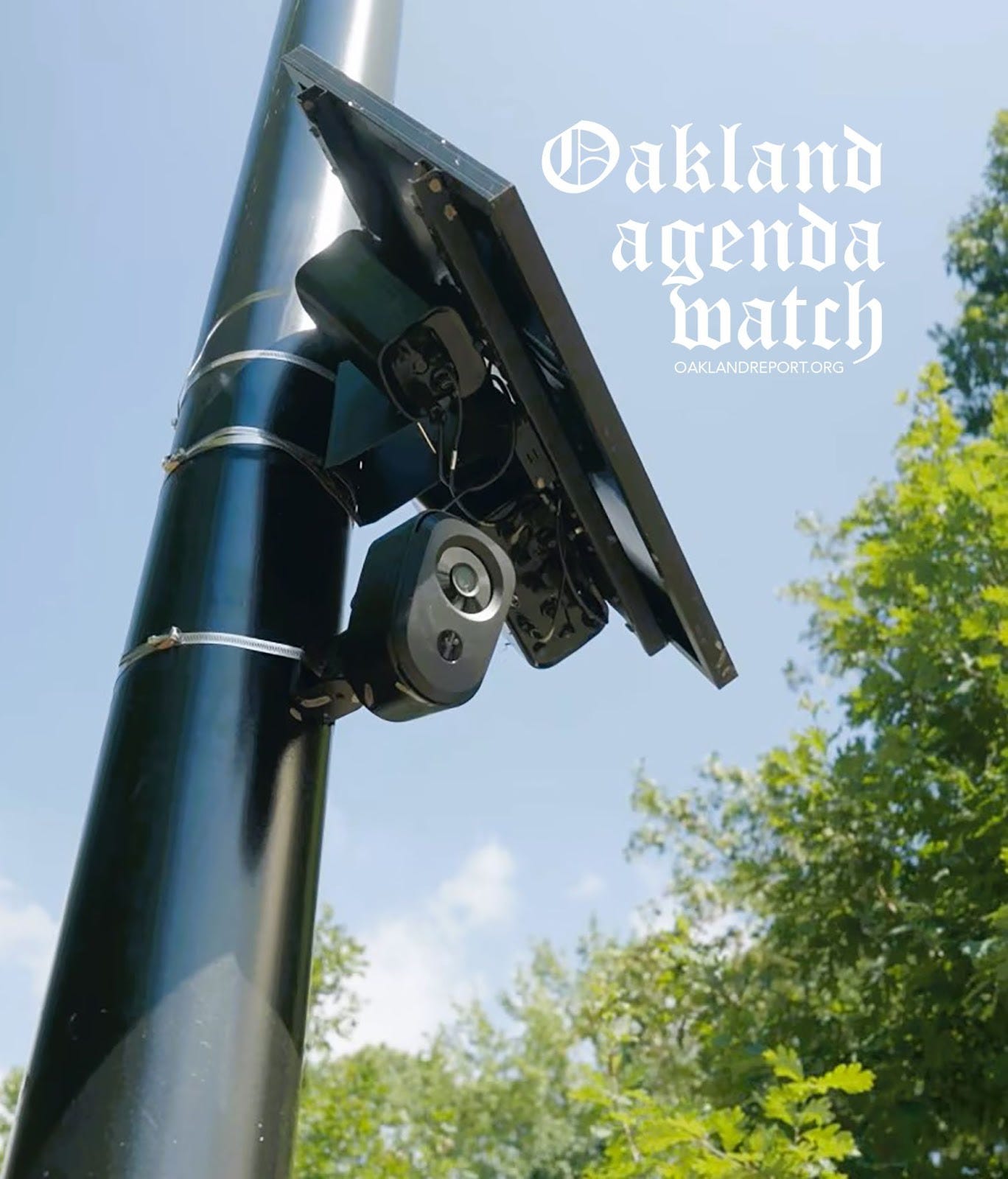
Oakland Agenda Watch provides short summaries of key items on upcoming public meeting agendas that catch our attention.
Oakland’s $2.25 million Flock Safety camera contract up for consideration
Oakland City Council meeting, December 16, 2025, agenda item #9
The city council is set to vote on a proposal to take over a $2.25 million, two-year contract for an existing city-wide network of Flock Safety automated license plate recognition (ALPR) cameras. The contract was previously funded by California Highway Patrol (CHP). The new city contract would be funded from the city’s general purpose fund.1
Flock Safety ALPR cameras are currently installed and in use in Oakland, San Leandro, Berkeley, Hayward, unincorporated Alameda County, San Francisco, and other Bay Area jurisdictions.
The council also will consider a new governing policy to regulate the system’s use to deter and investigate crimes like theft, human trafficking, sideshows, robberies, and homicides. If adopted, the policy would forbid using the system for personal reasons, harassment, or invading areas with a reasonable expectation of privacy; and would prohibit facial recognition technology, audio data capture, and infringing on First Amendment rights.2
The proposed contract includes a “Federal Assumption” clause that would allow the City to terminate the contract if federal action compromises the city’s sole ownership and use of the data collected.
According to the staff report, the continued use of the Flock Safety system would enhance public safety in communities disproportionately affected by violence and serve as a “resource multiplier” to combat crime amidst severe officer shortages.
Oakland’s police staffing levels fell from 711 sworn officers in January 2024 to 636 sworn officers by October 2025. When factoring out medical and administrative leaves, the current effective operational level is 511 sworn officers.
A council Public Safety Committee report dated October 28 stated that “carjacking robberies have been one of the main priorities of the [Police] Department, and one of the specific crimes Flock ALPR was brought in to address.”
The report said that in 2023 year-to-date there were 568 carjacking robberies, whereas in 2025 year-to-date there have been 192 carjacking robberies, a 66% decrease.3
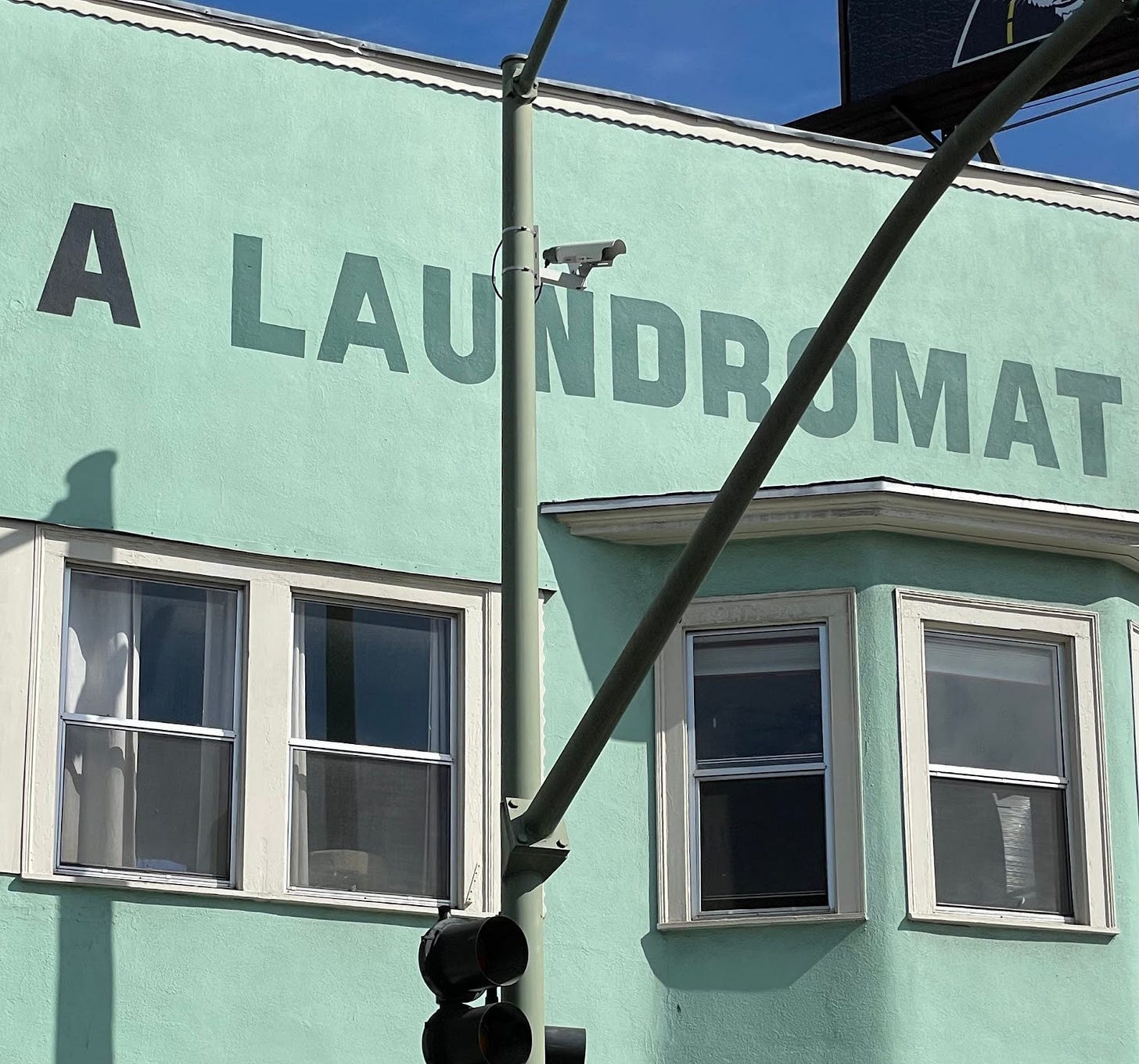
The staff report frames the Flock system as an equity tool that can help protect communities of color who are disproportionately victims of violent crime, and says that camera locations are intended to be data-driven by targeting crime hot spots and major travel routes identified through heat maps, rather than being based on demographics.
Opponents frame this strategy as inherently concentrating surveillance in the same communities it aims to protect, increasing the risk of over-policing and disparate negative impacts in those communities.4
According to the staff report, in the year 2025 to date, people of color accounted for 96% of victims of shootings and homicides, while 55% of robbery victims were Latino and 19% were Black.
Oakland Report could not locate an official map of the ALPR locations in time for this article’s publication. Governmental source documents on ALPR locations use lists of addresses as opposed to visual maps.5 However, this interactive Google Map of ALPR locations created by a community member appears to be derived from the address information gleaned from city documents.

The citizen-run Privacy Advisory Commission (PAC) previously voted to recommend that city council reject the proposed contract. Among its concerns were what PAC members described as loopholes regarding federal data access that appeared to conflict with the City’s sanctuary city commitments.6
A former PAC member wrote in Oakland Report on November 22 that the concerns seem to have been at least partly that the version of the contract shown to the PAC was a boilerplate that lacked details specific to Oakland’s sanctuary ordinances.
The council’s Public Safety Committee, made up of four city council members, deadlocked on a recommendation in November, so the item did not advance to the full council at that time.
However, the council’s Rules and Legislation Committee, per Rule 5.4.d of the city council’s Rules of Procedure has the authority to advance deadlocked items to the full council agenda for a vote, which it did for the full council’s December 16 meeting.
Mayor Barbara Lee may get a second chance to cast a tie-breaking vote on moving controversial votes to daytime work hours
Oakland City Council meeting, December 16, 2025, agenda item #8

As Oakland Report reported on December 7, the city council has so far held five separate meetings in attempts to amend the Council’s Rules of Procedure to allow non-consent agenda items to start earlier than 5:00 p.m. The council will take up the subject for the sixth time on December 16.
This change, if implemented would allow the council to take votes on controversial issues or decisions during standard daytime work hours when it is more difficult for working people to attend and participate in the meetings.
The council deadlocked when the issue came up for a final vote on November 4, which meant that mayor Barbara Lee would have cast the tie-breaking vote on December 2. But according to the December 2 meeting minutes, “The Mayor declined to break the tie.”
When city council asked if the mayor would be casting a tie-breaking vote as planned, the mayor did not appear in the council chamber. After a pause, the mayor’s deputy chief of staff Preston Kilgore appeared to offer these remarks:
“The mayor requested me to come down and share that she does not intend to vote on the pending motion… The mayor prefers to defer to the city council on their own rules of procedure and therefore will not be weighing in today, but thank you all for the opportunity.”7
— Preston Kilgore, deputy chief of staff to Mayor Barbara Lee
Other notable agenda items on December 16
Place a June 2026 ballot measure to cut taxes on small businesses and new businesses. If approved by Oakland voters, this would create a “small business incentive” by eliminating gross receipts tax for certain small businesses types that gross $1 million per year or less during 2027; and a “new business incentive” by eliminating imminent gross receipts tax up to $1 million for all businesses (of any size) establishing a new business location in a commercial space in Oakland during 2027. Agenda item #5.12
Increase the amount of taxpayer funding available to give to incumbents’ political campaigns. This item seeks to amend the Oakland Campaign Reform Act to increase the amount of “Democracy Dollars,” i.e. public campaign financing, made available to incumbent officeholders, among other changes. Agenda item #5.13
Develop a Costco at the former Oakland Army Base. This item is proposed by council member Carrol Fife, “to explore bringing a Costco to the undeveloped area of the former Army Base,” on a 22-acre parcel owned by the city. Agenda item #5.28
Oakland Report is by no means comprehensive in our coverage of public meetings in Oakland. The scope and frequency of public meetings are far more than we can presently cover. You can review the full agenda and all 45 items on deck for the December 16 city council meeting on the city’s meeting calendar.

City of Oakland. “Concurrent Meeting of the Oakland Redevelopment Successor Agency and the City Council.” Adopt A Resolution (1) Approving The Oakland Police Department Surveillance Use Policy “DGO I-32.1 - Community Safety Camera System” And The Acquisition Of Security Cameras And Related Technology; (2) Awarding A Two Year Agreement To Flock Safety For Acquisition Of Automated License Plate Reader And Pan Tilt Zoom Cameras, Operating System Technology, And Related Services At A Cost Not To Exceed Two-Million Two-Hundred Fifty-Two Thousand Five-Hundred Dollars ($2,252,500); And (3) Waiving The Competitive Multiple-Step Solicitation Process Required For The Acquisition Of Information Technology Systems And Waiving The Local And Small Local Business Enterprise Program Requirements. Dec. 16, 2025, agenda item #9. https://oakland.legistar.com/LegislationDetail.aspx?ID=7778357&GUID=BC9ADFD5-2714-4303-BEA4-70DF1AD489D1&Options=&Search=
Oakland Police Department. “Departmental General Order I-32.1.” Community Safety Camera Systems - Camera Registry and Department Remote Access to Public/Privately Owned Surveillance Camera Systems. Draft dated June 2025. https://oakland.legistar.com/View.ashx?M=F&ID=14871887&GUID=06A3F324-80A3-4799-8873-03D812C5DAA1
City of Oakland. “Public Safety Committee agenda report.” OPD Community Safety Camera System and Flock contract. Oct. 28, 2025. http://oakland.legistar.com/View.ashx?M=F&ID=15025526&GUID=2D623941-4C2B-4A29-A66D-CA1C00933A6E
Yu, Betty and James Torrez. “Oakland committee votes down expansion of Flock cameras amid heated debate.” KTVU Fox 2, Nov. 19, 2025. https://www.ktvu.com/news/oakland-committee-weighs-expansion-flock-cameras-amid-heated-debate
California Highway Patrol. “Statement of work: Flock Safety automated license plate reader camera system.” Mar. 29, 2024. https://cao-94612.s3.us-west-2.amazonaws.com/documents/OPD_ALPR6_Signed-Contract-CHP-Flock-Cameras_PAC-7-9-24.pdf
City of Oakland Privacy Advisory Commission. “Regular meeting agenda, August 7, 2025.” https://www.oaklandca.gov/files/assets/city/v/2/privacy-advisory-commission/documents/8-7-2025-agenda-packet-for-privacy-advisory-commission-meeting.pdf
City of Oakland, Concurrent Meeting of the Oakland Redevelopment Successor Agency and the City Council. “Meeting Video, November 4, 2025,” 2:37:21 - 2:38:00. Oakland, California, agenda item 9. https://oakland.granicus.com/player/clip/7152?meta_id=625299