


BY STEVEN FALK, BEN GOULD, AND NANCY FALK
Editor’s note: Oakland Report’s charter reform series is exploring Oakland’s city charter and how it potentially could change — a question that Oakland voters may be asked on the ballot in 2026. To kick off the series, we invited the Oakland Charter Reform Project to offer its perspective on Oakland’s governance model. Future installments will invite counterpoint perspectives from other prominent participants in the charter reform debate.
A Model City Charter for Oakland
First published more than a century ago by the National Civic League (NCL), the Model City Charter was created as an antidote to the cronyism, patronage, and corruption that plagued many strong-mayor U.S. cities in the late nineteenth and early twentieth centuries. Written by urban governance experts, city practitioners, and scholars – and now in its Ninth Edition (2021) – the Model City Charter is a best-practices guide for modern American cities. Oakland successfully operated under a Model Charter system for 65 years before Measure X replaced it in 1998, and the City should return to it now as it rewrites its current dysfunctional municipal charter.
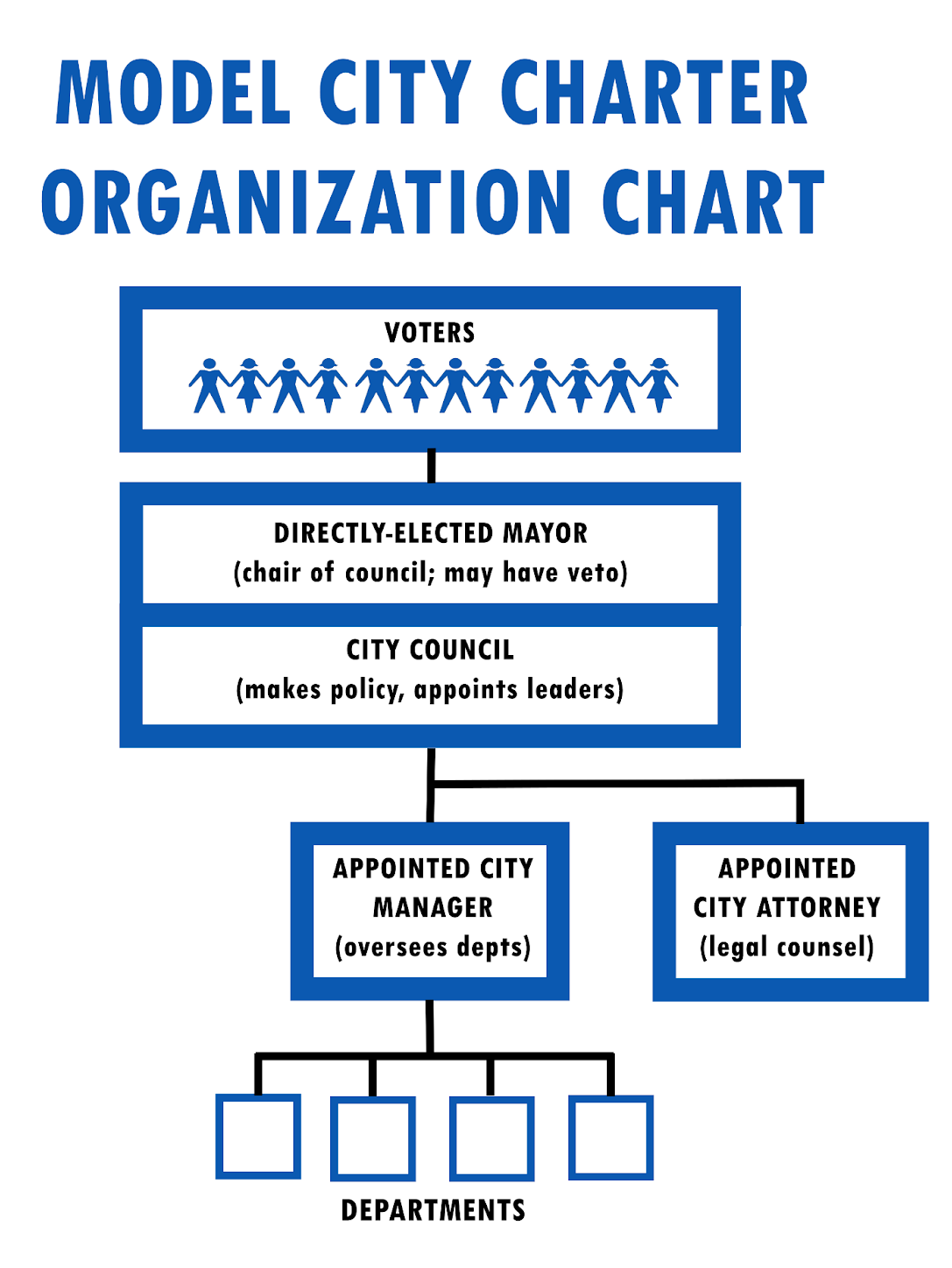
At its core, the Model City Charter promotes a unified council-manager form of government. In this structure, governing authority rests with a single elected body—the city council—which hires a professional executive, known as a city manager or city administrator, to oversee day-to-day operations. The city manager serves at the council’s pleasure under the terms of an employment contract.
In this system, the mayor sits as a full, voting member of the city council, not separate from it.
Under the Model City Charter:
The city council is fully responsible for setting policy and—through the city manager—overseeing administration and delivering results; and
The citywide-elected mayor serves as council president, overseeing meetings, setting the agenda, controlling committee appointments, casting votes and potentially exercising a veto.
While not the sole decision-maker, a popular and charismatic mayor in a Model Charter city can still be a powerful and decisive force in moving the city forward.
Oakland’s current governmental structure
The Model City Charter stands in contrast to Oakland’s current system, which resembles a strong-mayor structure featuring a federal-style separation of powers between the executive, judicial, and legislative branches—but without a fully empowered mayor.
Under Oakland’s current governmental structure, the mayor does not sit on the city council dais and votes on policy matters only in the event of a tie. As a result, the mayor typically does not attend council meetings, limiting their influence on legislation and budget decisions. The Oakland mayor’s primary authority thus rests in their appointment (and removal) of the city administrator, who serves as the city’s chief executive officer and oversees all city employees and operations. However, the mayor cannot hire, fire, or direct any other city employees—including department heads—resulting in limited mayoral control over the day-to-day management of the City.
City council members are similarly disempowered under Oakland’s current charter. They have no authority to oversee, set goals for, evaluate, discipline, or remove the city administrator (who supervises all municipal services) or any other line employee. This disconnect from the delivery of city services—and the inability to influence it—leaves both council members and their constituents deeply frustrated.
It’s no wonder that, as one Oakland council member told us, in today’s Oakland “the buck stops nowhere.”

The Model City Charter Has Anti-Corruption Features
The Model City Charter has one big advantage over Oakland’s current structure and every other “strong mayor” system: it features powerful built-in systems to reduce corruption and backroom dealing. Specifically, the Model City Charter:
Requires all major policy and contract decisions be made in public city council meetings, with approval by the full legislative body; and
Empowers the city council to hire, oversee, set goals for, and evaluate a professional city manager who is then accountable to the full city council, not just the mayor, for their performance and management.
Under the council-manager structure, the mayor cannot unilaterally appoint people to city jobs, or order staff to approve contracts without due diligence and checks on potential conflicts-of-interest. Given the recent federal indictment of former Oakland mayor Sheng Thao on corruption charges (still being litigated in court), this is an important feature to ensure fairness and accountability in local government.
The Model City Charter also recommends that the city attorney be an appointed position, accountable to and reporting to the full city council. Shifting the city attorney from an elected role to an appointed one reduces the risk of potential conflicts of interest arising from political donations and other influences that affect elected officials.
Video Clip 1: ABC 7 News Bay Area report. “Here’s the reason why Oakland is on the ‘wrong track,’ according to voters.” Sept. 2, 2025. (Source: YouTube / ABC 7 News Bay Area)
Does the Model City Charter Work?
Since the Model City Charter introduced the council-manager system in 1915, the framework has proven incredibly effective. Its adoption by thousands of municipalities has coincided with a sharp decline in urban corruption; by one estimate, corruption levels today are five times lower than they were in the 1870s.
Several recent scholarly studies confirm benefits of the Model City Charter.123456
Consider:
”Council-manager cities are 57 percent less likely to have corruption convictions than municipalities with Strong Mayors.”
”Council–manager cities have stronger budgetary solvency compared with mayor–council cities.”
”Municipalities with a city manager have higher bond ratings and lower borrowing costs.”
”Council–manager forms of government are statistically associated with higher levels of government transparency.”
”Council-manager governments favor more comprehensive policy solutions, experience less conflict among senior officials, and are more willing to adopt innovative policies and practices than mayor-council governments.”
”Cities with city manager forms of government are nearly 10% more efficient than cities with strong mayor forms of government.”
Given the Model City Charter’s longevity and successful track record, it is not surprising that 97% of California cities now operate under a variation of the council–manager model.
Likewise, in the Bay Area, 99 of the region’s 101 cities use this form of government. Indeed, San Francisco and Oakland are the only Bay Area municipalities that do not use this modern form of government – and perhaps not coincidentally – those two cities are often featured in the news for poor governance.

Is the Model City Charter Right for Oakland?
We think so. Implementing the Model City Charter in Oakland would address four fundamental flaws plaguing the City’s current charter:
A disconnected mayor;
A frustrated and powerless city council;
A rotating door at the top of city operations; and
A conflicted city attorney.
We hope the Mayor’s Charter Reform Working Group will see the benefits of the Model City Charter system and recommend adopting it. Many of America’s largest well-run cities—including Phoenix, San José, Sacramento, and Long Beach—function successfully with council-manager governments, proving the model’s scalability. Eighteen of America’s top twenty best-run cities use the council-manager structure. And Oakland successfully operated under a council-manager system for 65 years until Measure X replaced it in 1998.
A test for evaluating the much-anticipated recommendation of Mayor Lee’s Charter Reform Working Group is simple:
Would the Working Group have made the same recommendation a year ago, in the wake of Sheng Thao’s federal indictment and voter recall?
That’s because any change to Oakland’s charter must stand the test of time. It must work for decades. It must work for every mayor Oaklanders elect—the good ones and the bad ones, the virtuous ones and the corrupt ones.
Not just the current officeholder.
That’s why the Oakland Charter Reform Project (OCRP) has spent most of 2025 advancing and promoting the Model City Charter. This form of local government has delivered transparent, responsive, efficient, effective, equitable, and less-corrupt governance in cities across California and the nation. Oakland voters deserve the opportunity to vote on whether to adopt it.
It’s time to return The Town to a government system that works for Oaklanders.
About the Oakland Charter Reform Project
When we first gathered together as the Oakland Charter Reform Project (OCRP) in January 2025 after Oakland voters recalled former Mayor Sheng Thao, Oakland had no elected mayor.7 It wasn’t yet clear who the mayoral candidates would be to serve the remainder of Thao’s term, and Oakland’s current mayor, Barbara Lee had not yet entered the race.
It was a blank slate for the City—a rare opportunity to rethink how Oakland’s system of government could be reshaped to be more efficient, effective, and responsive to community needs.
We convened dozens of focus groups and meetings with community leaders and elected officials, and researched best practices in high performing cities. After speaking with hundreds of Oaklanders over the course of several months, we came to believe that the Model City Charter is the right solution for Oakland.

Shortly after winning the special election, Mayor Lee established a 10-person Charter Reform Working Group, facilitated by SPUR and the League of Women Voters. The group, appointed in August, is charged with gathering input from a broad range of community, business, labor, and government reform experts over the course of a few months and making recommendations for the mayor and council president to consider in January 2026.
We attended most of the Working Group’s public listening sessions while continuing to host community gatherings of our own… and we still have confidence in our original conclusion: the Model City Charter, with a council-manager form of government, is Oakland’s best chance for improved governance.
You can sign up for the OCRP mailing list here. You can sign up for the OCRP Substack feed here.
The views expressed in our Commentaries do not necessarily reflect the editorial views of Oakland Report or its contributing writers
“Ethics by Design: The Impact of Form of Government on Municipal Corruption.” Kimberly L. Nelson, Whitney B. Afonso. Public Administration Review. 09 April 2019.
“Municipal Government Form and Budget Outcomes: Political Responsiveness, Bureaucratic Insulation, and the Budgetary Solvency of Cities.” Benedict S Jimenez. Journal of Public Administration Research and Theory, Volume 30, Issue 1, January 2020.
“Local government type and municipal bond ratings: what’s the relationship?” John Dove. 2017/5/21. Journal of Applied Economics.
“Determinants of Internet-enabled Transparency at the Local Level: A Study of Midwestern County Web Sites.” Grichawat Lowatcharin and Charles E. Menifield. State & Local Government Review. Vol. 47, No. 2 (June 2015).
“What Have We Learned about the Performance of Council-Manager Government? A Review and Synthesis of the Research.” July 2015. Public Administration Review. Jered Carr. University of Illinois Chicago.
“Smarter, Faster, Cheaper.” David Edwards. Published by IBM Global Business Services.
Then-city council president Nikki Fortunato Bas served as interim mayor immediately after Thao’s voter recall. Next, council member Kevin Jenkins was appointed by the city council to serve as interim mayor until a special election could be held.
Nancy, Steven, Ben, outstanding article. Thank you for helping us to understand the differences and benefits of a council-manager system in such a clear and direct way.
It raised some questions for me: under the council-manager system:
First, would the mayor/council-president have any distinct executive authority other than setting the agenda and appointing committees? Would the mayor, for example, be able to appoint an ad hoc working group like the Charter Reform Working Group without a council vote? Would the mayor still have unique powers to appoint or remove members of certain commissions?
Second, what is considered a contract sufficiently 'major' that it would go to the council for approval vs. the city administrators sole authorization?
Third, would this bring transparency to the negotiation of contracts and labor agreements that are currently negotiated behind closed doors?
Fourth, would this continue to enforce the separation of powers (legislative and executive) such that council members are not permitted to direct the actions of employees other than the administrator (and perhaps other key officers appointed by the council, such as the city attorney)?
Here are my arguments against this form of government. Can we have a live debate? I would LOVE that.
First off....Democratic accountability matters
A city manager is not elected. When government fails, voters have no clear person to hold accountable — even though they still expect the mayor to fix citywide problems.
Oakland is too large and complex for a city-manager model
Council-manager systems may function in smaller or quieter cities. Oakland is neither. It faces regional, state, and federal pressures that require an empowered, visible executive with a public mandate.
People already look to the mayor for leadership
Residents intuitively expect the mayor to lead. A city-manager model creates confusion by separating authority from responsibility and leaving voters frustrated.
Oakland needs citywide leadership (especially now), not just administration
The city requires a political leader who can advocate for Oakland beyond City Hall — something an unelected manager is neither designed nor empowered to do.
Fragmented authority produces paralysis
When power is diffused, decision-making collapses into finger-pointing. No one owns outcomes. A city-manager model reinforces this dysfunction instead of correcting it.
Power should match voter expectations
If the mayor is blamed or credited for results, the mayor must have the authority to act. Anything else is governance by misdirection.
Bottom line: Oakland does not need a return to managerial governance. It needs clear authority, visible leadership, and a system where responsibility and power finally align.