


Oakland Report examines the data behind the headlines. In this installment, we look at a rarely-mentioned provision of Measure EE, the “strong mayor” charter amendment on the November 3 ballot.
Council members could get substantial raises with Measure EE
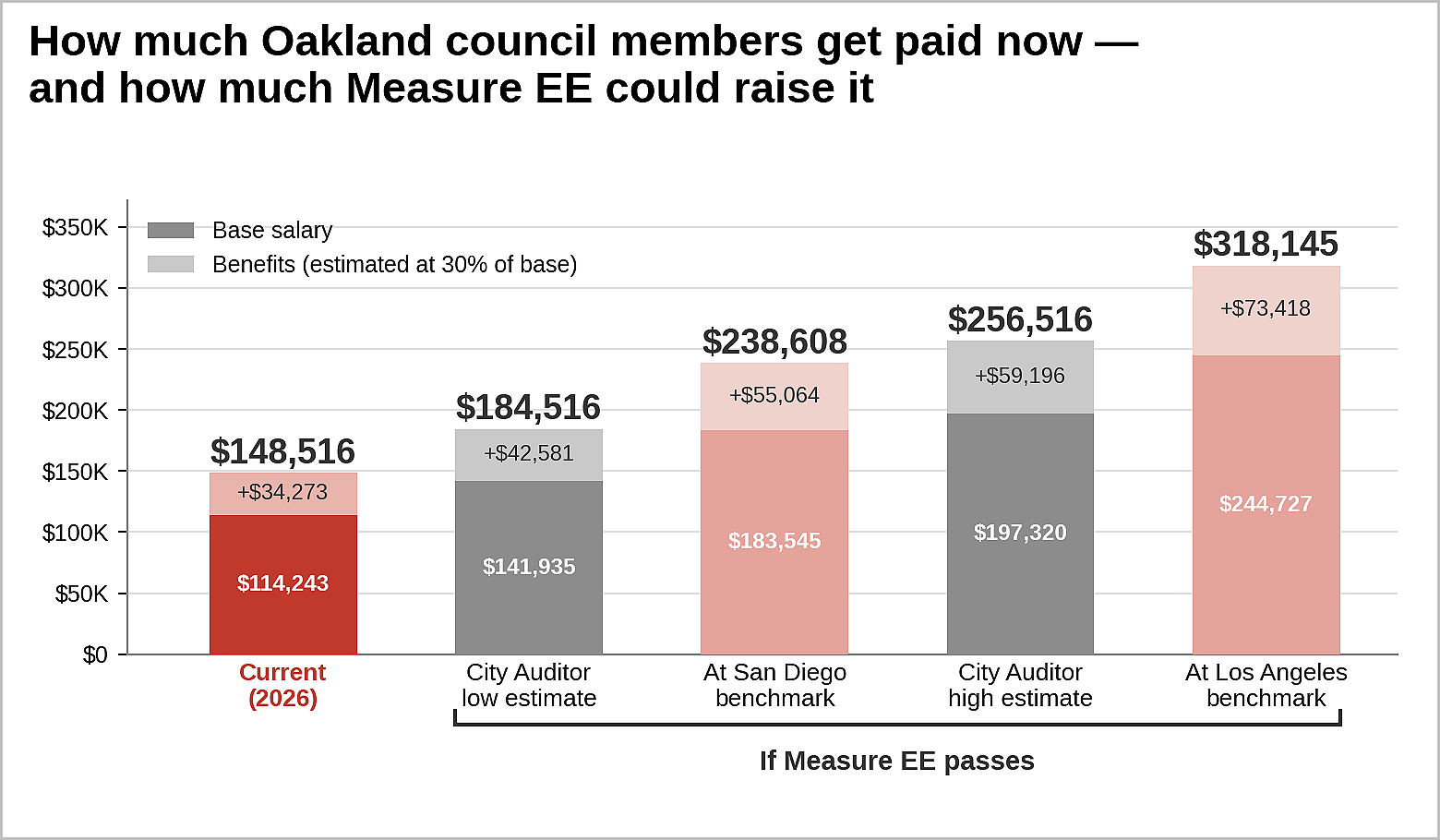
Oakland city council members currently receive about $148,500 in annual pay and benefits, each.1
Measure EE could raise each council member’s pay and benefits by up to $108,000 per year, if voters approve it on November 3. If council compensation is adjusted to the high end of the city auditor’s estimate, their total pay and benefits would increase to about $256,500 per year.2
Oakland already pays its council more per resident than any big city we examined.3
By comparison, Oakland’s median household income is $97,369 — which does not include benefits, and is household income, not individual income.4
None of the above is mentioned in the Yes on EE campaign’s materials.5
Key findings
Measure EE could increase city council compensation by an estimated $36,000 to $108,000 more per member — with no upper limit. The city auditor’s estimate covers salary and benefits.
Oakland already pays its council members the most per resident among other large cities — about 26 cents per resident, higher than San Francisco (21¢), Sacramento (19¢), San Diego (13¢), and Los Angeles (6¢).
Measure EE sets no specific dollar amount and no upper limit on council member pay. It would direct the city’s Public Ethics Commission (PEC) to reset council pay every two years to match ‘comparable’ full-time California councils — but attaches no dollar amount, and no limit.
The Yes on EE campaign doesn’t mention that its “strong mayor” measure would also give city council substantial raises. The mayor’s working group praised “market-appropriate” council pay, but offered no specific dollar amounts.6 The Yes on EE website, FAQ, and ballot argument don’t mention the potential pay increase at all, instead focusing on council working “full-time.”
Don’t miss a beat. Subscribe to Oakland Report (it’s free).
Oakland already pays its council members more per resident than other large California cities
Oakland Report divided each city’s latest published council salary by its Census population. Each Oakland council member’s current $114,243 annual salary (not including benefits) works out to about 25.8 cents per resident — more than San Francisco (21.2¢), Sacramento (19.2¢), or any other large California city we compared.
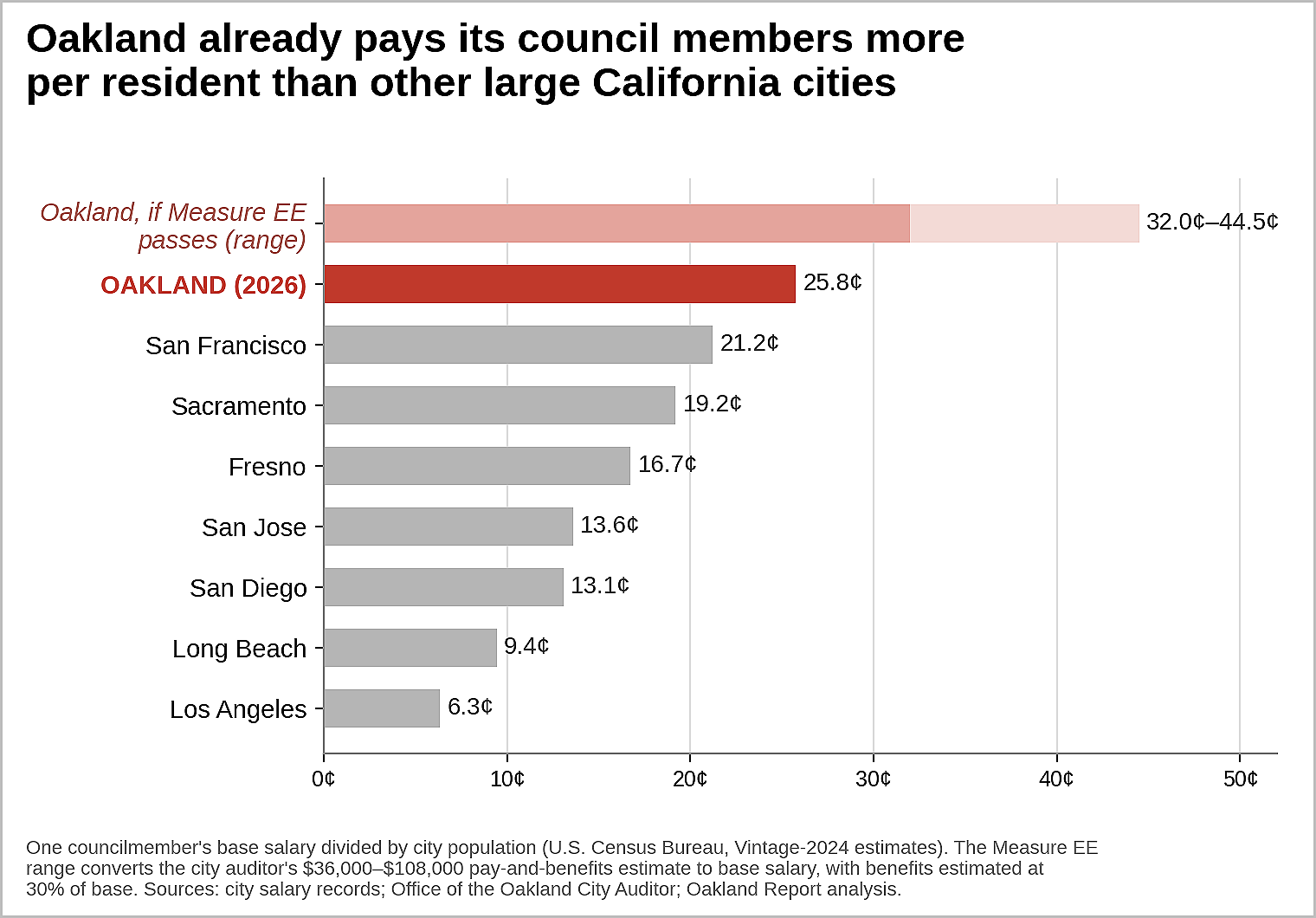
Measure EE could take that figure much higher. Converted to base salary, the city auditor’s estimated $36,000 to $108,000 in council pay raises works out to a new total between 32.0 and 44.5 cents of council pay per resident — roughly a quarter to three-quarters more than today, and well above every other city we examined, even at the low end.
There are several factors in this calculation for readers to consider. An Oakland councilmember represents about 55,000 residents, whereas a Los Angeles council member represents about 259,000 residents. However, cities with populations similar to Oakland’s — such as Long Beach (9¢), Fresno (17¢), and Sacramento (19¢) — all pay their councils less per resident.
If Measure EE passes and Oakland council pay is set to the San Diego benchmark — a city the mayor’s working group specifically cited in its final report while discussing council getting “full-time” pay — Oakland’s council pay per resident would be roughly triple San Diego’s rate.
Whether the PEC would go that high is unlikely. Nothing in the measure requires it to choose the top of the market — but nothing prevents it.
The working group showcased the best-paid councils — but named no number
Mayor Barbara Lee’s hand-picked “working group” — many of whose members had political or personal ties to the mayor, as Oakland Report previously reported — designed the measure.7 The group was co-facilitated by the League of Women Voters of Oakland and SPUR.
Its report called for “market-appropriate compensation” for full-time council work, and it specifically cited Los Angeles — the country’s best-paid council — and San Diego as examples. It named no specific dollar figure or limit for Oakland’s council.
Related article:

Why the mayor’s “working group” cited Los Angeles and San Diego — the state’s two best-paid councils — instead of, say, San Jose, Long Beach, or even San Francisco, isn’t clear. The report doesn’t say.
However, it is reasonable to consider the possibility that the working group cited those high-paying cities as a means to gain support from the Oakland council members whose votes were needed in order to place the measure on the ballot.
How the raises would be calculated if Measure EE passes
Under the current charter, the city’s public ethics commission (PEC) adjusts council pay for inflation every two years. Each raise is capped at 5%. Under that formula, council pay grew 81% over 22 years, to the current $114,243.
Measure EE would replace this with a new rule: starting in 2027, the PEC would reset council pay every two years to be “comparable to the salaries of full-time city councilmembers and full-time county supervisors in comparable California cities and counties selected by the Commission.”
How might the PEC choose those comparables? When setting the city attorney’s pay this April, the commission surveyed the four California cities above and the four below Oakland in population: San Francisco, Fresno, Sacramento, and Long Beach above; Bakersfield, Anaheim, Stockton, and Riverside below.8
Apply that same lens to council pay, and the highest-paid full-time legislative body among those peers is San Francisco’s Board of Supervisors, at $175,370. Matching it would raise Oakland council pay about 54% — roughly $228,000 per year with benefits. Every other peer with a published council salary pays less than Oakland does today: Sacramento ($102,793), Fresno ($92,000), and Long Beach ($42,480).
There is also precedent for a bigger jump. In 2022, voters shifted the city attorney’s salary from a council decision to PEC benchmarking (Measure X). The commission’s first benchmarked adjustment, in 2023, raised that salary 26 percent. This year, the PEC raised the city attorney’s pay 5.4%, to $338,291 — and raised the council’s 5.0%, the most its inflation cap allows.
We rely on voluntary donations from readers like you. Donate to support our nonprofit work.
More pay, arguably less responsibility
The council member pay raises are a rarely cited section within Measure EE’s proposed “strong mayor” governance restructuring. The measure would concentrate more power in the mayor’s office, and would reduce the council’s authority in several key areas. Opponents cite these provisions and others in the measure when they describe Measure EE as a “power grab.”9
If Measure EE is approved by voters, the mayor would take over the role of hiring, directing, and firing most department heads — currently the role of the city’s top professional executive, the city administrator. (The city administrator currently reports directly to and serves at the pleasure of the mayor.)
The mayor would also gain a veto over most legislation the council adopts — including a line-item veto over the city budget. Overriding the mayor’s veto would require six of eight council votes.10 A mayor with three allies could block most council actions.
On many key decisions — who runs departments, which budget lines survive — the council would shift from deciding to reacting. In exchange, it gains subpoena power and the ability to confirm some, but not all the department heads the mayor selects.
Read this related article:

City council didn’t actually approve Measure EE. Mayor Barbara Lee broke a deadlock to place it on the ballot
The council itself never approved the measure. On June 16, it deadlocked 4–4, and some yes votes came with reservations: for example, council member Charlene Wang voted yes only after her amendments adding checks on the mayor failed. Mayor Lee made a rare appearance at that council meeting and broke the tie herself.11 (Measure EE itself would eliminate that mayoral tie-breaking power, instead giving the mayoraa veto power).
Notably, the Yes on EE campaign says nothing about council pay raises. Its website and FAQ cover accountability and full-time service, and call EE “a government reform, not tax measure” — but never mention council salaries.
The ballot argument in favor of Measure EE, signed by mayor Lee and four co-authors, doesn’t mention council pay, either. The rebuttal argument defending Measure EE says it “Makes Council Service a Full-Time Job.”
The council’s resolution that placed Measure EE on the ballot says the reform “is not intended to automatically increase salaries.” The ballot question tells voters the PEC would set salaries “using similar formulas” — so it does provide a process, but not a number, nor an upper limit.
Other considerations and counterpoints
Measure EE’s supporters offer a number of points in favor of the measure, which we present here for readers to consider:
Full-time pay is framed as equity, on the premise that Oaklanders who have relatively less personal wealth or outside income can compete for council seats.
Nothing is automatic — the PEC, not the council, sets pay in public session.
The ballot question and city attorney’s analysis both disclose the “full-time” provision and that the PEC would set council salaries according to a new formula.
Conclusion
What the record shows: Measure EE would lift the cap on council pay during a declared fiscal emergency. It would enable potentially significant pay raises to a council already paid more per resident than any big-city peer. The measure was developed by a working group that highlighted the best-paid councils but named no number or upper limit for Oakland’s council before the council was set to vote on whether to place the measure on the ballot. After the measure passed council with the mayor’s tie-breaking vote, the Yes on EE campaign now says nothing about council pay. The facts are in the record. The description of them, mostly, is not.
Share this article

Oakland Report is an experiment in a new form of media. We are an independent, community-led 501(c)(3) nonprofit organization, not affiliated with any public agency, labor union, corporate interest or political campaign. If you value our services, please donate. We rely on your voluntary donations to continue our nonprofit work.
City of Oakland. “City Council Salaries,” including the salary history table, 2004–2026. Oakland Public Ethics Commission webpage, accessed Oct. 22, 2026. https://www.oaklandca.gov/Government/Boards-Commissions/Public-Ethics-Commission/Open-Government/City-Council-Salaries
Houston, Michael. “City Auditor’s Impartial Financial Analysis of the Mayor’s Charter Reform Ballot Measure.” Office of the Oakland City Auditor, Jul. 2026. https://www.oaklandauditor.com/wp-content/uploads/2026/07/City-Auditors-Financial-Analysis_Mayors-Charter-Reform-Ballot-Measure.pdf
Oakland Report analysis. Figure 1 shows annual pay and benefits per councilmember: benefits are estimated at 30% of base salary, and the auditor’s 36,000–108,000 increase, which covers salary and benefits together, is apportioned at the same ratio. The San Diego and Los Angeles bars show those cities’ council salaries, cited as benchmarks by the mayor’s working group, plus estimated benefits. Figure 2 plots one council member’s annual salary divided by the city’s population, using Census vintage-2024 estimates; its “if Measure EE passes” bar converts the auditor’s estimate to base salary at the same 30% ratio (141,935–197,320, or 32.0–44.5 cents per resident).
U.S. Census Bureau. Median household income (in 2023 dollars), 2019–2023 American Community Survey, QuickFacts for Oakland city, California; and Vintage 2024 city population estimates (July 1, 2024). Accessed Oct. 22, 2026. https://www.census.gov/quickfacts/
Committee for A Strong, Accountable Oakland: Yes on EE. "Home" and "FAQ," including the statement that EE is "a government reform, not tax measure." Campaign website, accessed Oct. 23, 2026. https://www.reformoaklandyesonee.com/
Blackwell, Fred et al. "Mayor's charter reform working group recommendations." Jan. 2026. Cited in: SPUR. "Path to Better Governance: Oakland Mayor's Working Group Releases Recommendations for Charter Reform." SPUR, Jan. 30, 2026. https://www.spur.org/news/2026-01-30/path-better-governance-oakland-mayors-working-group-releases-recommendations
Montana, Alex. "Hand-picked: the political and personal ties between mayor Barbara Lee and her 'charter reform working group'." Oakland Report, Jun. 16, 2026. https://www.oaklandreport.org/p/barbara-lee-charter-reform-working-group-ties
Doran, Suzanne. "Biennial City Attorney Salary Adjustment as Required by City Charter Section 401(1)." Oakland Public Ethics Commission staff memo, Apr. 3, 2026, for the Apr. 15, 2026 special meeting. https://www.oaklandca.gov/files/assets/city/v/1/boards-amp-commissions/documents/pec/staff-reports/2026-04-15-item-05-city-attorney-salary-adjustment.pdf
Oakland Residents for Good Government et al. "Vote NO on Measure EE." Campaign website, accessed Oct. 22, 2026. https://www.oaklandpowergrab.com/
KQED. “Oakland, Measure EE.” KQED Voter Guide, accessed Oct. 22, 2026. https://www.kqed.org/voterguide/alameda/measure-ee
Orenstein, Natalie. "Barbara Lee breaks tie, pushing 'strong-mayor' measure onto the ballot." The Oaklandside, Jun. 16, 2026. https://oaklandside.org/2026/06/16/barbara-lee-strong-mayor-oakland-november-charter/
I guess I am more concerned about the salaries and benefits of the large number of city employees than the handful of council members. The increase in city costs due to the council pay raises appears to be less than one tenth of one percent of the annual city budget.
Just maybe the pay increase will help keep them honest.
Thank you Alex and Oakland Report. I say VOTE NO on Measure EE. Mindy Pechenuk for Oakland Mayor 2026.