


Oakland Agenda Watch provides summaries of upcoming public meeting agenda items that catch our attention. In this installment, we take a closer look at councilmember Charlene Wang’s proposal to close streets to disrupt International Boulevard sex trafficking, on the agenda for today’s meeting of Oakland city council.
Oakland’s proposed street closures off International Boulevard
Oakland city council meeting, Jul. 7, 2026, agenda item #4.6
Oakland city council will hold a public hearing on council member Charlene Wang’s proposal to close portions of 9th, 10th, and 11th Avenues to through traffic for six months, between International Boulevard and East 15th Street, “to disrupt persistent activity associated with sex trafficking.”12
Traffic barriers would block the three avenues where they meet International Boulevard, in the stretch of East Oakland known as ‘The Blade.’3 Wang’s proposal says the side streets give sex buyers “concealed access points.”
Key findings
Oakland Report analyzed Wang’s proposal and nine years of Oakland Police Department (OPD) data on reported prostitution-related crimes.4
Council member Wang’s proposal has no cost estimates. Its fiscal section lists cost types but no estimates. If council approves the proposal, an undisclosed amount of funding would come from the District 2 (council member Wang’s) discretionary fund.
The proposal has no baseline data and no definition of success. It promises that OPD and Oakland Department of Transportation (OakDOT) will “jointly evaluate” the project, but does not say how it will be evaluated or what will be measured.
Oakland’s 2023 barricades on East 15th Street worked on the blocks they closed. Recorded prostitution-related incidents on those blocks fell from dozens per year to one or two.
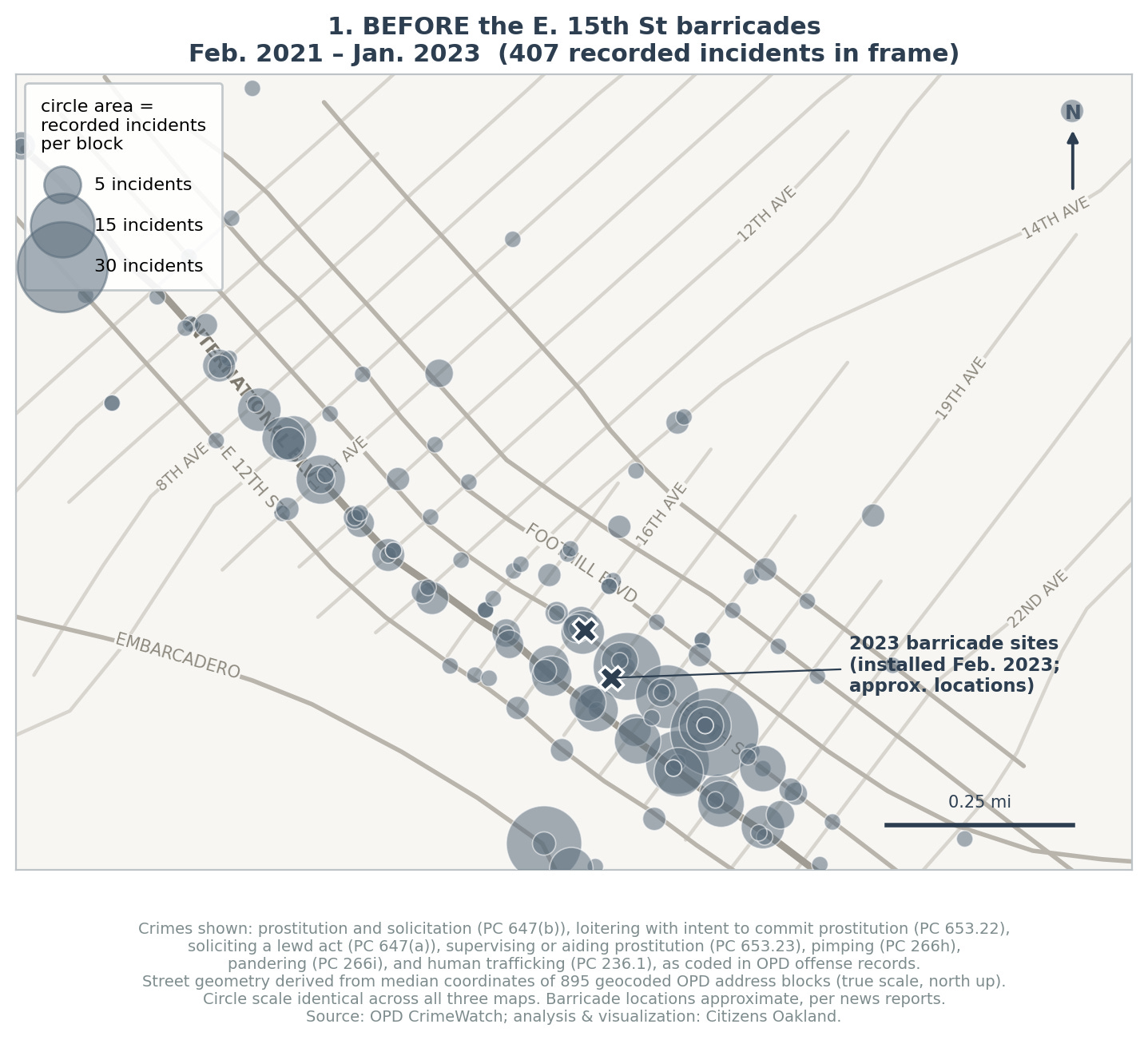
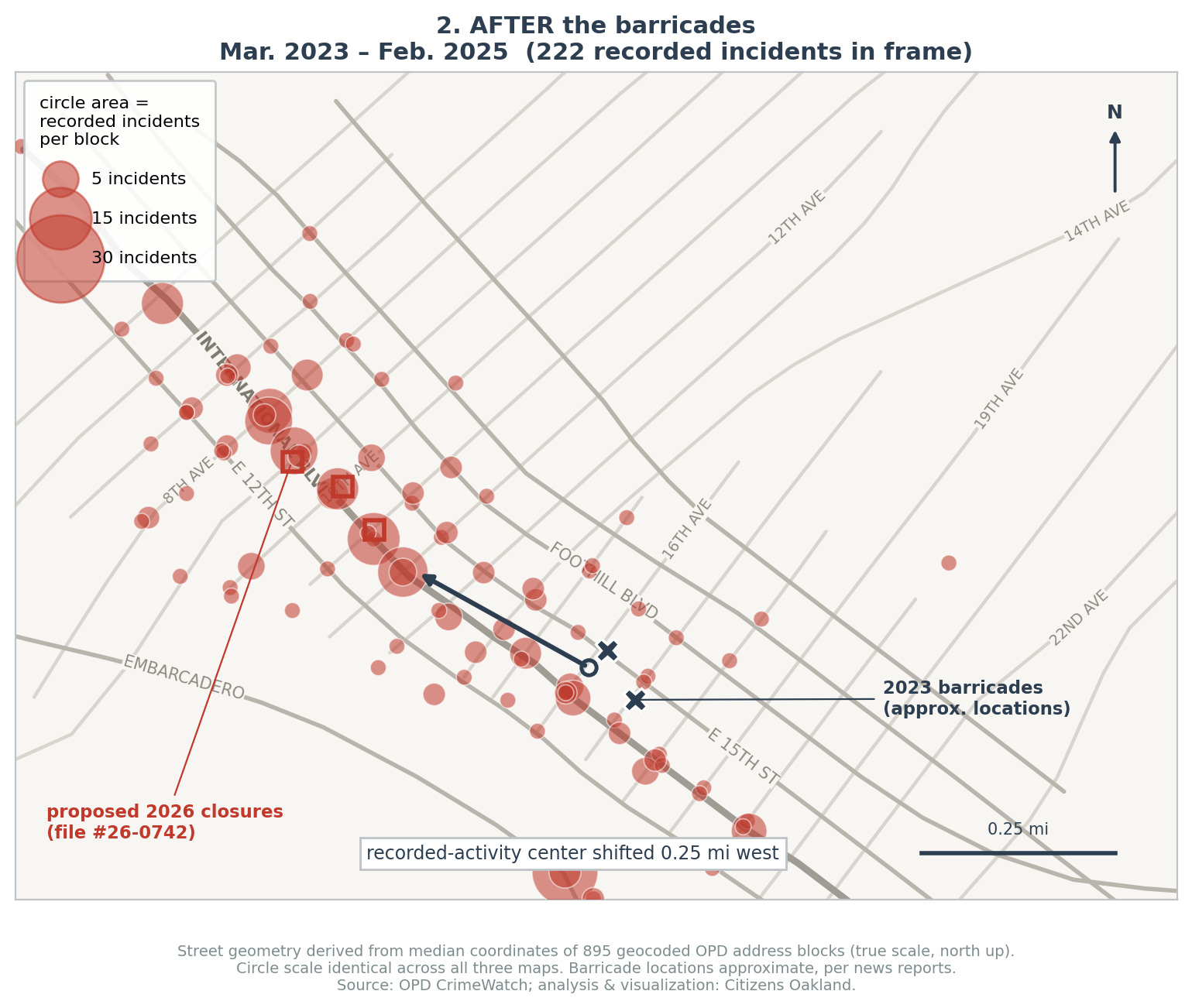
But the recorded sex trafficking activity moved into the exact blocks now proposed for closure. The center of recorded activity shifted a quarter mile west to the area now proposed for another closure, and incidents in that area rose 29 percent.
Outside the barricade area, the data shows no real change. In the two years after the East 15th Street barriers went in during 2023, the rest of Oakland — everywhere beyond a half mile of the site — recorded an average of 6.4 prostitution-related incidents per month, compared with 5.5 per month in the two years before.
The intent of the proposed street closures is obviously and rightly to reduce sex trafficking and the harms it causes. There is no dispute that human trafficking is extremely harmful to individuals and society, and efforts to reduce it should continue.
However, the lack of cost estimates or measures of success, combined with the lessons learned from past street closures that appeared to mostly just move the activity elsewhere, suggest that this proposal is not informed by empirical data or evidence, and even its sponsor appears not to have full confidence that it will work.
How the street closure would work, legally
The California Vehicle Code allows a city to temporarily close streets where “serious and continual criminal activity” exists, after a public hearing.5
Wang’s proposal is for a “pilot” street closure of six months. The council can extend it up to eight times, for up to 18 months each time. In theory, the “temporary” closure could last for years.
The avenues are not major streets, and the fire department found the barriers should not slow emergency response. Eastbound detours add no distance because 8th Avenue stays open; westbound detours average three blocks.
Disrupting sex trafficking — or concentrating it elsewhere on International Boulevard?
Council member Wang’s report lists three goals: disrupting sex buyer access, improving police sight lines, and “specifically decreasing the incidents of shootings and robberies.”
Yet in media interviews, Wang has described a somewhat different goal: “In some ways, it’s to force it [prostitution-related activity] onto International Boulevard. That way it makes it easier for the police to do their job.”67
“It’s an experiment. Honestly, I think it’s a 50/50 chance that it’ll be successful.”
— Council member Charlene Wang, in an interview with KTVU on April 29
Forcing activity into a defined area is a form of disruption. But the two goals imply different tests of success. If the plan works as Wang describes, activity on International Boulevard could be reduced, or as past efforts have shown, displaced to other areas.
Which outcome will the follow-up report count as success? Wang’s proposal does not say.
To her credit, Wang has not oversold her proposal: “It’s an experiment. Honestly, I think it’s a 50/50 chance that it’ll be successful.”
This gives rise to a question: does a “50/50 chance” of success meet the city’s criteria for investing time and resources into a proposal? Wang’s proposal appears to have no metrics for evaluating the question.
What happened the last time Oakland — and San Francisco — tried street closures to disrupt sex trafficking in the streets
This is not Oakland’s first attempt at street closures to disrupt prostitution in the streets along “The Blade.”
In February 2023, the city installed traffic barriers on East 15th Street near San Antonio Park.8
It appeared to work for a time: in May of that year, a neighborhood organizer told a local television outlet the number of women working East 15th had gone “from 30… to zero.” However, residents a few blocks away said the activity had moved to their streets.9
In 2024, another television outlet reported some neighbors’ view that the barriers worked in the closed streets, but pushed the activity back onto International Boulevard.10
Wang herself said “the problem simply shifted elsewhere.”11
Read this related article:

In the two years after the East 15th Street barricades were installed in 2023, the rest of Oakland — everywhere beyond a half mile of the site — recorded an average of 6.4 prostitution-related incidents per month, compared with 5.5 per month in the two years before.
That small rise is within the range of chance, but it does not confirm any meaningful reduction in sex trafficking overall.
Recorded incidents were reduced only where the barricades were installed. Everywhere else, they held steady or ticked up, including at spots miles away like the Hegenberger Road motel corridor. That pattern is consistent with activity relocating rather than being reduced.
Notably, because these incidents enter police data mainly through enforcement — that is, reported crimes — the numbers measure where police found and enforced activity, not necessarily the full extent of it.
Donate to Oakland Report. We are a 501(c)(3) nonprofit organization. Your contribution in any amount helps us to continue to produce accurate, well-researched articles like this one.
San Francisco saw the same pattern on Capp Street: relief on the closed blocks, then displacement to Shotwell Street — then barricades were installed there, too.
Last month, that city extended both closures 18 more months in response to a neighbor’s testimony about “the displacement that your infrastructure has created.”12
One set of San Francisco’s Capp Street bollards cost more than $250,000.13
Oakland’s proposal gives no cost estimate at all — meaning that the council must find that funding is “available” without disclosing the potential cost to the public.
What Oakland police department crime data shows about the 2023 barricades
We could find no published city review of the 2023 barricades’ effectiveness. So, we analyzed nine years of Oakland crime records to assess whether prostitution-related crimes were reduced after the barricades went up.
The barricades worked in the locations where they were installed. On the closed blocks of East 15th Avenue, recorded prostitution incidents fell from 20–55 per year to one or two. Within a half mile of the barricades, recorded incidents fell 57 percent — from 15.6 incidents per month to 6.8.
That drop is too large to be chance; however, recorded incidents in the rest of Oakland rose slightly over the same period.
After the 2023 barricades were installed, the hotspot blocks where the barricades were installed — the 1400–2000 blocks of East 15th and 19th Avenues — recorded 115 incidents in the two years before the barricades, and just five incidents after.
Meanwhile, the blocks now being proposed for closure rose from 65 incidents to 84, an increase of 29 percent. The center of prostitution-related reported crimes shifted a quarter-mile west.
In other words, the city blocks Wang now wants to barricade appear to be, in part, where the displaced activity moved to after the previous 2023 barricades.
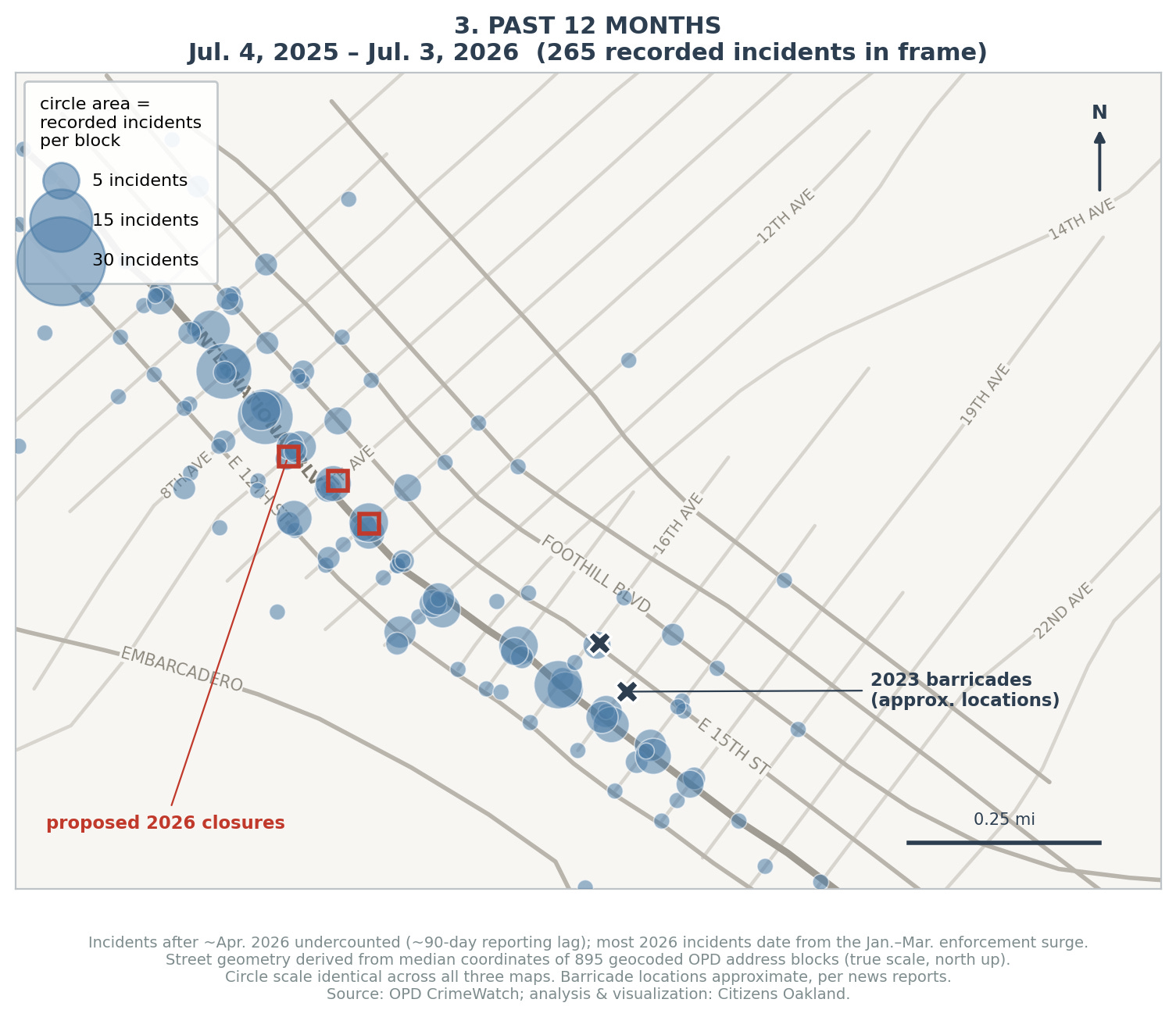
The most recent 12 months of crime data show the focus of sex trafficking activity has remained focused where they moved in 2023. Today’s busiest blocks are the 700 and 800 blocks of International Boulevard — a few blocks west of the proposed closures — plus side-street segments north of East 15th, beyond the new barriers’ reach. Even a successful pilot would leave both untouched.
One notable caveat: the data show where police found and reported criminal activity, not a full census of it. Police reports are themselves a function of where police focus their crime prevention and enforcement efforts — and their capacity to carry out those efforts.
Crime data shows where police focus their attention, not necessarily how much crime is actually taking place
The data show where police focused their efforts, and cannot be construed as a complete accounting of all the sex trafficking activity taking place.
Sex trafficking crimes enter police reports when police act, so the counts track police capacity and priorities as much as the rate of crime.
OPD fielded 747 sworn officers in 2018, and 625 officers by late 2025. There are about 545 officers on active duty today.
From 2018 to 2025, recorded prostitution-related crimes citywide fell 75 percent — in part because a 2022 state law repealed the loitering offense. However, they then tripled in early 2026.
Over the past year, 77 percent of Oakland’s recorded incidents occurred within a half mile of the proposed street closures.
Oakland’s wider crackdown on sex buyers and traffickers
The proposed barricades would be part of a larger push to disrupt visible sex trafficking in the side streets off International Boulevard.
On Feb. 3, the council adopted Wang’s ordinance — covered in our January Agenda Watch column — increasing fines on sex buyers up to $4,000–$8,000, traffickers up to $10,000–$20,000 per victim per day, and nuisance properties up to $2,500, tripled when minors are involved.1415
Staff projected $250,000–$450,000 a year in citation revenue; OPD reported 71 trafficking arrests in the first two months of 2026.16
Counterpoint: the case for the anti-sex-trafficking barricades
There are a number of counterpoints in the proposal’s favor.
The barricades are less expensive than police overtime. They’re also reversible and time-limited; and fire and transit review have been already completed.
Some residents of the affected blocks — near an elementary school and a health clinic — asked for the barricades, after years of rampant sex trafficking activities in the streets.
Pushing activity to where officers can see it is a coherent theory, backed by weekly OPD operations.
The crime data supports the proposal’s premise that the area needs help: in 2025, police Beat 19 (the target area for the proposed barricades) ranked first citywide in recorded robberies.
The proposal’s sponsor, council member Wang has been honest about the odds, and promises a follow-up report.
As stated above, human trafficking is extremely harmful to individuals and society, and efforts to reduce it should continue.
Proponents of the proposed pilot are right to assert that something needs to be done to reduce sex trafficking in the streets of Oakland, and to offer some relief to residents and businesses in the area where it is currently most visibly concentrated.
Read this related article:

Correlation is not causation
Any change in the crime rate after installation of the barricades could also reflect the new local fines, changes to state law, stepped-up police operations, or seasonal patterns — not just the barricades.
This analysis relies on OPD’s crime data, and recent months may be under-counted because Oakland’s crime data portal takes up to 90 days to update with the most recent data.
The July 7 proposal’s claim that police Beat 19 had “the highest number of shootings and robberies citywide in 2025” is accurate for robberies; but for shootings, the staff report’s “some of the highest” is more precise.

The intent is laudable; but the proposal lacks cost estimates and measures for success
Our review of crime data suggests that barricades reliably bring relief to the specific blocks they close: down 95 percent on the barricaded blocks, down 57 percent within a half mile. But just as reliably, some activity moves nearby — in 2023, onto the very blocks now slated for barriers. Whether that trade is worth making is for the council to decide today.
What the council could address and request before voting is what the proposal still lacks: a public cost figure, a baseline, and a definition of success.
Ideally six months from now at the conclusion of the pilot period, the question “did it work?” will have an answer grounded in data — not in whichever block the activity lands on next.

WE ARE 100% SUPPORTED BY YOU
Oakland Report provides accurate, unflinching, data-driven reporting and analysis that you will find nowhere else. If you value our work, please donate. All contributions go directly to sustaining and growing our 501(c)(3) nonprofit work.
City of Oakland. "Temporarily restricted street closure from International Blvd." Oakland City Council meeting agenda, Jul. 7, 2026. https://oakland.legistar.com/LegislationDetail.aspx?ID=8034965&GUID=C6BCA011-F647-442D-AD8E-F89DB6B83BAA&Options=&Search=
Wang, Charlene. "Agenda report: resolution authorizing the city administrator to temporarily close to through traffic 9th, 10th and 11th Avenues." Oakland City Council meeting agenda, Jul. 7, 2026. https://oakland.legistar.com/View.ashx?M=F&ID=15578013&GUID=7E1328F4-A076-45C3-B0FC-EC70E66895F4
City of Oakland. "Draft resolution authorizing the city administrator to temporarily close to through traffic 9th Avenue, 10th Avenue, and 11th Avenue between International Boulevard and 15th Street, for a period of six months, pursuant to California Vehicle Code section 21101.4." Oakland City Council meeting agenda, Jul. 7, 2026. https://oakland.legistar.com/View.ashx?M=F&ID=15578014&GUID=FC354D4B-45BB-4132-8F6A-4747CC8419C0
City of Oakland. “CrimeWatch data.” Oakland Police Department crime data portal, accessed Jul. 6, 2026. https://data.oaklandca.gov/Public-Safety/CrimeWatch-Data/ppgh-7dqv/about_data
State of California. “California Vehicle Code, Division 11, Chapter 1, Section 21101.4.” https://leginfo.legislature.ca.gov/faces/codes_displaySection.xhtml?lawCode=VEH§ionNum=21101.4.
Yu, Betty. "Oakland to use street barriers to curb sex work in known hotspot." KTVU, Apr. 29, 2026. https://www.ktvu.com/news/oakland-use-street-barriers-curb-sex-work-known-hotspot
Stinson, Sara. “Oakland’s new strategy to combat sex work in this neighborhood.” KRON4, Apr. 27, 2026. https://www.kron4.com/news/bay-area/oaklands-new-strategy-to-combat-sex-work-in-this-neighborhood/
Lin, Da. “’All night long’; Oakland installs barriers in neighborhood victimized by brazen prostitution.” CBS News Bay Area, Feb. 26, 2023. https://www.cbsnews.com/sanfrancisco/news/oakland-sets-up-street-barriers-neighborhood-prostitution/
Sierra, Stephanie. “Traffic barricades installed to deter alleged sex work are pushing ‘suspicious activity’ to other grade schools in East Oakland.” ABC7 News, May 22, 2023. https://abc7news.com/oakland-sex-workers-trafficking-pimps-e-15th-st-barricades/13272030/
Lin, Da. “Prostitution in plain sight prompts Oakland community condemnation.” CBS News Bay Area, Apr. 28, 2024. https://www.cbsnews.com/sanfrancisco/news/prostitution-plain-sight-prompts-oakland-community-condemnation/
Ibid. Stinson, Sara.
Dahlstrom-Eckman, Azul. "Mission District street closures to curb sex work extended for 18 months." KQED, Jun. 17, 2026. https://www.kqed.org/news/12087940/mission-district-street-closures-to-curb-sex-work-extended-for-18-months
Sierra, Stephanie. “New barriers to deter alleged sex work along San Francisco’s Capp St. may be permanent.” ABC7 News, Oct. 26, 2023. https://abc7news.com/post/capp-street-san-francisco-st-sex-work-permanent-collapsible-bollards-cement-planter-barriers/13975102/
Rodgers, Jakob. "Getting caught buying sex in Oakland could now mean thousands of dollars in new fines." The Press Democrat, Feb. 17, 2026. https://www.pressdemocrat.com/2026/02/17/getting-caught-buying-sex-in-oakland-could-now-mean-thousands-of-dollars-in-new-fines/
Reinhart, Sean S. “Oakland prostitution enforcement and support services up for revisions.” Oakland Report, Jan. 26, 2026. https://www.oaklandreport.org/p/20260126-oakland-prostitution-enforcement
Russell, Kiley. “8 more arrested in Oakland police crackdown on prostitution along International Blvd.” Bay City News, Mar. 6, 2026. https://localnewsmatters.org/2026/03/06/oakland-police-arrests-prostitution-human-trafficking/
I appreciate council member Wang for being honest about the probability for success from this proposal. I have no doubt that if this approach doesnt work, she will claim so and, likely, pivot to another solution instead of doubling down by spouting ideological non-sense and asking for more funding which is the de facto route that grifting "leaders" resort to.
To quote a wise and venerable frat boy: I think that this situation absolutely requires a really futile and stupid gesture be done on somebody's part.