


EDITOR’S NOTE: Our Oakland Agenda Watch column provides short summaries of items on upcoming public meeting agendas that catch our attention. Previously, this column’s format covered multiple agenda items in each column. Going forward, we aim to provide more frequent Agenda Watch columns that focus on one item per column.
Proposed changes to prostitution enforcement and support services funding
Special public safety committee meeting, Jan. 27, 2026, agenda item #4
The city council public safety committee will review a proposal from councilmember Charlene Wang to revise the Oakland Municipal Code sections concerning prostitution.1
The proposed ordinance,2 if adopted by the full city council at a future meeting, would shift enforcement focus away from sex workers and victims of sex trafficking, and toward buyers of commercial sex.
The ordinance also would add new penalties on businesses and property owners deemed nuisances that support and propagate sex trafficking.
If adopted, the ordinance would create a dedicated new Human Trafficking Survivor Support Fund using the fines collected from people convicted of soliciting commercial sex; and from nuisance properties deemed to be contributors to sex trafficking.
Help us reach our goal of 10,000 subscribers
“Loitering with intent to purchase sex” definition could open door to profiling
Per state law, individuals who are convicted of soliciting prostitution are currently subject to imprisonment of up to one year in county jail and escalating fines up to $10,000.3
The proposed ordinance under review on January 27 would expand local enforcement in Oakland to go beyond active solicitation to include people deemed by law enforcement to be “loitering in a public place with the intent to purchase commercial sex.”
The proposed ordinance defines loitering with intent to purchase sex as, “acting in a manner and under circumstances which openly demonstrate the purpose of inducing, enticing, or soliciting prostitution, or procuring another to commit prostitution such as circling an area in a motor vehicle.”
This definition appears not to account for other, legitimate reasons for “circling an area in a motor vehicle,” such as looking for a parking space or trying to find a location without clear directions or an address. When combined with the demographic description of predominant offenders (see below), this appears to suggest that some degree of profiling based on people’s physical attributes while engaged in legal activities (like driving) would be factored into enforcement.
Video clip 1. [Warning: Graphic content.] A drive down International Boulevard (aka The Blade). Oakland, California, Dec. 20, 2022. (Edited for length from source: Street Clipz / YouTube.)
Councilmember Wang’s report introducing the ordinance says that “sex buyers are predominantly higher-income men who do not reflect the demographics of the East Oakland communities they frequent.”
While this characterization may be statistically accurate, the report’s highlighting of this statistic implies — consciously or not — that enforcement of “loitering with intent” should take into account people’s perceived demographics, income levels, and neighborhoods/cities of residence.
Conversely, the highlighting of this statistic could also be taken to imply that people who live in the neighborhood, are not higher-income, or do not share the demographic profile of most offenders should not be held to the same level of suspicion or accountability for participating in the crime of sex trafficking.
In the language of the proposed ordinance, examples of loitering to buy sex include, “repeatedly beckoning to, contacting, or attempting to contact or stop pedestrians or other motorists, making unauthorized stops along known prostitution tracks, or engaging in other conduct indicative of soliciting with intent to purchase commercial sex.”
These examples offer some specificity about the behaviors that commonly are associated with and often precede sex purchasing. However, some of the described behaviors such as “attempting to contact pedestrians or other motorists” are legal in and of themselves, and people exhibiting those behaviors could have legitimate reasons besides solicitation.
When combined with the other definitions, this proposal on the whole appears to suggest that stops and arrests could be initiated based on law enforcement’s subjective assessments of people’s intent based on their legitimate activities, the neighborhood they are in, and their perceived demographic attributes alone.
The intent of the proposed ordinance is obviously and rightly to reduce sex trafficking and the harms it causes. There is no dispute that human trafficking is extremely harmful to individuals and society, and efforts to reduce it should continue.
However, the vague definition of the proposed “loitering with intent” offense and the potential for appearance-based profiling could potentially leave the door open to legal challenges and increased risk to the city by defendants (or more precisely, their attorneys) who, under these definitions, potentially could argue that they were illegally stopped and prosecuted merely for circling the block in the “wrong” neighborhood while appearing to fit a certain profile in the eyes of the arresting officer.
See this related article:
District 2 candidates lay out their priorities

Charlene Wang, Kara Murray-Badal, Paula Thomas share their ideas for Oakland. Oakland Report invited all of the candidates running for City Council in District 2 to respond to the following prompt: If you are elected to the city council, what are your 3 biggest priorities?
Nuisance properties would be subject to new civil penalties
In the current municipal code, businesses and property owners “whose buildings or venues are knowingly used for the purpose of lewdness, assignation, or prostitution” are subject to misdemeanor prosecution and abatement actions.4
The proposed ordinance would revise the municipal code to establish new civil penalties “of up to $2,500 per day against the owner of any property constituting a public nuisance.”
The ordinance includes a “whereas” clause that appears to offer examples of what constitutes a nuisance property:
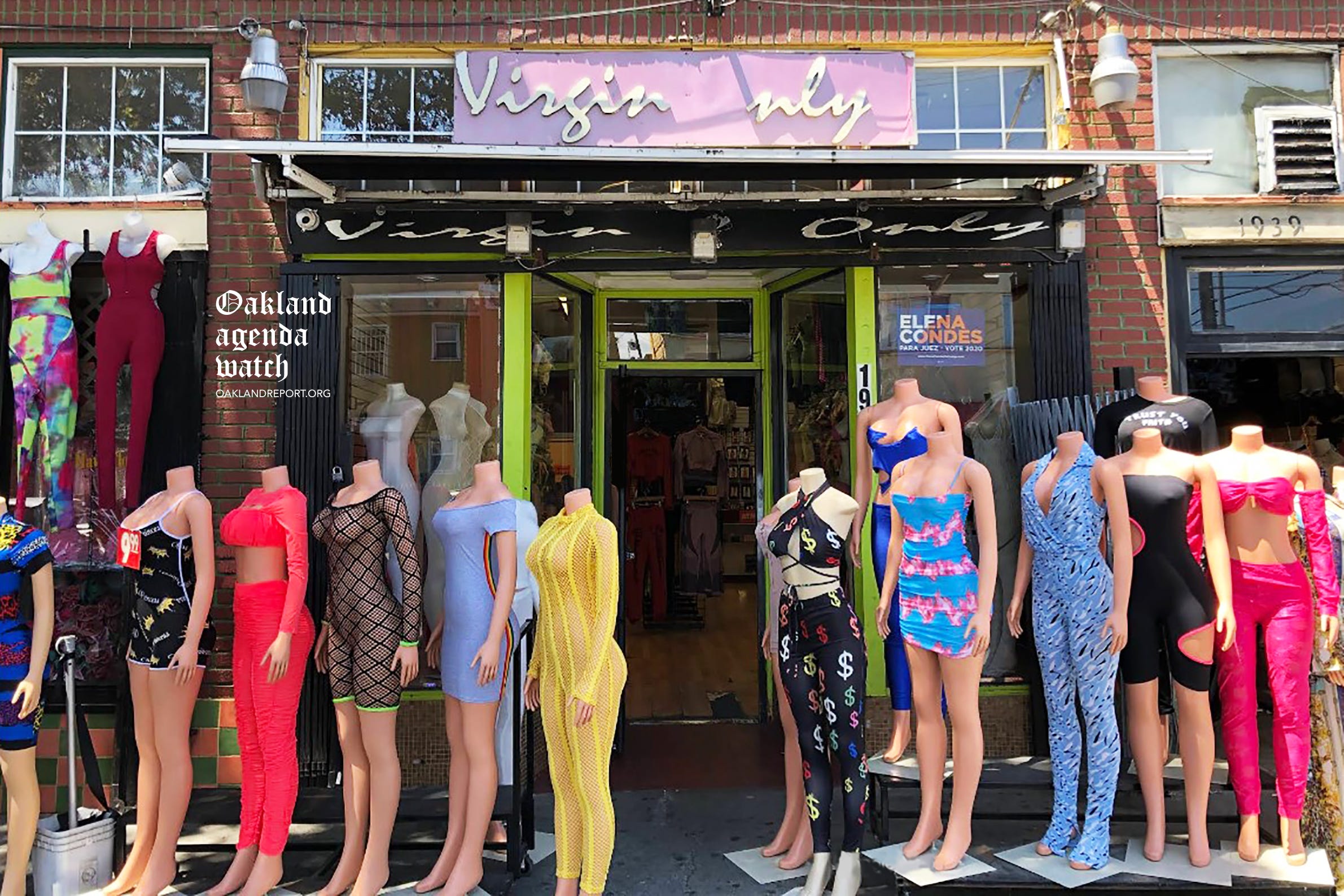
Local small businesses and the regional economy are stifled by the presence of “problem motels” that facilitate exploitation, and convenience stores that stay open late into the night catering to products such as skimpy clothing, see through lingerie, stiletto shoes, and boots, and wigs, products worn by prostituted children and adults, all of which contribute to reduced foot traffic for legitimate merchants and the erosion of neighborhood property values and safety.
— City of Oakland, “Proposed ordinance amending Oakland municipal code 9.08.260 (prohibition of prostitution and prostitution related offenses) to conform to state law.”
However, the proposed ordinance itself appears not to change the current definition of a “public nuisance” property in the relevant section of Oakland Municipal Code 9.08.260. That section is somewhat more broadly stated and does not specify as nuisances businesses that sell “skimpy clothing, see through lingerie, stiletto shoes, and boots, and wigs”:
A public nuisance is anything which is injurious to health, or is indecent, or offensive to the senses, or an obstruction to the free use of property, so as to interfere with the comfortable enjoyment of life or property by an entire community or neighborhood, or by any considerable number of persons, or unlawfully obstructs the free passage or use, in the customary manner of any public park, square, street, or highway is a public nuisance.
— Oakland Municipal Code 9.08.260 §E.1.(a)

New support fund would “create a direct transfer of wealth” through fines on sex buyers and nuisance properties
The proposed new Human Trafficking Survivor Support Fund would provide financial support in the form of emergency housing and medical and mental health assistance; as well as funding for education and prevention programs, street outreach, workforce development, legal services, and undercover enforcement.
The revenues deposited into the support fund would be “continuously appropriated for expenditure by the City Administrator, or designee, without further Council action after the first year.”
The councilmember’s report says that the fine revenue “creates a direct transfer of wealth from those who cause harm (buyers/traffickers) to those who have been harmed (the exploited and the survivors), providing the capital needed to secure and provide services for those most harmed by prioritizing access to the Survivor Support Fund, regardless of their prior contact with the criminal justice system.”
The report says that the proposed ordinance would reduce impact on exploited and trafficked individuals and address bias: “By focusing penalties on buyers and traffickers, we combat the systemic trend where Black and Brown girls have no agency or control, and their exploiters including purchasers are ignored.”
In revising existing local laws prohibiting and enforcing solicitation of prostitution, the proposal seeks to conform to and expand on state laws pertaining to sex trafficking, most notably AB 379 – Survivor Support and Demand Reduction Act,5 and California Penal Code Sections 647, 647.5,6 and 653.25.7
If advanced by the public safety committee, the proposed ordinance will go to the full city council for a vote potentially at its next meeting on February 3.

Other notable agenda items on deck
Oakland Report aims to take a closer look at these upcoming agenda items in future Agenda Watch columns. Subscribe now to receive Oakland Report in your inbox:
City of Oakland receives a “negative outlook” from all three major credit rating agencies. On December 9, Mayor Barbara Lee held a press conference touting the city’s long-delayed sale of infrastructure bonds, a basic municipal function, and celebrating the sale as a sign of Oakland’s improving financial condition. On January 27, the city council’s finance and management committee will review reports from credit rating agencies Moody’s Investors Services, S&P Global Ratings, and Fitch Ratings in which the city received a “negative outlook” from all three agencies. According to the credit rating agencies’ reports, the negative outlook is largely due to the city’s ongoing structural budget challenges and poor financial management practices. Finance and management committee, Jan. 27, 2026, agenda item #4.
Alameda County Board of Supervisors is negotiating to buy back its 50% share of the Oakland Coliseum. Alameda County sold its 50% stake in the Oakland Coliseum Complex to the Oakland A’s for $85 million in 2019. At the time, supervisors stated that the move was aimed to, “get out of the sports venue business” and focus on the county’s core services. In recent months, the board of supervisors has held several closed sessions that appear to be aimed at buying back the 50% stake from the A’s and then selling it to a developer. The prices and terms of these potential sales are not publicly known. The developer in question is in the process of also purchasing the City of Oakland’s 50% share in the property. The developer missed scheduled payments on that sale. The city then revised the terms of the sale agreement and put in place a new payment schedule allowing the developer to defer the payments to future dates. Alameda County Board of Supervisors, Jan. 27, 2026, closed session conference with real property negotiators item #A.
Is there an upcoming agenda item that you would like Oakland Report to cover? Contact us.
Oakland Report is by no means comprehensive in our coverage of public meetings in Oakland. The scope and frequency of public meetings are far more than we can presently cover.
You can view the Oakland City Council meeting agendas and meeting materials on the city’s meeting calendar.
You can view the Alameda County Board of Supervisors meeting agendas and meeting materials on the county’s meeting calendar.
DONATE TO SUPPORT OUR WORK

If you like our work, please consider donating.
We are a charitable nonprofit based in beautiful Oakland, California.
Your tax-deductible donation helps us continue to produce articles like this one.
Thank you!
Wang, Charlene. “Report to the Honorable Mayor and Members of the City Council.” Recommendation: Ordinance Amending Oakland Municipal Code 9.08.260 (Prohibition Of Prostitution And Prostitution Related Offenses) To Conform To State Law. Oakland, California, Jan. 15, 2026. https://oakland.legistar.com/View.ashx?M=F&ID=15088119&GUID=79BD61E9-5BD5-4A8C-881C-DEB020E9AC53
City of Oakland. “Proposed Ordinance.” Amending Oakland Municipal Code 9.08.260 (Prohibition Of Prostitution And Prostitution Related Offenses) To Conform To State Law (1) By Repealing The Offense Of Loitering For The Purpose Of Engaging In Prostitution; (2) Adding Loitering For The Purpose Of Purchasing Commercial Sex As An Offense; (3) Allowing For The Administrative Assessment Of Fines Against Sex-Purchasers, Sex-Traffickers, And Properties Used For Prostitution; And (4) Creating A Human Trafficking Survivor Support Fund. Oakland, California, Jan. 27, 2026. https://oakland.legistar.com/View.ashx?M=F&ID=15088179&GUID=E199582D-98B4-4711-B734-20E8E460D52C
California Penal Code. Part 1, Title 15, Chapter 2, Section 647. https://leginfo.legislature.ca.gov/faces/codes_displayText.xhtml?lawCode=PEN&division=&title=15.&part=1.&chapter=2.&article=
City of Oakland Municipal Code 9.08.260 § E.1-2, “Prohibition of prostitution and prostitution related offenses.” https://library.municode.com/ca/oakland/codes/code_of_ordinances?nodeId=TIT9PUPEMOWE_CH9.08OFAGPUPEDE_9.08.260PRPRPRREOF
California State Legislature. “Assembly Bill No. 379.” An act to amend Sections 52.6 and 52.65 of the Civil Code, and to amend Section 647 of, to add Sections 647.5 and 653.25 to, and to add Chapter 5.8 (commencing with Section 13849) to Title 6 of Part 4 of, the Penal Code, relating to crimes. Sacramento, California, July 30, 2025. https://leginfo.legislature.ca.gov/faces/billTextClient.xhtml?bill_id=202520260AB379
Ibid. California Penal Code Sections 647 and 647.5.
California Penal Code. Part 1, Title 15, Chapter 2, Section 653.25. https://leginfo.legislature.ca.gov/faces/codes_displayText.xhtml?lawCode=PEN&division=&title=15.&part=1.&chapter=2.5.&article=
You should post a copy of the false and fraudulent ethics report that the CM filed against me before escalating his fiction in a city council meeting before further escalating his fiction in an Oaklandside interview before finally escalating his fiction by posting a threatening social media video directed and me and my family. BTW, his false and fraudulent ethics complaint against me has already been dismissed. It was totally and completely absurd. Why would a council member submit a fake report against a city leader? Why is nothing being done when a city employee is subjected to such threatening behavior by a council member? I’d be happy to share what I was working on at the time of his assault on my reputation.