


Oakland Report examines the data behind the headlines. In this installment, we look at the Interstate 580 Truck Access Study — and the trucking industry’s decades-long push to open the MacArthur Freeway to heavy trucks.
Why Caltrans is studying the ban on heavy trucks on I-580
Since 1963, trucks over 4.5 tons have been barred from a nearly 9-mile stretch of Interstate 580 between Grand Avenue in Oakland and Foothill Boulevard in San Leandro — also known as the MacArthur Freeway.
The agency describes the question as one of environmental justice:1
“Since 1951,2 large trucks have been prohibited on part of I-580... As a result, truck traffic has been routed to I-880, contributing to health and environmental impacts in nearby neighborhoods.”
— Caltrans I-580 Truck Access Study fact sheet, Nov. 7, 2025
The burden on the I-880 corridor is real. More than half of the people living along I-880 are classified by the state as environmentally burdened. Along I-580, the figure is about 9%.3
The study’s first results, released in July 2026, let us test that premise against the state’s own numbers.45
Oakland Report reviewed the study’s preliminary traffic and air quality memos, technical advisory committee (TAC) notes, Caltrans’ published history of the ban, state campaign finance and lobbying records, and the research on what happens when roads open to more traffic.
Key findings
The California Trucking Association has pushed to lift the ban since at least 1967, and it now holds the Caltrans study’s only industry seat. Its political committees have given $671,700 to state campaigns since 2001. Some of this money has gone to Sacramento’s transportation-policy leadership, to the 2010 campaign to suspend California’s climate law, and against that law’s author.
Caltrans describes the study’s purpose in conflicting ways. Caltrans told its advisory committee the study will make no recommendation on the ban, and its public fact sheet answers “No” to whether the ban will be removed as a result of the study. But its project page also says the study creates an opportunity to find “common ground for its potential repeal.”
The model assumes — without evidence — that truck traffic will not grow when a new freeway opens to trucks. Caltrans’ own ‘induced demand’ traffic research contradicts this, and Caltrans’ research division is currently paying to find out whether that holds for trucks.
The projected health gain for I-880 communities is negligible (one cancer case per 1,000,000 people) — and within the model’s margin of error. Removing the ban would lower 2035 excess cancer risk for environmentally burdened communities from 9 cases per 1,000,000 people to 8 per 1,000,000.
Total diesel pollution across the study area will go up, not down, if the ban is lifted. The 2035 model shows 1.09 tons of diesel particulate matter (DPM) per year with the ban and 1.20 tons without it — about 10% more if the ban is lifted.
Almost all of the projected improvement will come from cleaner trucks, not the ban decision. Regulations for newer diesel engines are projected to cut cancer risk by 19 cases per 1,000,000 people by 2035 either way. The ban decision changes it by one.
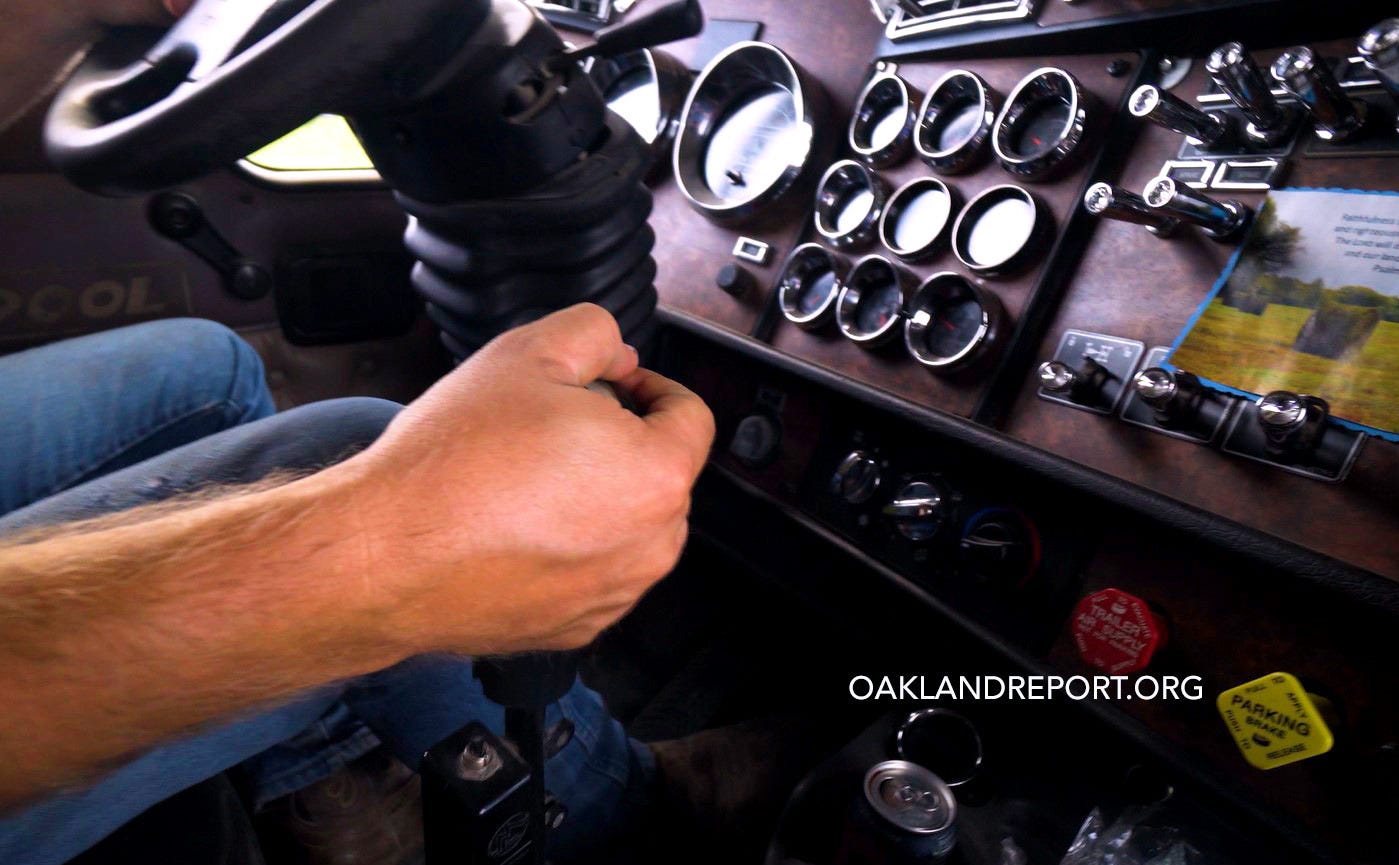
‘How come my trucks are banned on this stretch of 580?’ The trucking industry has pushed to lift the ban for nearly 60 years
Caltrans says the current study was initiated in response to community air quality concerns in 2019 and 2021. But the trucking industry’s push to lift the ban began long before then.
When the 1963 ban came up for renewal in 1967, the California Trucking Association’s (CTA’s) Richard Zeller argued that truck taxes had helped pay for the freeway. He called the restriction “discriminatory against the people who live near the Nimitz Freeway [I-880] or must use it,” and he asked whether the schools and hospitals along the MacArthur Freeway were more valuable than those elsewhere.
The trucking industry’s argument in 1967 was similar to the environmental fairness argument that frames Caltrans’ study today.


Caltrans’ own history records what came next. CTA proposed a study of lifting the ban in 1990 and asked again in 1996. Then in 1999, a new study was proposed — with CTA to take part.6 The San Francisco Chronicle reported that Caltrans ultimately shelved the plan after strong opposition from Oakland and San Leandro residents.7
The man behind the 1999 request, Robert Ramorino, ran Roadstar Trucking and later became CTA’s president. He framed the request with a blunt question: “How come my trucks are banned on this stretch of 580?” Ramorino asserted that he was paying federal highway taxes on trucks that could not use the freeway near his business, and said that opening it would be convenient for his company and for freight movement generally.
Caltrans officials indicated at the time that if they found good reasons to lift the ban and Oakland agreed, they would recommend opening the freeway to trucks.
The study never happened. Residents along I-580 pressed their representatives to stop it before it began. The Oakland City Council passed a resolution affirming the ban.
That fight produced the law now at issue. Assembly Bill 500 began in 1999 as an unrelated bill about state buildings. It was rewritten that spring and summer to put the truck ban into the state’s Vehicle Code.8
Gov. Gray Davis signed it into law in August 2000, barring vehicles of 9,000 pounds or more from the I-580 freeway segment.9
CTA opposed the bill. Charles Ramorino, CTA’s president in 1985 and later chairman of the American Trucking Associations called the ban unfair because I-580 is an interstate paid for with federal highway taxes.1011
Robert Ramorino, the man behind the 1999 request to lift the ban, is Charles Ramorino’s son. Both Ramorinos have led the trucker’s association; Robert is listed as a past president in CTA’s 2023 directory.12
Governor Davis wrote in 2000 that he did not favor bans on commerce, but since the ban had stood since 1963, and a Caltrans study had found no reason to lift it, doing so “would be a breach of faith with the residents of Oakland.”
Because the ban is state law, Caltrans cannot remove it — only the legislature and governor can.
The residents who opposed the 1999 study supplied the argument that has anchored the ban since. Ellen Corbett, then a newly elected assemblymember whose district covered much of Oakland, told KQED she fielded dozens of calls from angry constituents and convened a meeting with Caltrans that drew hundreds of people, with the overflow spilling into the parking lot. Corbett said her research indicated I-580 had not been built for trucks. Caltrans disputed this, saying the freeway “was designed to be safe for all vehicular traffic.”
For her part, Corbett also told KQED that residents believed lifting the ban would break a promise:13
“People were actually displaced and homes were taken from people. There was a commitment made that trucks would not be on that freeway because these neighborhoods had been destroyed.”
— Former assembly member Ellen Corbett, Jul. 1, 2021
That account is the source of a claim the ban’s defenders still make today: that the state promised to keep trucks off I-580 when the freeway was built.
Caltrans’ history describes it differently. The ban was a 1963 Oakland city ordinance, approved by the state and federal governments, set to expire in 1968. It was extended after local governments asked governor Ronald Reagan to renew the state’s approval. The promise was real to the people who believed it. The legal tool was a city ordinance with an expiration date, and it did not become permanent state law until Corbett’s bill passed 37 years later.
Corbett, in 2021, also described the one-sidedness the current study is meant to address. She said she did not hear from any constituents who lived or worked along I-880, the corridor most impacted by heavy trucks.

California Trucking Association now has a seat in the cabin
A quarter-century later, the CTA is now a key player inside the process to study lifting the ban. CTA holds the only industry seat on the Caltrans study’s advisory committee, and sent two representatives to its first meeting.14
Minutes from the committee’s February 2026 meeting record the Port of Oakland asking whether some metrics could be presented as benefits. The meeting’s key takeaways include a suggestion to frame a projected reduction in trucking hours of delay as a benefit.15 But two Caltrans web pages describe the study’s purpose differently.
Caltrans’ project page says the study is a chance to “reevaluate the purpose of the truck ban, find common ground for its potential repeal,” and “address existing issues of inefficient traffic flows for the impacted communities and logistics industry.”16
Caltrans’ public engagement portal, describing the same study, speaks of finding “consensus for its future status” and refers to “the freight industry.”17
Its November 2025 fact sheet lists three study focuses. One is “addressing existing issues of inefficient traffic flows for the logistics industry.”
The industry’s practical stake is modest, by the study’s own numbers. Total truck delay would fall by about 100 hours a day, just over 2%, if the ban is lifted. More than 80% of the westbound trucks and 90% of the eastbound trucks that would use I-580 would be passing through to destinations outside the region. Port of Oakland trips are around 5% of the area’s heavy truck trips.18

Following the money
CTA is a trade group with about $3.6 million in annual revenue.19 Oakland Report reviewed California Secretary of State records for CTA’s two political committees: CARGO PAC and Truck Unit PAC.
We used a Cal-Access PowerSearch export of every itemized contribution reported from CARGO PAC, and found 229 contributions totaling $671,700 across the 2001 through 2025 political cycles.2021
Here’s the pattern we found in its verified political spending:
No donations to the campaigns of the corridor’s state legislators. No reported contributions went to Ellen Corbett (AB 500’s author), Nancy Skinner, Buffy Wicks, Mia Bonta, Liz Ortega, Aisha Wahab, nor to current Oakland-based legislators. Rob Bonta, now attorney general, received $1,500 in 2014.
Steady money to transportation committee leaders. Lori Wilson, who chairs the Assembly’s transportation committee, has received $20,300. Her checks rose to the legal maximum after she became the chair. Former Assembly transportation chair Jim Frazier received $11,400 while chair; and former Senate transportation chair Jim Beall received $6,200.
Spending to defeat a state climate law. In 2010, CARGO PAC gave $50,000 to Yes on Proposition 23, the failed measure to suspend AB 32, California’s climate law, plus it gave $70,000 during that cycle to business coalition PACs. Then in 2012, the Truck Unit PAC spent $28,379 opposing state senator Fran Pavley, AB 32’s author, and $42,747 supporting her opponent.
A quarter-million-dollar industry lobbyist. CTA pays its lead outside lobbying firm, Shimoda Government Strategies (founded by CTA’s former government affairs chief, Chris Shimoda) $53,697 per quarter — $269,426 from March 2025 through June 2026 — for work its filings describe as focused on state climate and clean truck rules.22
No filing lists Caltrans as a directly lobbied agency, and no repeal bill has been introduced. The electronic record only goes back to 2001; earlier giving, including during the fight over AB 500, would require additional research.
The political spending reports suggest a steady, state-focused effort, not a local pressure campaign. CTA’s verified influence spending primarily goes through Sacramento’s policy chokepoints, the courts, and its advisory seat on the current Caltrans study group.
It is reasonable to consider the possibility that the $600,000 Caltrans study is the latest move in a six-decade campaign: a state-funded analysis, with the industry at the table, that could become the evidence for a repeal bill only the legislature and governor can pass.23
It also stands to reason to ask who benefits if the study’s framing holds and the ban is lifted: an industry whose trucks would gain nearly nine miles of interstate access, and whose decades of requests are recorded on Caltrans’ own website.
Whether that framing holds is a question the study’s own numbers can answer. They rest on a traffic model — and the model begins with an assumption.
Donate to Oakland Report. Your monthly or one-time contribution in any amount helps us to continue to produce accurate, deeply researched, data-driven articles like this one.
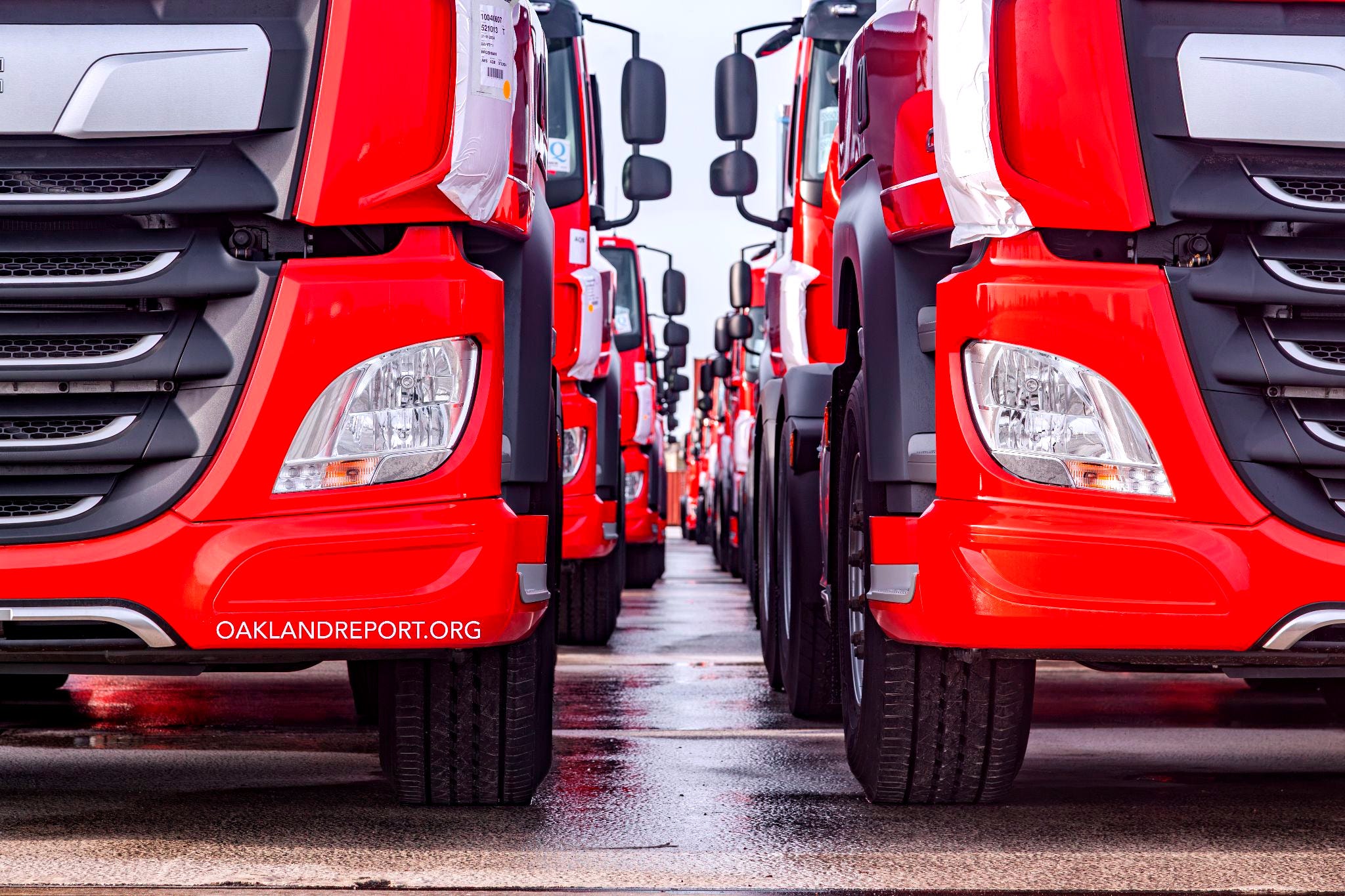
The assumption doing the heavy lifting: that trucks won’t multiply
Every pollution and health number in the Caltrans study depends on a key assumption in its traffic model: that some trucks will shift to other freeways, but their total will not grow when a major new freeway opens to them.
When residents and advisory committee members raised concerns about ‘induced demand’ — the well-documented tendency of new road capacity to create more traffic — the project team answered that truck demand follows consumer behavior, not added capacity.
The consultant, Fehr & Peers, repeated the assumption, telling the committee that the amount of truck traffic moving through the study area “does not actually change.”
The research on induced demand rejects that assumption for roads in general. A 2015 policy brief by UC Davis professor Susan Handy — sponsored by Caltrans — devotes a section to it. Adding capacity increases total driving rather than shifting it between roads. Of the “shifting” argument, the brief states: “Evidence does not support this argument.”24
The study Handy relies on, Duranton and Turner’s “The Fundamental Law of Road Congestion,” found that driving rises about one-for-one with increased interstate capacity. It named commercial traffic as one of three causes: “commercial driving and trucking increase with a city’s stock of roads.”25
California wrote this into policy. The state’s official calculator of induced travel, adopted by Caltrans in 2020, assumes that a 10% increase in interstate capacity produces a 10% increase in driving.26 A 2025 California Air Resources Board brief found that the most rigorous studies agree.27
Opening nearly nine miles of interstate to trucks is not the same as building new lanes, and induced demand for trucks is less studied than for cars. Caltrans’ own research division admits it doesn’t have sufficient data to assume that truck traffic would not increase. An October 2025 research note for an active Caltrans project lists “updating elasticities to exclude truck VMT [vehicle miles traveled]” as a priority, because the truck-specific effect has never been separately measured.28
In other words, one arm of Caltrans was accepting its consultant’s assurance that truck traffic will not increase with increased road capacity. Another arm was paying for research because the scale of that specific assumption is unknown.
Two more limitations appear in the study’s findings to date.
Fehr & Peers, the Caltrans study consultant, told the committee the analysis covers the near to medium term, and may not capture long-term impacts. Additionally, research finds the full effect of new capacity takes five to ten years to appear.
Caltrans’ study model appears not to account for these limitations. It is reasonable to consider the possibility that their model understates future truck traffic on both freeways.
The assumption that overall heavy truck traffic won’t increase matters because of what the data show, even when one accepts it as true.
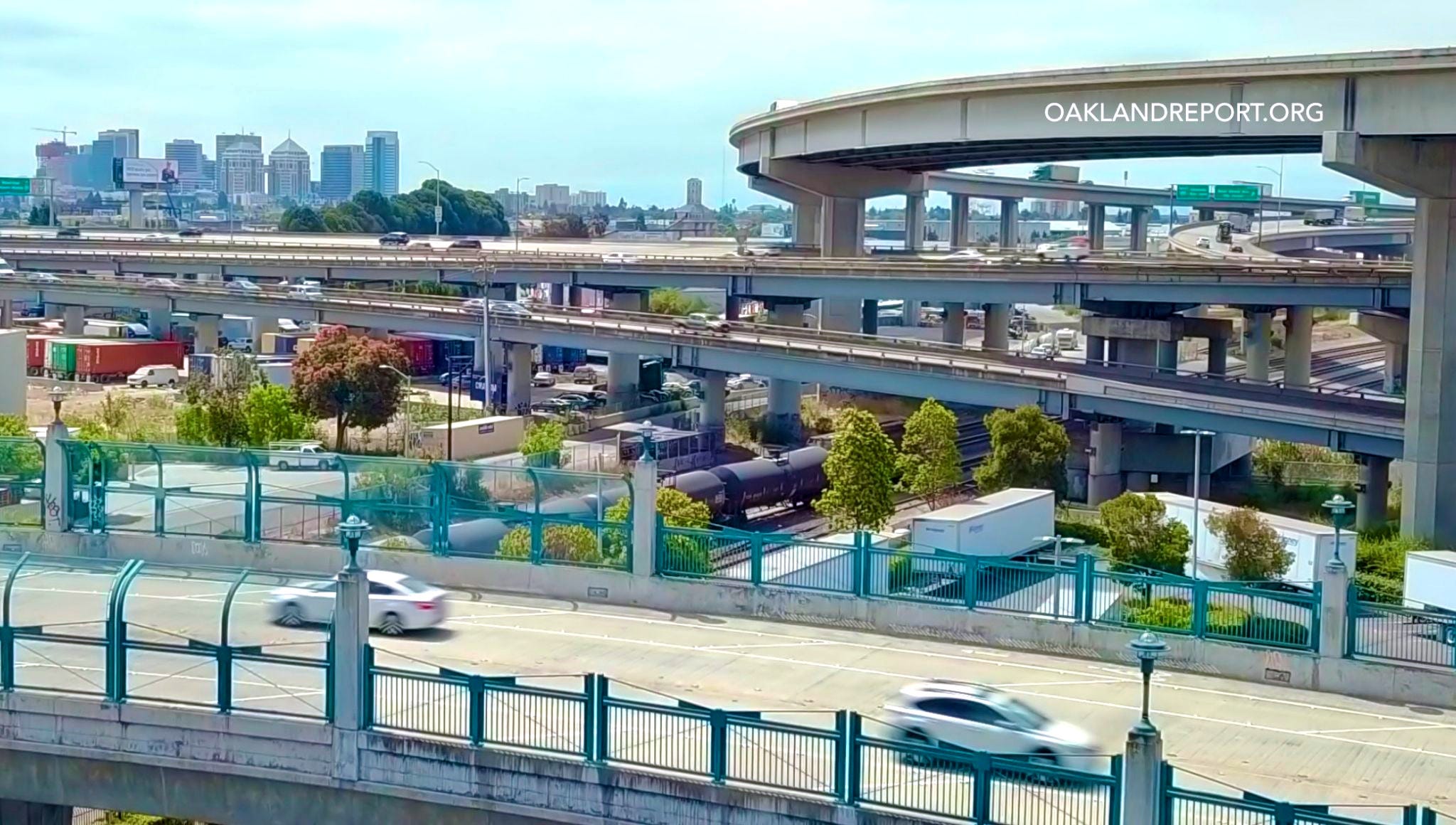
Even on the study’s own assumptions, the health benefit to I-880 is small
The health numbers are where the study’s premise appears to be weakest — largely because regulations for cleaner trucks will account for the bulk of the projected health improvements by 2035, whether the ban changes or not.
Even with the assumption that heavy truck traffic will not increase overall when a new freeway is opened to them (the ‘induced demand’ effect), Caltrans’ own data show that the projected health gains for the I-880 corridor that carries the heaviest health burden would be remarkably slight — while the health burden to the whole study area would increase.
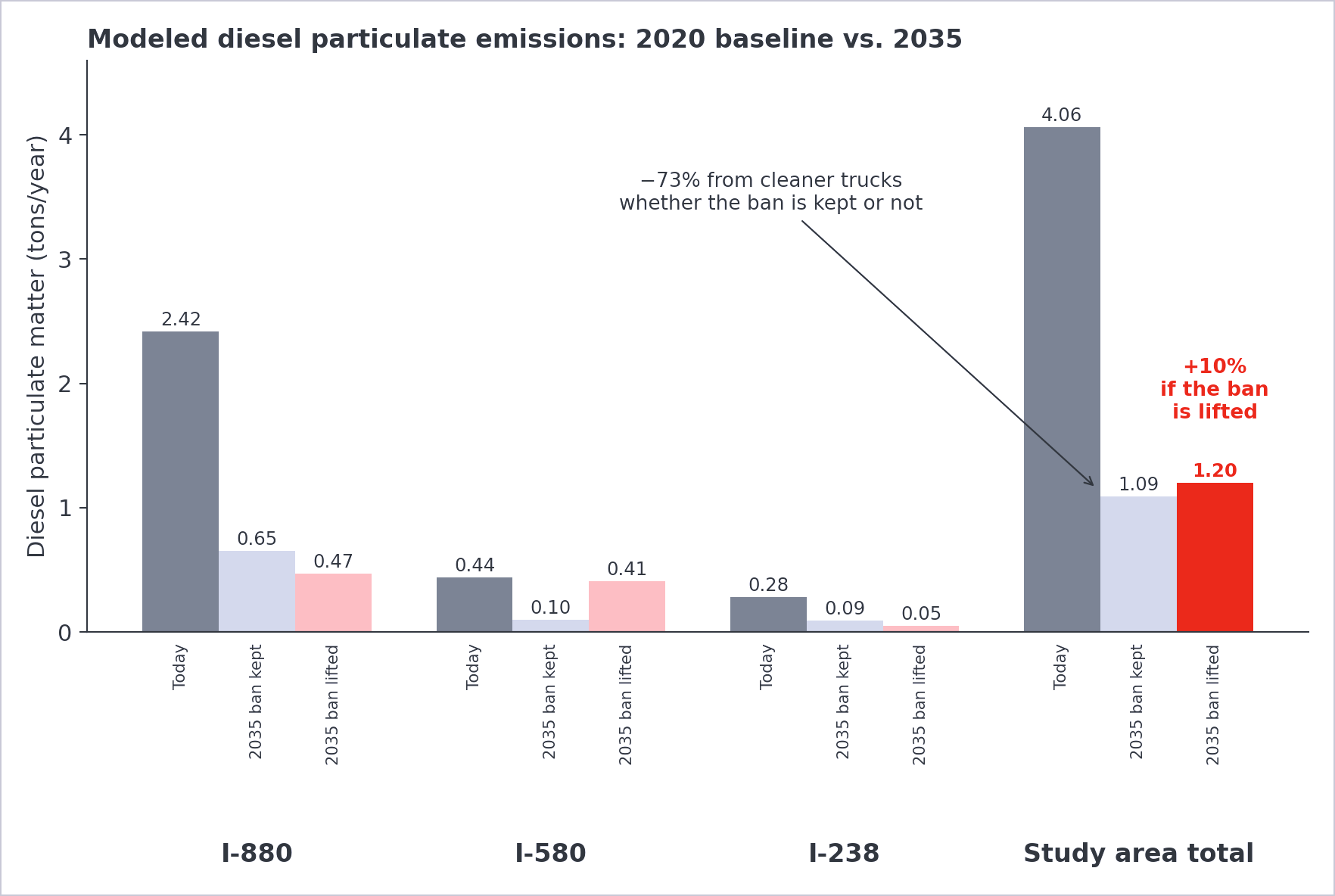
Diesel particulate matter (DPM) is the fine soot from diesel engines that the state of California links to cancer. On I-880, DPM would fall about 28% if the ban is lifted, compared to keeping the ban. On I-580, it would roughly quadruple from a small base.
Notably, when looking at the entire study area, lifting the ban would mean 10% more diesel soot across Oakland and San Leandro. If the ban is lifted, total study area DPM is projected to be 1.20 tons per year by 2035. If the ban stays in place, it is projected to be only 1.09 tons per year.
In other words, the study’s air quality memo describes the ban’s effect on total emissions as small, and its own math shows total emissions rising if the ban goes away.
Projected change to cancer risk from diesel emissions would be slight — and the risk would increase among key populations
For environmentally burdened communities, projected excess cancer risk would fall from 28 per million today to 9 per million in 2035 if the ban is kept, and to 8 per million if it is lifted. The one extra point from the ban decision is, in the study’s own words, likely “within the error of the model.”
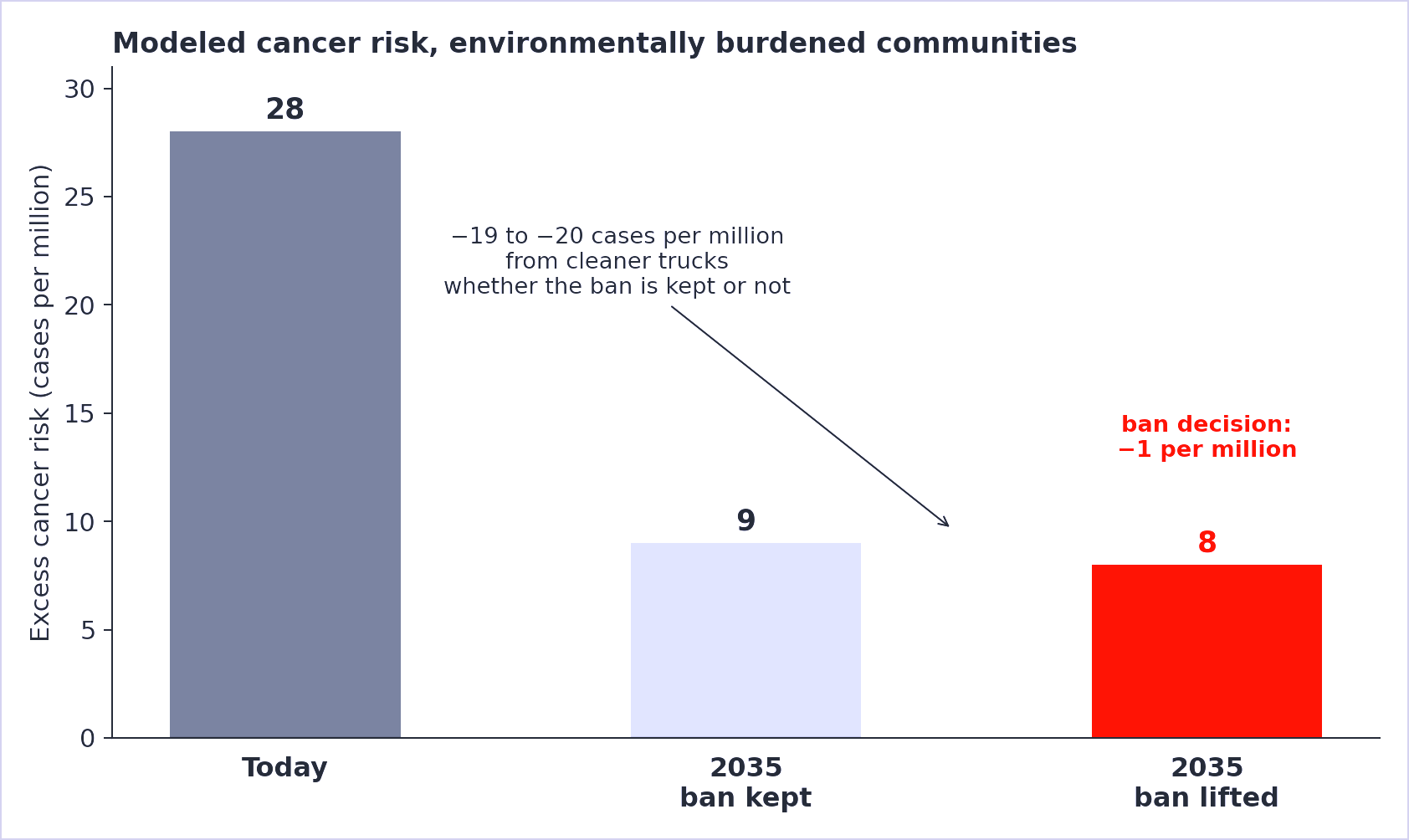
According to the study’s own data, the bigger reduction will come from cleaner trucks, which is expected to happen either way.
Several groups’ projected cancer risk actually would increase slightly if the ban is lifted, including Black residents, children under 10, and residents below 200% of the poverty line.
The study also counts 72 schools, day cares, senior centers and hospitals within 1,000 feet of I-580, compared with 41 along I-880.
How many heavy trucks would travel I-580 and connecting freeways?
The study projects that removing the ban would shift about 3,800 heavy trucks a day onto I-580 by 2035. I-880’s daily volume would fall from about 9,300 to 6,200, a one-third drop.
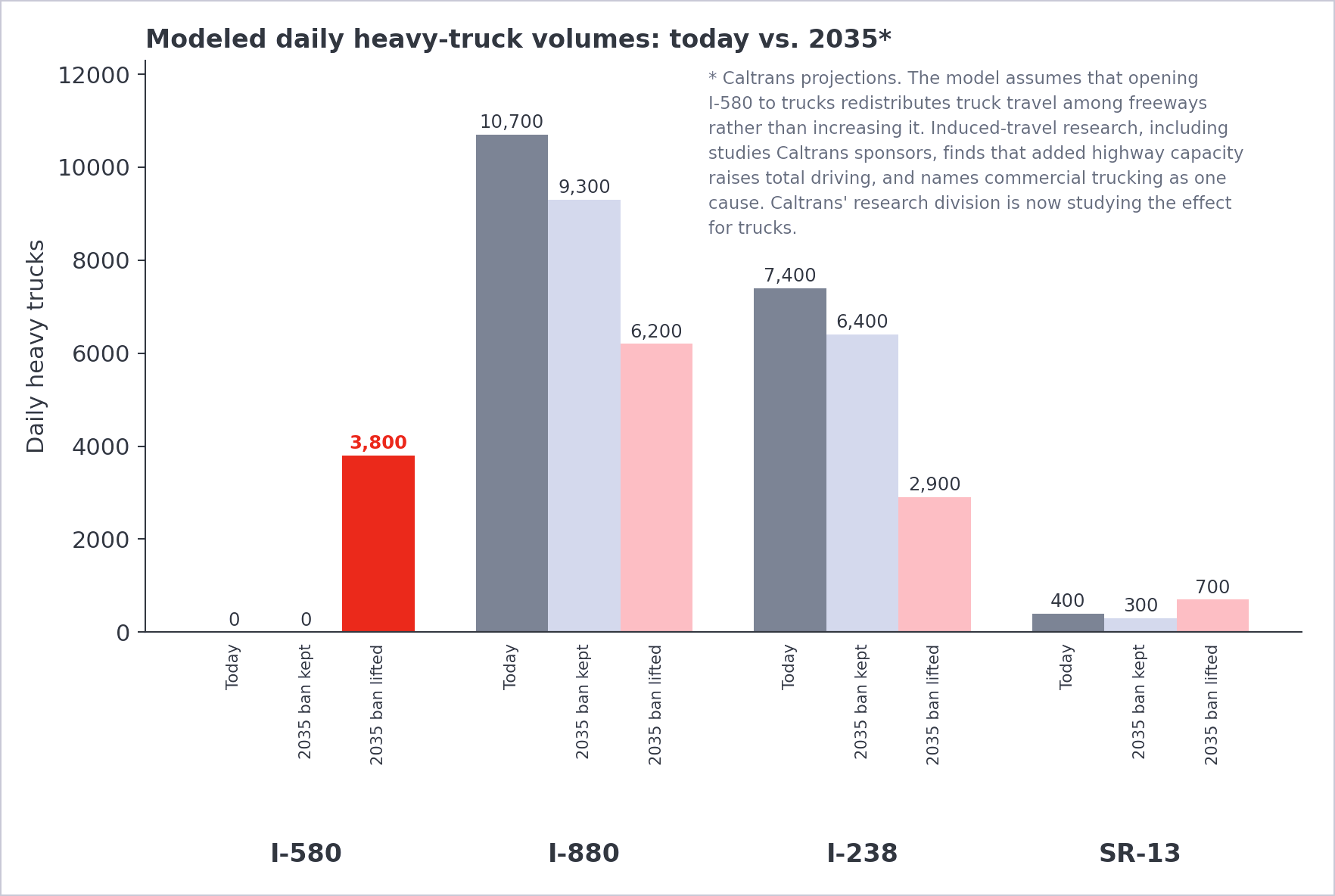
I-238’s daily volume would fall from 6,400 to 2,900. Trucks would also appear on State Route 13, rising from about 300 to 700 a day.
Notably, the one-third drop on I-880 is measured against the study’s 2035 forecast, not against today. Perhaps more notably, Caltrans’ model expects I-880 and I-238 to carry fewer trucks in 2035 than they do now, even if the ban stays in place.
Other considerations and counterpoints
Here we offer several counterpoints, largely without further rebuttal, for readers to consider:
The I-880 burden is real and severe. Caltrans deputy district director Cameron Oakes has said West Oakland’s diesel exposure ranks in the state’s 95th percentile.29 The data backs this up. A monitoring study by the Environmental Defense Fund and partners found black carbon about 80% higher, nitrogen dioxide 60% higher, and nitric oxide more than double in neighborhoods along I-880 compared to those along I-580. Two community-rooted plans, from West Oakland in 2019 and East Oakland in 2021, recommended examining the ban.
The latest push to lift the ban was publicized by East Oakland students, not the industry. Sixth graders at Life Academy of Health and Bioscience, studying air pollution, learned about the ban and asked why trucks ran through their neighborhood. At the time, then-Oakland council member Rebecca Kaplan called the ban “a troubling example of environmental racism.” Alameda County supervisor Nate Miley, who backed the ban in 1999, changed course and said he would now work to phase it out, but not at the expense of air quality along I-580.
Community voices have conflicting views of the issue. Communities for a Better Environment told the committee the ban has been good for East Oakland and projected a doubling of truck traffic there without it. But the West Oakland Environmental Indicators Project has long documented how the ban concentrates trucks at West Oakland’s doorstep.
The study says it will not recommend an outcome, and Caltrans cannot lift the ban itself. The project team told the committee in June 2026 that the study has no predetermined conclusion and is funded by a state planning grant, not trucking industry interests.30
Some trucks really would move off I-880 in the near term, and banning heavy trucks is uncommon. The Federal Highway Administration counts nine such bans nationwide. Seven exist because of structural limits. I-580’s ban is the only one that was adopted primarily to address residents’ concerns. Reasonable people can assert that an interstate closed to interstate commerce is an exception that needs justifying.
The clean truck fleet turnover finding cuts both ways. If cleaner trucks deliver most of the health benefit regardless, the cost of lifting the ban is also likely smaller than today’s numbers suggest.
Additional considerations and caveats
These are preliminary Caltrans memos, not the final report. Figures may change in the revised draft due this fall.
The traffic model has a stated margin of error of about 1%.
The air quality model assumes older diesel trucks will be mostly replaced by new diesels rather than electric trucks, which could change in the future as the electric vehicle industry evolves.
Our analysis of trucking industry spending on lobbying and political contributions examined only itemized state contributions filed electronically since 2001. It is a floor, not a ceiling, and we have not yet searched Oakland and Alameda County local filings.
Correlation is not causation. Nothing in the record proves that industry pressure, rather than the health concerns and community plans Caltrans cites, prompted the study. Both are documented, and the record supports “both/and,” not a single motive.
What the record supports
The fairness case for lifting the I-580 ban, as measured by Caltrans’ own study, delivers little projected health improvement to the corridor that bears the heaviest burden — within the study’s 1% margin of error — while markedly increasing total diesel pollution across the study area.
Caltrans and its consultants use a traffic model that assumes zero growth in heavy truck traffic, contrary to research about traffic growth in general — and its own research program says the extent of traffic growth is unmeasured for trucks.
The trucking industry that has sought to lift the ban since 1967 now sits on the study’s advisory committee and has donated to several of the legislators who would referee any potential repeal.
None of that proves the study wrong, and none of it lessens the burden on I-880’s residents. But based on Caltrans’ current data, the two decisive claims for lifting the ban — that health outcomes along I-880 would meaningfully improve, and that the study area as a whole would not get more pollution — appear to be unsupported.
Oakland Report is an experiment in a new form of media: reasoned, data-driven analysis focused on verifiable evidence. We present the facts and let the reader decide. If you value our work, please donate.
California Department of Transportation. "I-580 Truck Access Study fact sheet." Caltrans, July 8, 2026. https://dot.ca.gov/-/media/dot-media/district-4/documents/d4-580-truck-access-study/i-580-tas-fact-sheet-2026-07-08-a11y.pdf
Caltrans’ statement that large trucks have been banned from Interstate 580 “since 1951” is imprecise. I-580 did not exist in 1951. The major highway at that time was MacArthur Boulevard — a surface street that ran through the hills. The city of Oakland barred heavy trucks from MacArthur Boulevard in 1951. When Interstate 580 was constructed in the 1960s over roughly the same corridor, the Oakland city council passed a new ordinance extending the prohibition to the freeway itself, which Caltrans and the federal Bureau of Public Roads approved as a condition of construction. That 1963 ordinance carried an expiration date of January 1, 1968, which led to the 1967 renewal fight when CTA's Richard Zeller argued for lifting the ban.
Sun, Molly et al. "On-road emissions and community health burden assessment.” Fehr & Peers, I-580 Truck Access Study preliminary air quality assessment memorandum. Jul. 8, 2026. https://apps.fehrandpeers.com/i580_equity_explorer/memos/air-quality-memo.pdf
Jackson, Ella. "Caltrans I-580 truck ban study finds modest health gains, major traffic shifts." KQED, Aug. 7, 2026. https://www.kqed.org/news/12094076/caltrans-i-580-truck-ban-study-finds-modest-health-gains-major-traffic-shifts
Fermoso, Jose. “Trailer trucks on I-580? Lifting the ban would open the floodgates, study finds.” The Oaklandside, Aug. 18, 2026. https://oaklandside.org/2026/08/18/trailer-trucks-on-i-580-lifting-the-ban-would-open-the-floodgates-on-it-study-finds/
California Department of Transportation contributors. “Special route restriction history - Route 580.” Caltrans webpage, accessed Aug. 30, 2026. https://dot.ca.gov/programs/traffic-operations/legal-truck-access/restrict-route-580
Pimentel, Benjamin. “Ban on trucks made permanent on I-580.” San Francisco Chronicle (via SFGate), Aug. 11, 2000. https://www.sfgate.com/bayarea/article/ban-on-trucks-made-permanent-on-i-580-2744485.php
California Legislature. “Assembly Bill 500, as amended in Assembly Jul. 15, 1999 (Corbett).” Official California Legislative Information, Jul. 15, 1999. https://www.leginfo.ca.gov/pub/99-00/bill/asm/ab_0451-0500/ab_500_bill_19990715_amended_asm.html
California Vehicle Code §35655.5. “Limit changes on state highways (added by Stats. 2000, ch. 194, AB 500).” California Legislative Information. https://leginfo.legislature.ca.gov/faces/codes_displaySection.xhtml?sectionNum=35655.5&lawCode=VEH
Chasty, Tina. "Charles Bernard Ramorino Obituary." Redwood City Pulse, Mar. 18, 2023. https://www.rwcpulse.com/obituary/2023/03/18/charles-bernard-ramorino/
Transport Topics contributors. "Former ATA chairman Charles Ramorino dies." Transport Topics, Apr. 13, 2023. https://www.ttnews.com/articles/ata-charles-ramorino-dies
CalMatters contributors. “California Trucking Association.” CalMatters Digital Democracy, accessed Aug. 30, 2026. https://calmatters.digitaldemocracy.org/organizations/-3072
Klivans, Laura. “Trucks are banned on Oakland’s I-580. These sixth graders wondered why.” KQED (Bay Curious), Jul. 1, 2021 (updated Sept. 10, 2024). https://www.kqed.org/news/11879641/trucks-are-banned-on-oaklands-i-580-these-sixth-graders-wondered-why
Fehr & Peers contributors. “I-580 Truck Access Study, Technical and Advisory Committee Meeting #1 — notes.” Jul. 29, 2025. https://docs.oaklandreport.news/i580-tas-tac-meeting-1-notes-20250729.pdf
Fehr & Peers contributors. "I-580 Truck Access Study, Technical and Advisory Committee Meeting #3 — notes." Feb. 17, 2026. https://docs.oaklandreport.news/i580-tas-tac-meeting-3-notes-20260217.pdf
California Department of Transportation. “Interstate 580 Truck Access Study.” Caltrans project page, accessed Aug. 30, 2026. https://dot.ca.gov/caltrans-near-me/district-4/d4-projects/d4-580-truck-access-study
California Department of Transportation. "Interstate 580 Truck Access Study — overview, purpose and goals." Caltrans public engagement portal, accessed Aug. 30, 2026. https://engage.dot.ca.gov/m23110
Picado-Aguilar, Gaby et al. “I-580 Truck Access Study – traffic analysis and operations technical memorandum.” Fehr & Peers, I-580 Truck Access Study — preliminary traffic assessment memorandum, Jul. 8, 2026. https://apps.fehrandpeers.com/i580_equity_explorer/memos/traffic-memo.pdf
California Secretary of State. “Cal-Access PowerSearch export: itemized contributions, contributor ‘Concerned Americans for Responsible Government’ (CARGO PAC, committee #760458), all recipients, all dates.” Exported Aug. 30, 2026. https://docs.oaklandreport.news/calaccess-independent-expenditures-20260830.csv
California Secretary of State. “Cal-Access independent expenditure dataset, filtered to Truck Unit PAC (committee #1238126).” Exported Aug. 30, 2026. http://docs.oaklandreport.news/cargo-pac-contributions-calaccess-powersearch-20260830.csv; http://docs.oaklandreport.news/cta-independent-expenditures-filtered-20260830.csv
ProPublica contributors. “California Trucking Association (EIN 95-1028780), Form 990 filings FY2022–FY2025.” ProPublica Nonprofit Explorer, accessed Aug. 30, 2026. https://projects.propublica.org/nonprofits/organizations/951028780
Shimoda Government Strategies contributors. "Reports of lobbying firm (Form 625), Q1 2025 to Q2 2026, and lobbying firm registration statement (Form 601)." California Secretary of State, Cal-Access, filing IDs 3039986, 3039990, 3068386, 3090764, 3114409, 3147087, 3179540. https://docs.oaklandreport.news/shimoda-form-625-20250331.pdf; https://docs.oaklandreport.news/shimoda-form-625-20250630.pdf; https://docs.oaklandreport.news/shimoda-form-625-20250930.pdf; https://docs.oaklandreport.news/shimoda-form-625-20251231.pdf; https://docs.oaklandreport.news/shimoda-form-625-20260331.pdf; https://docs.oaklandreport.news/shimoda-form-625-20260630.pdf; https://docs.oaklandreport.news/shimoda-form-601-2025-26.pdf
Silvani, Wendy. “Packed meetings, strong opinions on lifting the I-580 truck ban.” Piedmont Exedra, Jun. 2026. https://piedmontexedra.com/2026/06/packed-meetings-strong-opinions-on-lifting-the-i-580-truck-ban
Handy, Susan. "Increasing highway capacity unlikely to relieve traffic congestion." University of California, Davis, National Center for Sustainable Transportation, Oct. 2015. https://escholarship.org/uc/item/58x8436d
Duranton, Gilles and Matthew A. Turner. “The fundamental law of road congestion: evidence from US cities.” American Economic Review, Oct. 2011. https://www.aeaweb.org/articles?id=10.1257/aer.101.6.2616
National Center for Sustainable Transportation contributors. “California induced travel calculator.” University of California, Davis, National Center for Sustainable Transportation, accessed Aug. 30, 2026. https://travelcalculator.ncst.ucdavis.edu/about.html
Volker, Jamey. “Roadway capacity and induced travel.” California Air Resources Board, Apr. 2025. https://ww2.arb.ca.gov/sites/default/files/2025-04/Roadway%20Capacity%20and%20Induced%20Travel%20-%202025%20Policy%20Brief.pdf
California Department of Transportation contributors. “Updated estimates of induced travel demand from roadway expansions.” Caltrans, Division of Research, Innovation and System Information, Oct. 2025. https://dot.ca.gov/-/media/dot-media/programs/research-innovation-system-information/documents/research-notes/task4491-rns-10-2025-a11y.pdf
Fermoso, Jose. “A decades-old truck ban on I-580 could end. Oakland residents are giving Caltrans an earful.” The Oaklandside, May 29, 2026. https://oaklandside.org/2026/05/29/truck-ban-i-580-could-end-oakland-caltrans-opposition/
Fehr & Peers contributors. "I-580 Truck Access Study, Technical and Advisory Committee Meeting #4 — meeting summary." Jun. 1, 2026. https://docs.oaklandreport.news/i580-tas-tac-meeting-4-summary-20260601.pdf
880 is a commercial corridor mostly populated by businesses whereas 580 is a residential and park corridor mostly populated by Parks and homes. Why would we move trucks from a commercial corridor to a residential corridor? It makes absolutely no sense whatsoever.
This article is built around the impact of diesel pollution, especially along the I-880 corridor. Spreading the pollution, and probably increased pollution, to other neighborhoods is not a viable solution.
A far better long-term solution, and consistent with State goals, would be electrification of the trucking fleets. Cal Trucking Association has deep ties to old school carbon powered vehicles and represents only equity big businesses, not Californians nor especially Oakland. For Cal-Trans, Oakland in an impediment to get through, not a city to be served equally.