


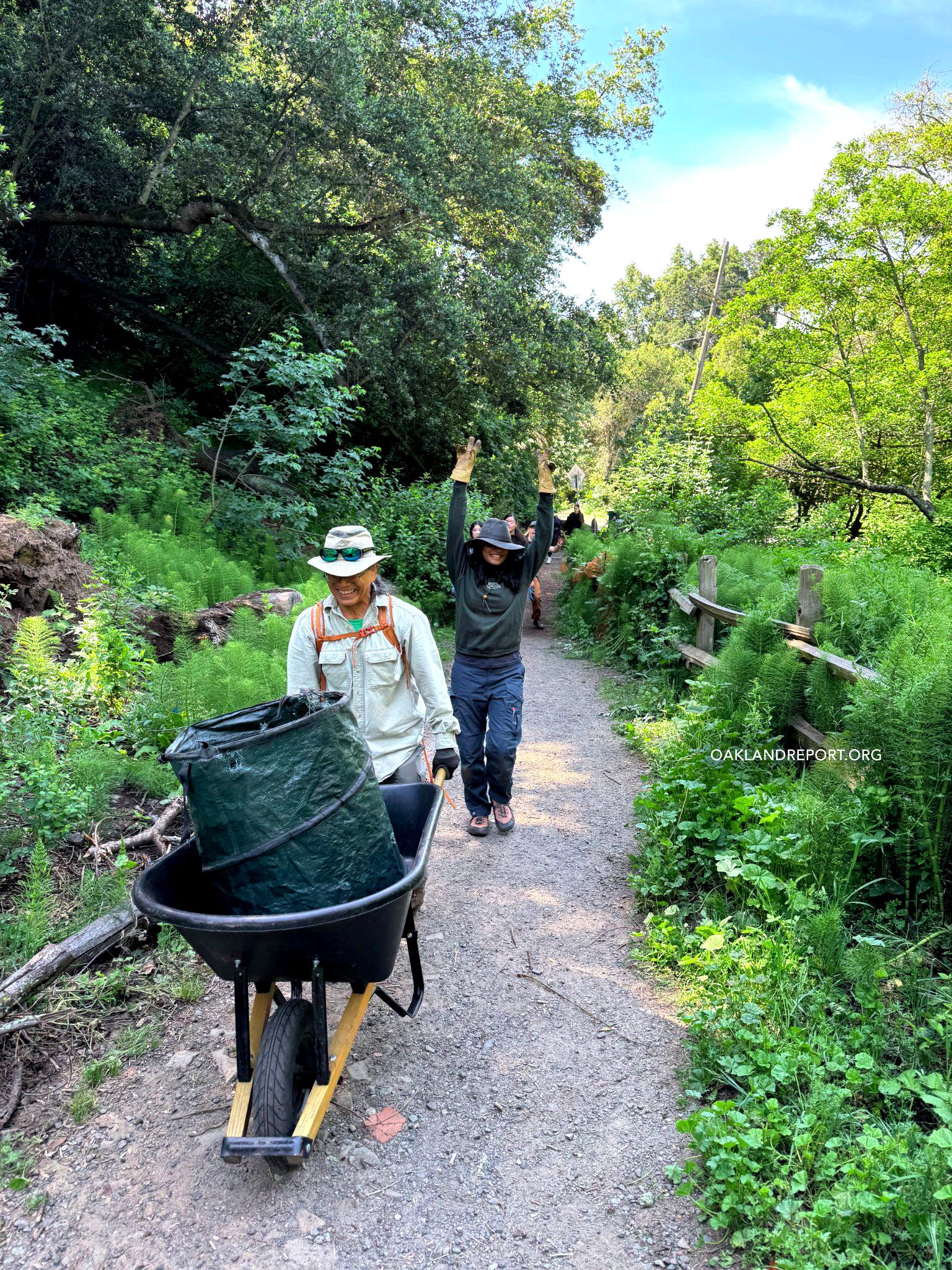
Oakland Report is taking a closer look at the people who step up when the city’s capabilities falter. In this installment, we review Friends of Sausal Creek’s 30 years of service — and the city’s unfulfilled parks tax promise that was meant to make its work less necessary.
Planted 30 years ago: community stewardship helped bring Sausal Creek back to life
Sausal Creek’s ebbing and flowing waters cascade down the Oakland hills and through Dimond Canyon, where vegetation and greenery spring forth in verdant patches. Trees tower overhead, sunlight fracturing through their branching arms and bright leaves. The roots of mature oaks and maples planted decades ago, and California poppies and asters planted just last season, reach deeper into the soil with each passing year, thriving in this watershed’s ecosystem.
In a few places, bare patches of dirt, seemingly empty and devoid of life, are harbingers of new life to come — awaiting the seeds carefully planted there to sprout and flourish.
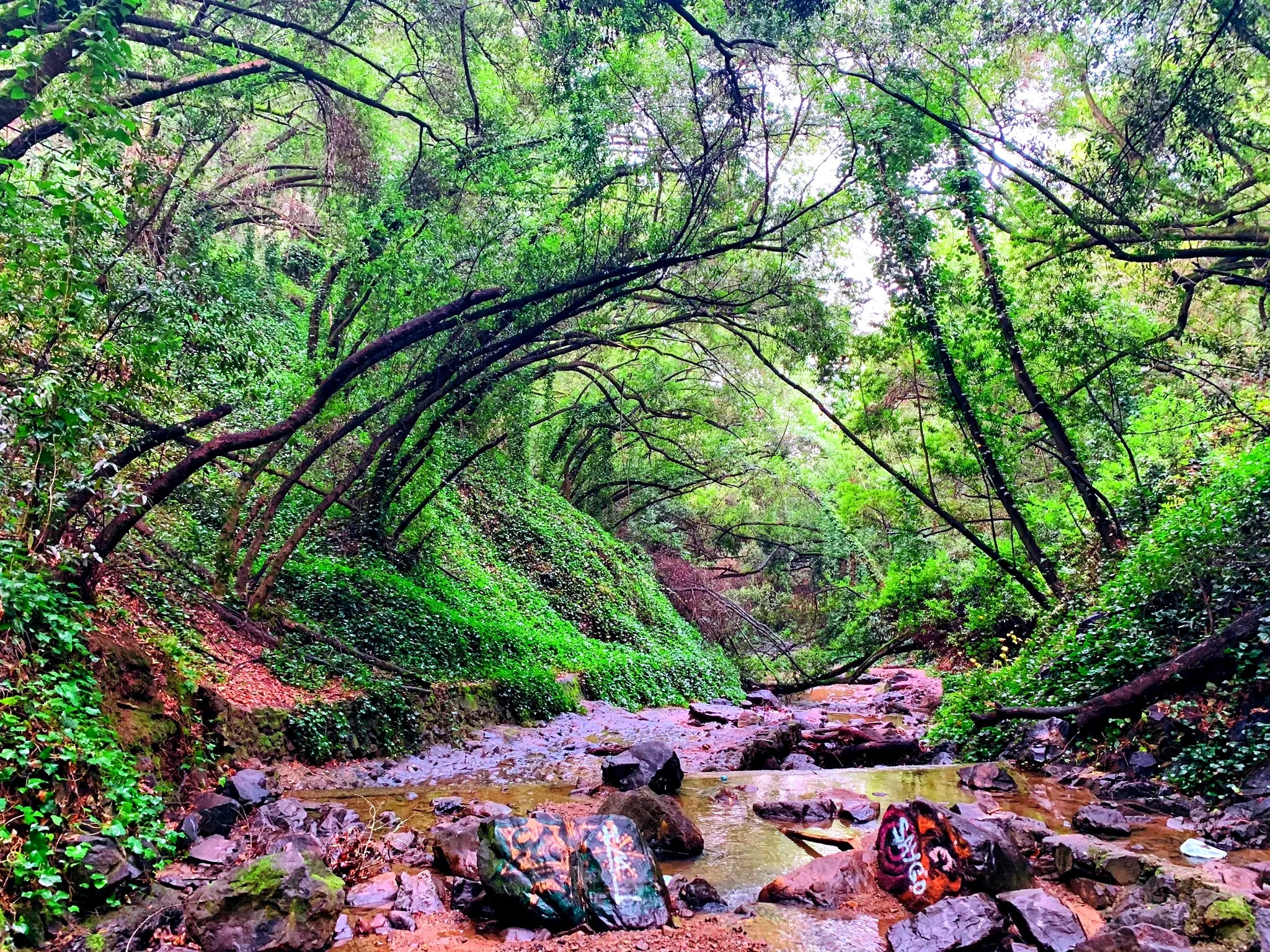
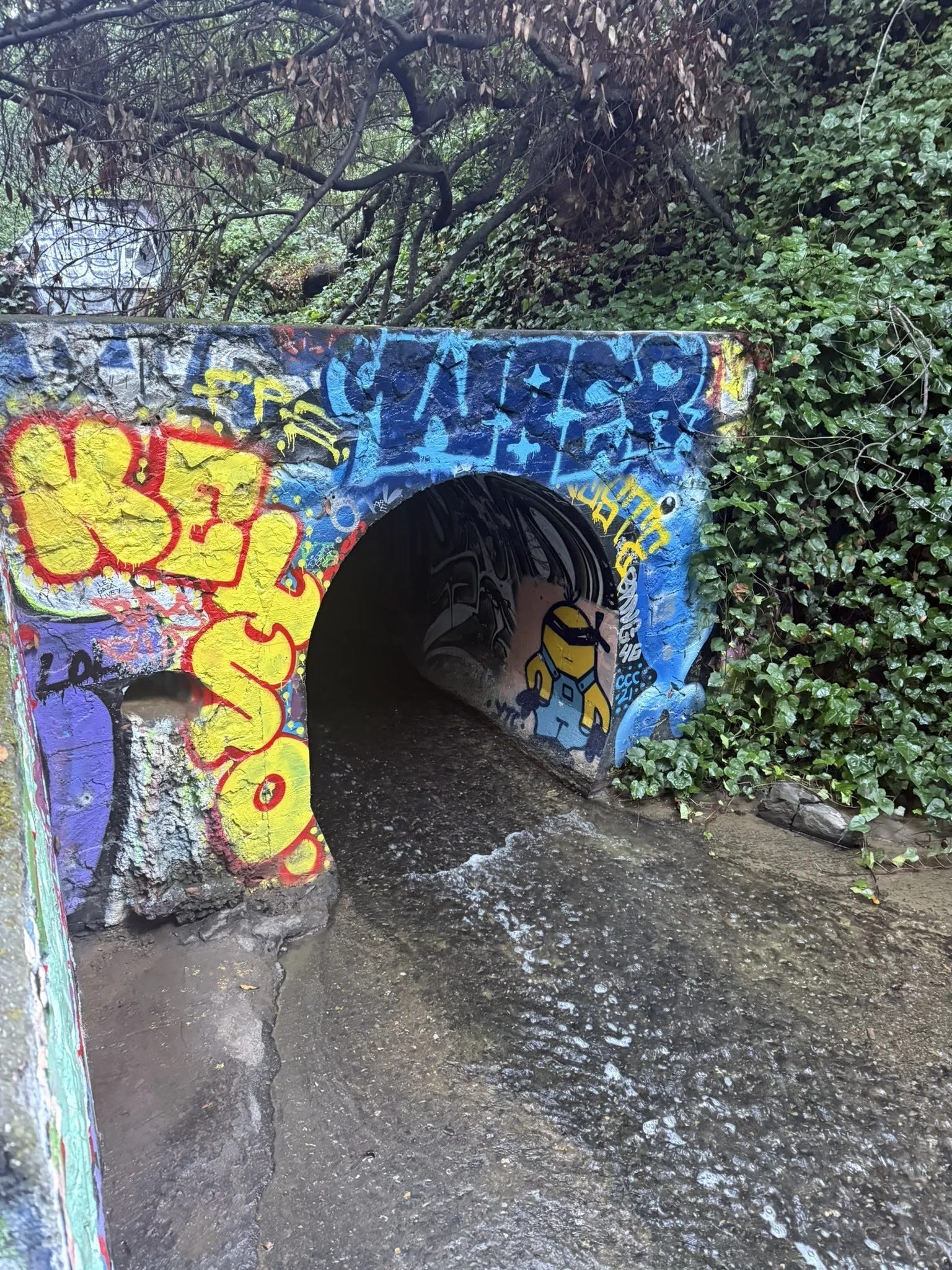
Oakland’s Sausal Creek didn’t always look this way. Back in 1996, the area was overgrown with invasive species, crowding the ecosystem and sapping nutrients from the native flora. The creek was dried up in certain places, and some of its twists and turns undermined and conflicted with the urban infrastructure built to channel it in days gone by.
That year, 1996, Michael Thilgen got a message from his friend Kathy Kramer, then executive director of the Aquatic Outreach Institute, about starting a watershed awareness group.1
Around 40 people came to the first meeting. “It was clear that there was a common sense of commitment,” Thilgen said.
With support from the City of Oakland, the Aquatic Outreach Institute and the county flood control district, the group adopted a neglected stretch of the creek.2 Friends of Sausal Creek (FOSC) incorporated as a nonprofit in 2001.
Today, thirty years since that fateful meeting, that seed has grown to become a mature and remarkably successful community-based organization.
Subscribe to Oakland Report (it’s free).
Key facts
FOSC stewards about 140 acres of the 2,600-acre watershed. It reported over 2,800 volunteer visits and over 8,000 service hours across more than 20 restoration sites in fiscal year 2025.3
The city promised voters the Measure Q parcel tax (2020) would add to, not replace, existing park maintenance spending. The city had collected $82.5 million from the tax by June 2023, but left $22 million unspent — and it used a loophole in the measure’s language to evade its promised minimum spending on parks maintenance in June 2023, June 2025 and June 2026.45678
FOSC’s revenue roughly doubled between fiscal years 2022 and 2025. It reported $533,000 in fiscal year 2025 revenue; most of its revenue that year (57 percent) came from government grants — mostly from the state, not the city.9
Community-led restoration, one patch at a time
FOSC’s main work is removing species deemed invasive, replanting species deemed native, and promoting biodiverse zones to support wildlife and help keep the creek’s water clean.
FOSC has monitored the creek’s water quality monthly for more than 15 years, adding to our understanding of the watershed’s health over time.
Sausal Creek is home to a population of genetically wild rainbow trout.10
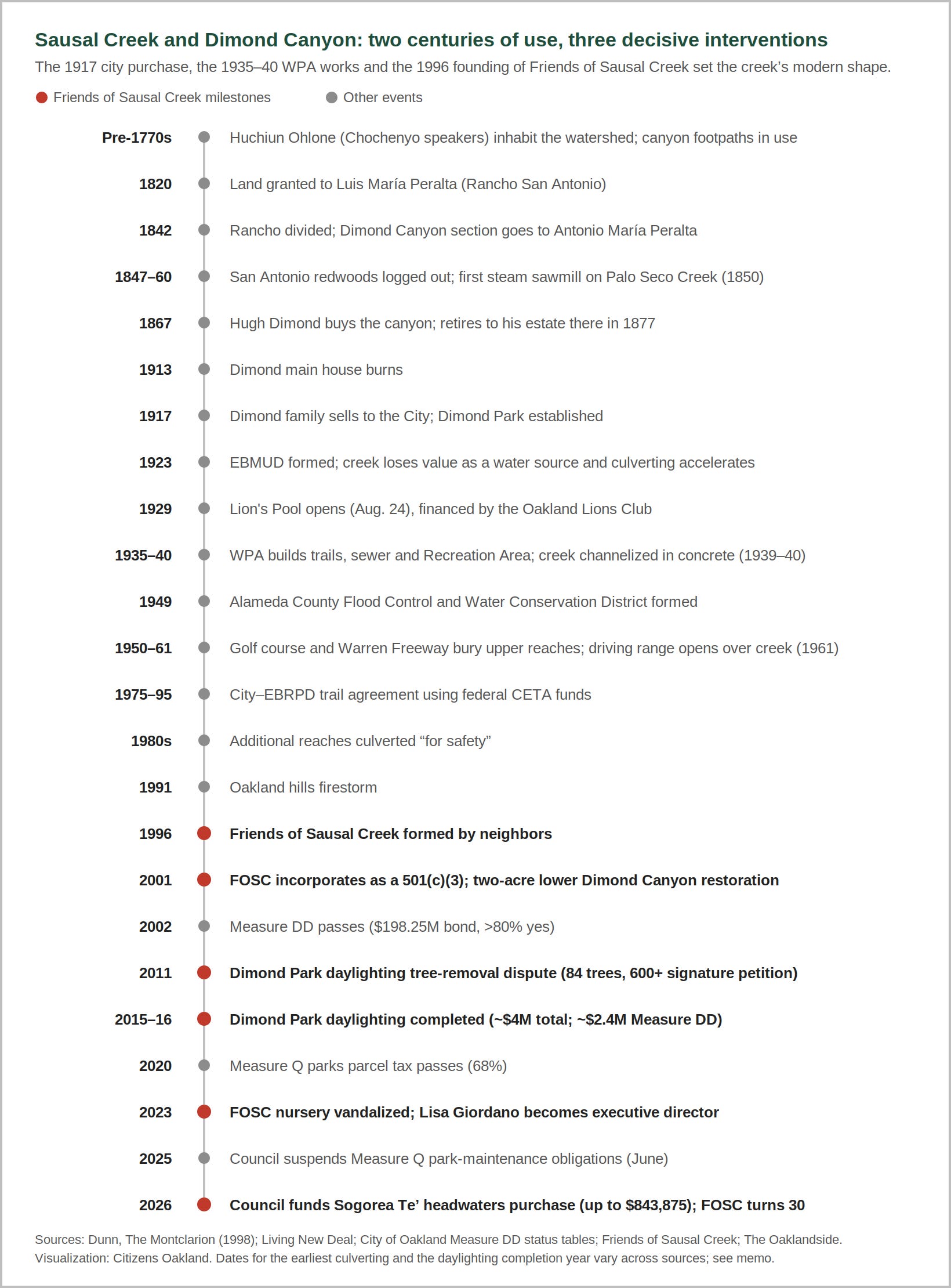
FOSC’s work is undetaken in the context (and some would say the aftermath) of a long history of channeling and urbanization. Nearly half of Sausal Creek now flows through culverts beneath city streets as it makes its way from the Oakland hills to San Francisco Bay.
In the creek’s modern era, larger-scale improvement projects along the watershed typically have been carried out with government partners.
In 2001, with the city, FOSC restored two acres of riparian habitat in lower Dimond Canyon, reporting a nearly 50 percent gain in native species cover.11
In 2016, FOSC, the city and the county flood control district removed more than 250 feet of culvert and concrete spillway below Wellington Street in Dimond Park, widening a buried section of the creek and replanting it with native flora. Roughly $4 million of work, about $2.4 million of it, came from the 2002 Measure DD tax.12
The current flagship effort is a three-year restoration of 50 acres of redwood forest at the headwaters, building on earlier work at Fern Ravine in Joaquin Miller Park.
Major projects like these “mostly are initiated by the city,” Thilgen said; FOSC “comes along toward the end to do the planting.”
FOSC executive director Nicki Alexander said about 57 percent of FOSC’s 2025 revenue came from government grants, chiefly state agencies; 32 percent from individual donors; and the rest from program services such as corporate work days, foundations and other sources.
The city’s capacity “ebbs and flows, and definitely has waned recently”
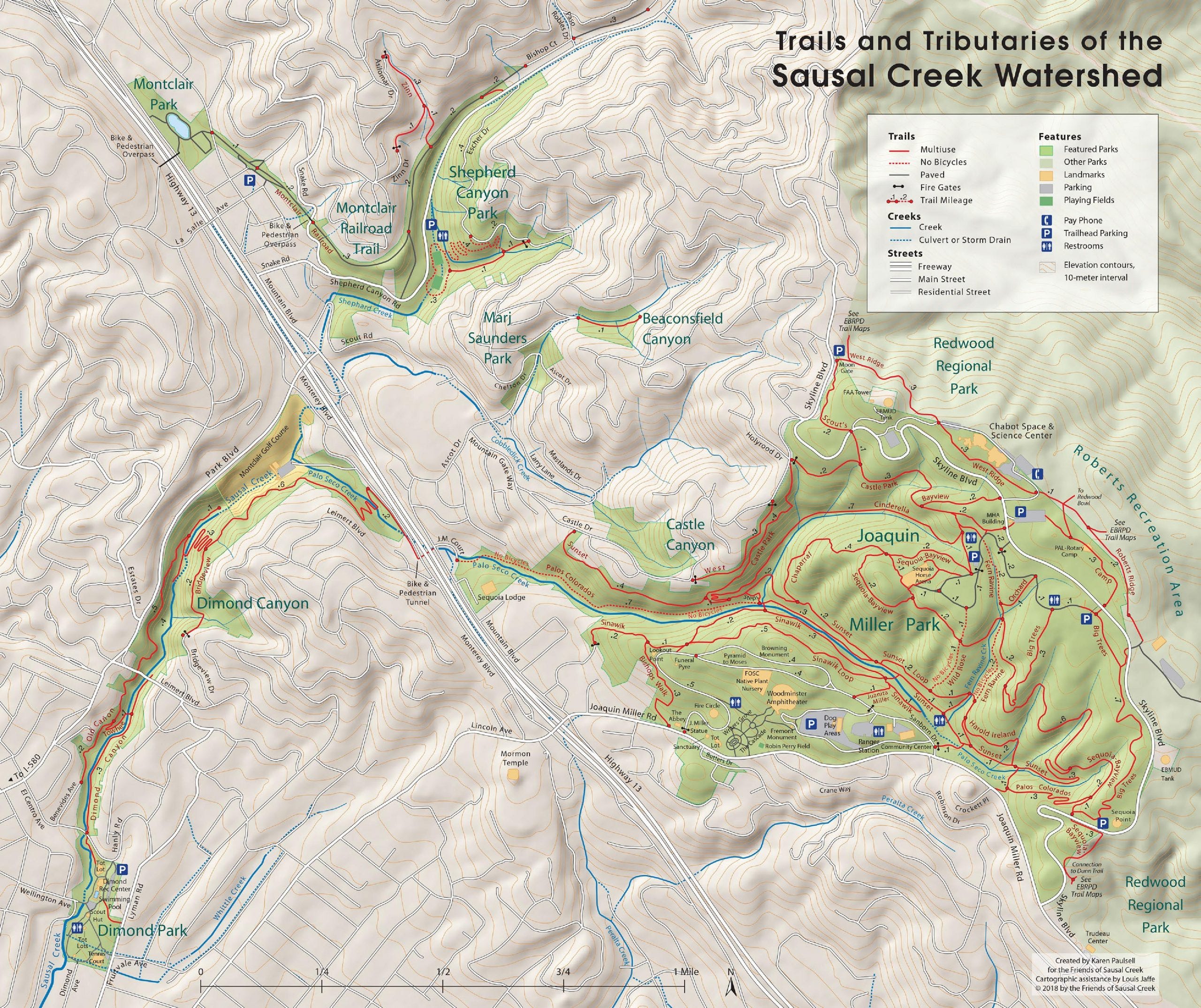
Because the city of Oakland owns the parkland, FOSC operates under Oakland’s Adopt-A-Spot program. FOSC restoration manager Noé Romo Loera said the nonprofit has adopted about 140 acres of the roughly 2,500-acre watershed; much of the rest is private yards. City tree crews remove large non-native trees pro bono, and the city writes letters of support for grants.
“The reality is that the city of Oakland is strapped for both finance and time,” Loera said, and the permitting system treats a native planting project with the same scrutiny as a developer building a house beside the creek. When split-rail fencing FOSC installed in Joaquin Miller Park was cut down twice, there was no one to call: the city has no park rangers, Loera said, and the police have “bigger fish to fry.”
“Historically, the city has been very supportive because we are filling in those gaps,” communications and outreach coordinator Eliana Thompson said. “But their capacity ebbs and flows, and definitely has waned recently.”
Share this story with someone you know.
The parks tax voters approved — and the promise city council keeps suspending
Oakland voters were told the gap would close. On March 3, 2020, 68 percent of them approved Measure Q, a 20-year parcel tax of $148 per single-family parcel, with 64 percent of revenue dedicated to parks maintenance and recreation.13
Measure Q requires the city to maintain its existing park maintenance spending so the new money will add to, not replace, existing funds. However, the measure included a loophole that enables the city council to suspend that requirement by declaring “extreme fiscal necessity” — which it has done, repeatedly.
In June 2023, June 2025 and again in June 2026, the Council declared a state of “extreme fiscal necessity” and temporarily suspended Measure Q’s park maintenance requirement in its budget. Staff estimated that fully honoring the measure’s maintenance-of-effort and minimum funding requirements would cost about $33.9 million in FY2026–27.14
The city continued to collect the Measure Q tax money from Oaklanders while evading some of the requirements voters were promised: a total of $82.5 million by June 30, 2023. By December 2023, a performance audit had found the funds were spent within the measure’s rules but underspent, leaving a $22 million balance, and that the city had set no baseline for park conditions.
(Note: The city faced a roughly $265 million two-year deficit in 2025.15 The 2023 city auditor’s report found the money was spent within the rules, including the invocation of the “extreme fiscal necessity” loophole — concluding that the Measure Q funds were underspent, but not misspent.16)
The tax is still collected, but the floor beneath it — the city’s own parks spending — is no longer guaranteed. It is reasonable to consider the possibility that some of what FOSC’s volunteers do in Dimond Canyon is work the city would otherwise be obligated to fund.
The situation in another park across town provides an instructive contrast. Tyrone Carney Park, a half-acre park in East Oakland’s Sobrante Park neighborhood, was fenced off in 2002 after drug activity and shootings. The park remained closed for 24 years. It finally reopened to fanfare on Aug. 29, 2026, after a $3.5 million renovation.1718
The city of Oakland appears to lack the capability to fully support its own parks for various reasons — including its budget, priorities, and policy decisions that span decades.
The practical result is that the city left one park offline and inaccessible for a generation, while another one flourished largely through help from an organized group of Oaklanders who took it on themselves to weed, plant, and help improve it.19
It does not escape notice that the neighborhoods around both these parks are subject to the same city taxes, including property taxes, parcel taxes, and fees.
Working within the urban fabric: why outreach matters
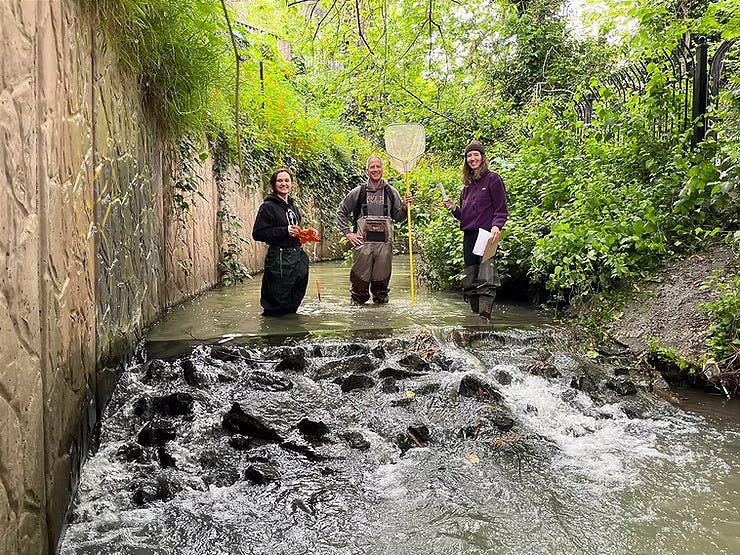
Public reception to park improvements and other changes is not always positive. Large-scale removal of species deemed invasive can be jarring, Loera and Alexander said: a green hillside is not necessarily a healthy one. In 2011, the creek daylighting project’s planned removal of 84 trees in Dimond Park, including 22 redwoods, drew a petition of more than 600 signatures objecting to the tree removals, and much of the backlash landed on FOSC.20
Hence the outreach: free monthly walk-and-talks, signage at planting areas and a K-12 program that reached nearly 2,000 students in fiscal 2025. Thilgen described homeowners along the creek now planting native flora in their own gardens, reducing the potential for seeds from flora deemed invasive to wash into the watershed and encroach again. The engagement appears to be compounding: Alexander said that in 2018, 25 or 30 people at a work day was a big win; last year’s Creek to Bay Day event drew 200.
The increased level of engagement with the community, according to Thompson, helps propel FOSC’s efforts forward and allows the organization to grow and be successful. Thompson and Thilgen credit FOSC’s increasing volunteer base to the visible signs that Sausal Creek, Dimond Canyon, and Dimond Park are well-loved and taken care of. This reinforces a positive cycle, as the improving health and beauty of these spaces, which are largely due to the efforts of the community, seems to then directly increase community participation.
Even if the change may be difficult and uncomfortable, Alexander said it’s ultimately not for FOSC or any one individual, but the community that it brings together.
Making a difference, little by little
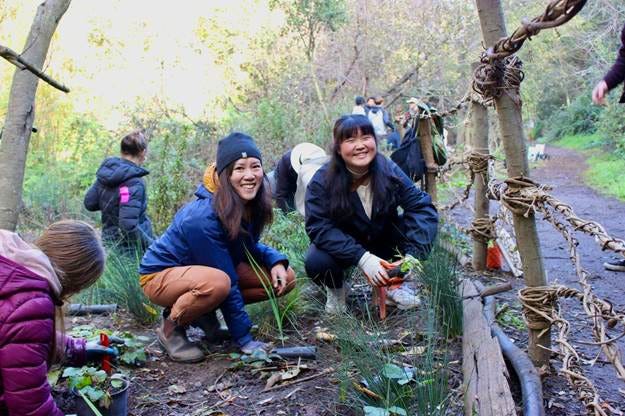
The ongoing restoration of Sausal Creek is not the work of one day, one year, or even 30 years. There will always be another weed that resprouts, another blockage to dislodge, more invasive ivy to untangle. Thompson said that isn’t something to be cynical about.
“The city might not have the capacity, but you do have a couple hours to spend every week. And a lot of restoration work is weeding, and anybody can do that. And, the best part is, you’ll begin to see a really wonderful community form.”
— Eliana Thompson, communications and outreach coordinator, Friends of Sausal Creek
That the city’s capabilities have ebbed is a fact; that the volunteers are still flowing in after 30 years is a fact too. Whether the parks tax ever delivers the baseline city capabilities and park maintenance voters were promised is a question for the city’s next budget cycle.
ABOUT THE AUTHOR
Phoebe Vo is a second-year student at the University of California, Berkeley, where she is a reporter for the Daily Californian. She has five years of experience in journalism and plans to continue covering issues important to the Bay Area. Phoebe first joined Oakland Report through its inaugural summer internship program, and is continuing as a freelance contributor.

DONATE TO SUPPORT OUR WORK
Oakland Report is an experiment in a new form of media. We are an independent 501(c)(3) nonprofit organization, not affiliated with any public agency, labor union, corporate interest or political campaign. If you value our services, please donate. Your donation in any amount helps us continue to produce stories like this one.
Friends of Sausal Creek contributors. “Newsletter.” FOSC, July 2021. https://www.sausalcreek.org/_files/ugd/fbe72e_22e9514183714550b1674ee14bb57260.pdf
Hackett, Kelly. "How Sausal Creek made Oakland." Bay Nature, May 17, 2012. https://baynature.org/article/how-sausal-creek-made-oakland/
Friends of Sausal Creek contributors. “Annual report, fiscal year 2025.” FOSC webpage, accessed Oct. 8, 2026. https://www.sausalcreek.org/annual-report-2025
Houston, Michael. "Audit of Measure Q, the 2020 Oakland Parks and Recreation Preservation, Litter Reduction, and Homelessness Support Act." Office of the Oakland City Auditor press release, Dec. 21, 2023. https://www.oaklandauditor.com/wp-content/uploads/2023/12/20231220_Measure-Q_Press-Release.pdf
Houston, Michael et al. “2023 annual report.” Office of the Oakland City Auditor, Mar. 21, 2024. https://www.oaklandauditor.com/wp-content/uploads/2024/03/20240321_City-Auditors-2023-Annual-Report-1.pdf
City of Oakland. “Declaring a state of extreme fiscal necessity, to provide for the temporary suspension of the ‘Park Maintenance’ maintenance of effort requirements, pursuant to Section 4 of “The 2020 Oakland Parks and Recreation Preservation, Litter Reduction, and Homelessness Support Act (Measure Q).” Oakland city council meeting, Jun. 26, 2023, agenda item #S5, section 5. https://oakland.legistar.com/LegislationDetail.aspx?ID=6268967&GUID=FA1D6D2E-49BF-4AA8-BD34-22FA9BD6DCF0&Options=&Search=
City of Oakland. "FY 2025-27 execution of maintenance of effort waivers and use of one-time revenues to balance the biennial budget." Oakland city council meeting, agenda item #6, Jun. 11, 2025. https://oakland.legistar.com/LegislationDetail.aspx?ID=7427859&GUID=239B1EFE-FD5F-4B7D-BDE0-BCF736D516C2&Options=&Search=
City of Oakland. "FY 2026-27 execution of maintenance of effort waivers and use of one-time revenues to balance the biennial budget." Oakland city council meeting, agenda item #5, Jun. 12, 2026. https://oakland.legistar.com/LegislationDetail.aspx?ID=8057097&GUID=27F5385B-B445-4E76-9D0C-5203E69AD044&Options=&Search=
Philanthropy.org contributors. “Friends of Sausal Creek.” Philanthropy.org 990 Scout webpage, accessed Oct. 8, 2026. https://philanthropy.org/990/report/912147216/friends-of-sausal-creek
Berlin, Kate. “Rainbow trout of Sausal Creek.” Friends of Sausal Creek, Jul. 15, 2023, updated May 14, 2024. https://www.sausalcreek.org/post/rainbowtroutofsausalcreek
Friends of Sausal Creek contributors. “Dimond Park.” FOSC webpage, accessed Oct. 8, 2026. https://www.sausalcreek.org/restoration/dimond-park
City of Oakland. "Measure DD project status summary." Revised Feb. 16, 2023. https://www.oaklandca.gov/files/assets/city/v/1/public-meetings/measure-dd-community-coalition/2023/measure-dd-project-update-table-march-2023.pdf
SPUR contributors. “Oakland Measure Q: parks and homelessness tax.” SPUR Voter Guide, March 2020. https://www.spur.org/voter-guide/2020-03/oak-measure-q-parks-and-homelessness-tax
Citizens Oakland contributors. “Broken promises: Oakland parcel taxes.” Citizens Oakland, May 7, 2026. https://www.citizensoakland.org/broken-promises
Orenstein, Natalie. “’Nobody’s happy budget’: Oakland adopts $4.2 billion spending plan.” The Oaklandside, Jun. 11, 2025. https://oaklandside.org/2025/06/11/oakland-budget-adopted-illegal-dumping-police/
Op. cit. Houston, Michael (note 5).
City of Oakland. “Tyrone Carney Park renovation.” City of Oakland webpage, accessed Oct. 8, 2026. https://www.oaklandca.gov/Government/Oakland-Improvement-Projects/Tyrone-Carney-Park-Renovation
Quintana, Amanda. “Park reopens in Oakland after being shut down because of drugs, violence.” KTVU, Aug. 31, 2026. https://www.ktvu.com/news/tyrone-carney-park-reopens-oakland-after-being-shut-down-because-drugs-violence
FOSC’s growth is substantially from public money (57 percent of its 2025 revenue), so the financial resources it uses to help improve Dimond Park, Dimond Canyon, and the Sausal Creek watershed are largely derived from state funding routed through a nonprofit. Tyrone Carney Park’s closure in 2002 was a public safety decision.
Hawkes, Alison. “Trees snag Oakland’s first major creek daylighting project.” Bay Nature, Dec. 20, 2012. https://baynature.org/2012/12/20/conservation/stewardship/trees-snag-oaklands-first-major-creek-daylighting-project/
Thank you so much for this great article! I volunteer with Friends of Concordia Park and it is incredibly frustrating how little the city cares for its parks. We’ve been trying to get the lights at the park repaired/replaced for at least two years. The park is still dark.
Excellent article. Yes, FoSC has done so much work in Dimond Canyon and further up in Joaquin Miller Park. There are also volunteer groups working in a similar capacity in JMP. Recently Friends of JMP, which includes volunteers associated with Woodminster Theatre, restored the beautiful cascade water feature. Volunteers spent hundreds of hours and donated money to repair the water falls and gardens. The gem was built in the 1930s by the WPA and had fallen into disrepair. Seeing it functional is something to behold and it is pathetic that the City let if fall apart to begin with