


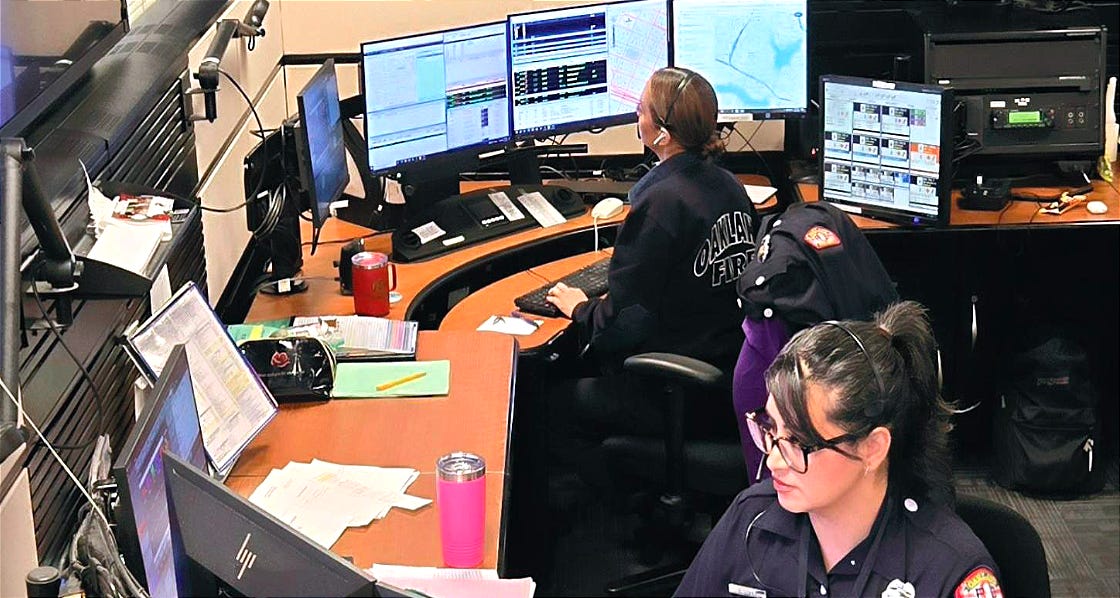
Editors’ note: This article was originally posted by Oakland resident Rajni Mandal on her Substack page. Oakland Report is republishing it with Mandal’s permission for our readers to consider. Subscribe to Rajni Mandal’s Public Safety Updates to receive her articles directly.
Oakland’s 911 call-answering times have improved significantly over the past two years.
In July, 79% of calls were answered within 15 seconds,1 compared with 54% in 2024.2 While this remains below the state standard of 90%, the improvements follow efforts to address longstanding dispatcher staffing and hiring problems, along with upgrades to Oakland’s computer-aided dispatch (CAD) system.3
However, answering a 911 call is only one part of emergency response. Once a call is received, dispatchers must identify and send the appropriate police, fire, or medical resources to the scene.
Oakland’s CAD system includes an automatic resource location (ARL) feature that uses global positioning system (GPS) data from emergency vehicles to determine their real-time locations — and allows the system to recommend the closest appropriate resource.
The Oakland fire department has now been using this capability since 2025,4 while the same feature remains unavailable for routine police dispatch.
Implementing GPS-based dispatch at the fire department
The fire department began testing ARL in March 2025,5 and moved to an extended field evaluation in June 2025.6
Instead of relying solely on traditional “first-due” districts, which generally determine which fire company responds based on geographic boundaries, ARL allows the CAD system to recommend units based on their actual locations at the time of a call.
The fire department identified faster response times, improved situational awareness and enhanced safety as benefits of the change.
The transition required adjustments to routing, mapping and unit recommendations, with the department using feedback from firefighters to refine the system.7
By October, the fire department reported that ARL had been “significantly improved,” although additional geolocation and routing updates were still underway.
Whether those changes have translated into faster response times has not yet been independently evaluated. The city auditor is currently reviewing fire department response times from call intake through turnout and arrival on scene.8
While ARL was designed to improve emergency response, the collection and retention of employee location data also raised questions about how that information could be used outside of dispatch, particularly in employee investigations.
Video clip 1. Zac Unger, then-president of the Oakland firefighters union, addresses the city’s privacy advisory commission on July 9, 2024. (Video source: City of Oakland. Clips assembled by Oakland Report.)
GPS and employee investigations
Oakland’s use of GPS to track city employees is not new.
As far back as 2004, ABC News reported that Oakland’s public works department was using GPS devices on road crews and street-sweeping vehicles as part of an effort to improve worker accountability — allowing supervisors to monitor vehicle locations, stops and employee activity.9
The Oakland fire department’s policy takes a more limited approach.10
When the proposed fire department policy came before the city’s privacy advisory commission on July 9, 2024, then-Oakland firefighters union president Zac Unger raised concerns about GPS data being used in employee investigations:11
“They could use the [GPS] data for discipline. But then if I tried to find out... think of an example where they are disciplining our members for not being on the freeway when they were supposed to be on the freeway, but if you look at the data five minutes beforehand, it’s because the freeway was closed and they made a detour.”
— Zac Unger, July 9, 202412
The final version of the policy allows ARL data to “aid in internal investigations where ARL data is relevant to the allegations.” It also provides employees access to relevant ARL data after an investigation is complete.
The policy identifies emergency response as ARL’s primary purpose, using real-time location data to help dispatch appropriate resources and meet response-time objectives. Its use is limited to specific authorized purposes, rather than general employee monitoring.
The privacy advisory commission recommended extending the proposed retention period from 30 days to one year to ensure GPS records would remain available for potential investigations. The final policy incorporates that change, with longer retention allowed for an internal investigation or when otherwise legally required.
What this means for Oakland police department
The Oakland police department proposed using the same CAD-based ARL capability as the fire department, but its policy has still not been finalized.
The police department policy version presented at the same July 9, 2024 privacy advisory commission meeting described uses such as identifying vehicles near an incident, improving deployment, and coordinating responses to critical incidents.13
Unlike the fire department’s policy, the proposed police department policy does not expressly identify internal misconduct investigations as an authorized use.
City officials and the city auditor have attributed the delay in finalizing the police department policy to the required labor meet-and-confer process.14 Importantly, this does not involve only the Oakland Police Officers’ Association (OPOA). Because the ARL policy applies to both sworn and civilian OPD employees, the city must meet and confer with two employee unions: OPOA and Service Employees International Union Local 1021 (SEIU).
The specific issues being negotiated with either union are not part of the public record, making it difficult to determine exactly what has prevented the parties from reaching an agreement.
A possible path forward for the police department GPS policy
The fire department’s policy may provide a model for resolving the not-yet finalized police department policy. It allows GPS data to be used when relevant to an internal investigation, while limiting the technology to specific authorized uses rather than routine employee monitoring.
With both OPOA and SEIU currently negotiating new contracts with the city,15 there may be an opportunity to reach a similar agreement for the police department policy.
The city auditor’s forthcoming review should also provide a clearer picture of whether ARL has improved fire department response times.
With Oakland continuing to struggle with emergency response times, making full use of technology already available through the City’s dispatch system should remain a priority.
Don’t miss a beat. Subscribe to author Rajni Mandal’s Public Safety Updates.
Oakland Police Department contributors. "911 answering speed: Vesta call count by wait time range, January-July 2026." City of Oakland, accessed Aug. 22, 2026. https://www.oaklandca.gov/files/assets/city/v/1/police/documents/opd-data/911-answering-speed/911-answering-speed-2026-jan-july.pdf
Houston, Michael et al. "Inadequate 9-1-1 staffing and outdated beat boundaries lead to slow and inequitable police emergency response times." Office of the Oakland City Auditor, Oct. 8, 2025. https://www.oaklandauditor.com/wp-content/uploads/2025/10/20251008_9-1-1-Emergency-Response-Times-Audit.pdf
Madrigal, Alexis. "911 … please hold." KQED, Jun. 2, 2026. https://www.kqed.org/forum/2010101913992/911-please-hold
Oakland Fire Department contributors. "Oakland Fire Department 2025 annual report." City of Oakland, accessed Aug. 22, 2026. https://heyzine.com/flip-book/4fe26a4134.html#page/22
Nichelini, Matthew. "Automated Resource Locator (ARL) system testing — Monday, March 17, 1900-2300." Oakland Fire Department, Mar. 13, 2025; accessed via City of Oakland NextRequest portal on Aug. 22, 2026. https://oaklandca.nextrequest.com/documents/69005753
Nichelini, Matthew. "Extended field testing of Automatic Resource Locator (ARL)." Oakland Fire Department, May 22, 2025; accessed via City of Oakland NextRequest portal on Aug. 22, 2026. https://oaklandca.nextrequest.com/documents/69005754
Nichelini, Matthew. "ARL update." Oakland Fire Department, Mar. 6, 2026; accessed via City of Oakland NextRequest portal on Aug. 22, 2026. https://oaklandca.nextrequest.com/documents/69005756
Houston, Michael et al. "Annual audit work plan, fiscal year 2025-26." Office of the Oakland City Auditor, Aug. 28, 2025. https://www.oaklandauditor.com/wp-content/uploads/2025/08/20250828_Annual-Audit-Work-Plan-for-FY-2025-26.pdf
Muller, Judy. "City monitors employees With GPS." ABC News, Feb. 4, 2004. https://abcnews.com/WNT/story?id=129219
Oakland Fire Department contributors. "Automatic Resource Locator policy (final)." Oakland Fire Department, July 3, 2024; accessed via City of Oakland NextRequest portal on Aug. 22, 2026. https://oaklandca.nextrequest.com/documents/69095651
City of Oakland. "Surveillance technology ordinance – OFD – automatic resource locator (CAD GPS) impact statement and proposed use policy.” Privacy advisory commission special meeting, agenda item #4, Jul. 9, 2024. https://www.oaklandca.gov/files/assets/city/v/1/public-meetings/privacy-advisory-commission/2024/privacy-advisory-commission-agenda-packet-for-7-9-2024.pdf
City of Oakland. “Privacy advisory commission meeting video.” July 9, 2024. https://oakland.granicus.com/player/clip/6245
City of Oakland. “Surveillance technology ordinance – OPD – automatic resource locator (CAD GPS) impact statement and proposed use policy.” Privacy advisory commission special meeting, agenda item #5, Jul. 9, 2024. https://www.oaklandca.gov/files/assets/city/v/1/public-meetings/privacy-advisory-commission/2024/privacy-advisory-commission-agenda-packet-for-7-9-2024.pdf
City of Oakland. "Receive an informational report from the City Auditor on the performance audit of Oakland's police emergency response times." Council public safety committee meeting, agenda item #5, Nov. 18, 2025. https://oakland.legistar.com/MeetingDetail.aspx?ID=1347647&GUID=DBDD31BD-CE81-4CE3-934A-926112348F61
City of Oakland. "Special closed session Agenda, Thursday, August 6, 2026." Office of the City Attorney, Aug. 4, 2026, item 1(a) (SEIU Local 1021) and item 1(f) (Oakland Police Officers Association). https://www.oaklandca.gov/files/assets/city/v/1/city-clerk/documents/closed-session-agendas/2026.08.04-special-closed-session-agenda-for-thursday-august-6-2026.pdf
Thank you Rajni - a story that is both hopeful about progress made (and progress that could be made), yet realistic and sober about the work we still need to do. I hope we see proven technological solutions increasingly implemented (with thoughtful policies that address risks).
It's a necessity given the deeply understaffed public safety departments, police in particular (>300 staff short of the 877 recommended). Many may not realize it, but fire is also understaffed (though less severely than police), relying heavily on overtime to patch the gap.
Unfortunately, the Oakland Report’s publication of this SubStack piece doesn’t include any information about its author, who she is, or most importantly why and how the O.R. determined she was credible and that her reporting was supported by the actual facts. Does the O.R. just republish anyone whose statements/reports it deems interesting?