


Editors’ note: This article was originally posted by Oakland resident Rajni Mandal on her Substack page. Oakland Report is republishing it with Mandal’s permission for our readers to consider. Subscribe to Rajni Mandal’s Public Safety Updates to receive her articles directly.
Oakland is repairing far more potholes than it did just a few years ago
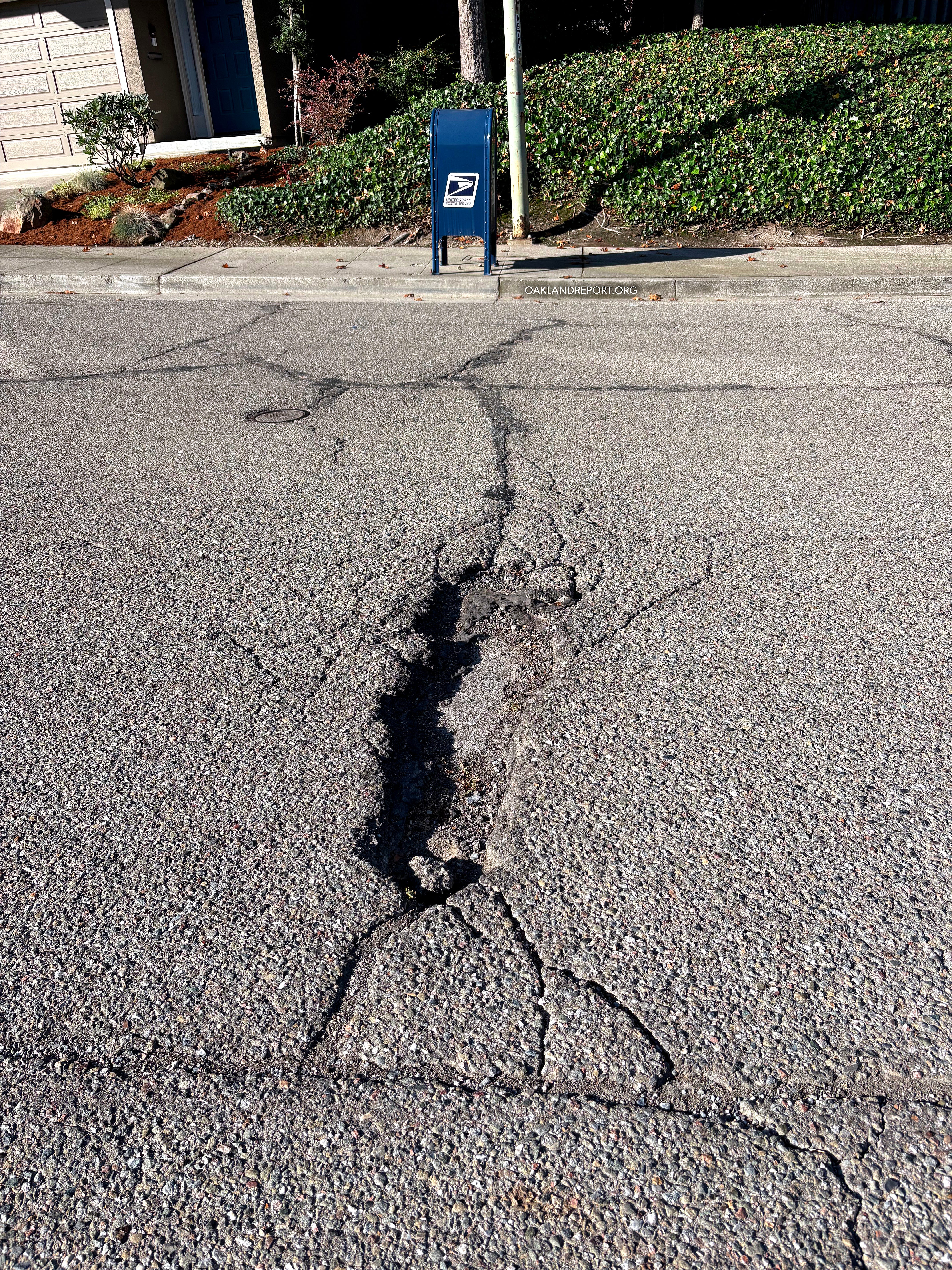
Potholes are a perennial problem for most Oaklanders. Oakland’s 311 system (Oak311) provides residents with a way to report potholes, creating a documented service request that the city can use to track and address the problem.1
City records show that Oakland is repairing far more potholes than it did just a few years ago.2 The city reported repairing more than 58,000 potholes in fiscal year 2024–25, more than three times as many as in 2021–22.
Yet that increase in repair activity isn’t readily apparent in the 311 data. Oak311 receives thousands of pothole requests each year, and many requests remain open — including requests filed over a year ago.
So how can we reconcile what the city reports repairing with what residents see in 311, and what does that mean for a resident reporting a pothole?
Subscribe to Oakland Report (it’s free).
Oakland is fixing far more potholes than 311 requests
City reports show a significant increase in annual pothole repairs beginning in 2022, from about 14,000 a year to more than 58,000. Oak311 requests are a fraction of that figure, generally ranging from about 2,100 to more than 4,000 per year.
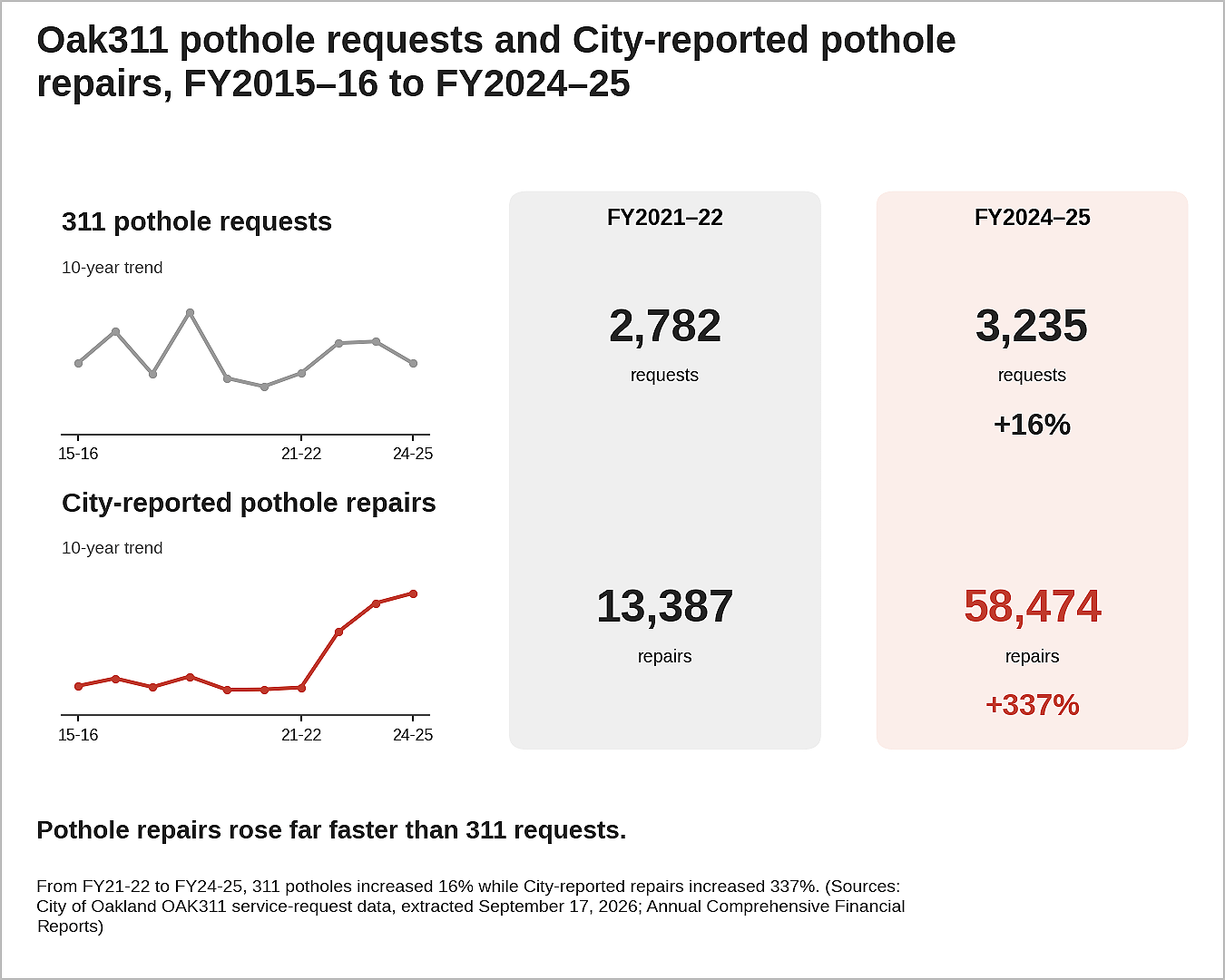
The figures are not equivalent. A resident can report a location with multiple potholes, crews can repair additional defects they encounter while working in an area, and one deteriorating section of roadway may need repeated patches over time.
Oakland has become substantially faster at closing pothole requests. Among “closed” requests filed in 2024, the median time to closure was 319 days. For requests filed in 2025, it fell to 68 days, and for requests filed through July 2026 it was 28 days.
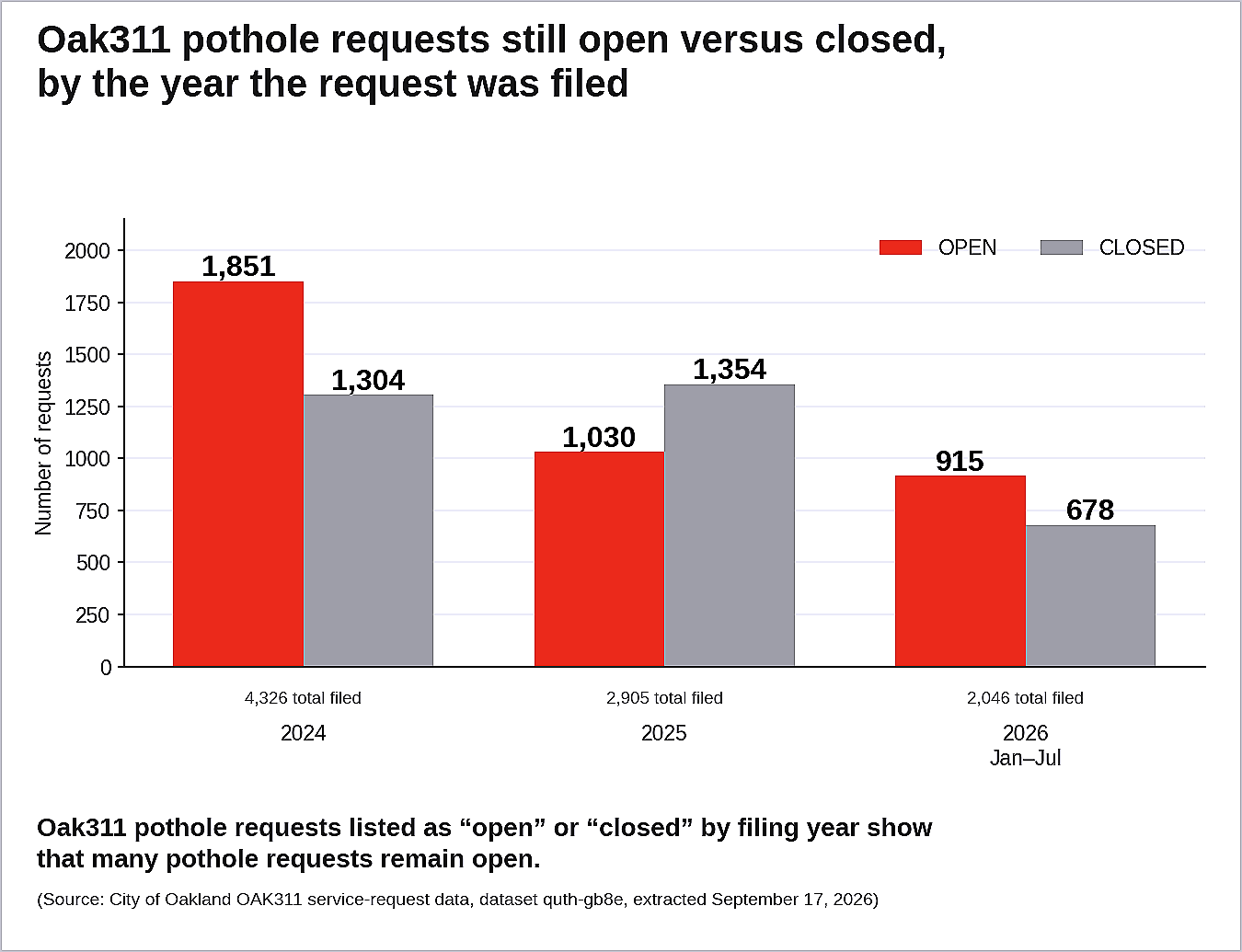
But faster closure times among closed requests tell only part of the story. Of the 2,905 pothole requests filed in 2025, 1,354 were listed as “closed,” while another 1,030 remained “open.”
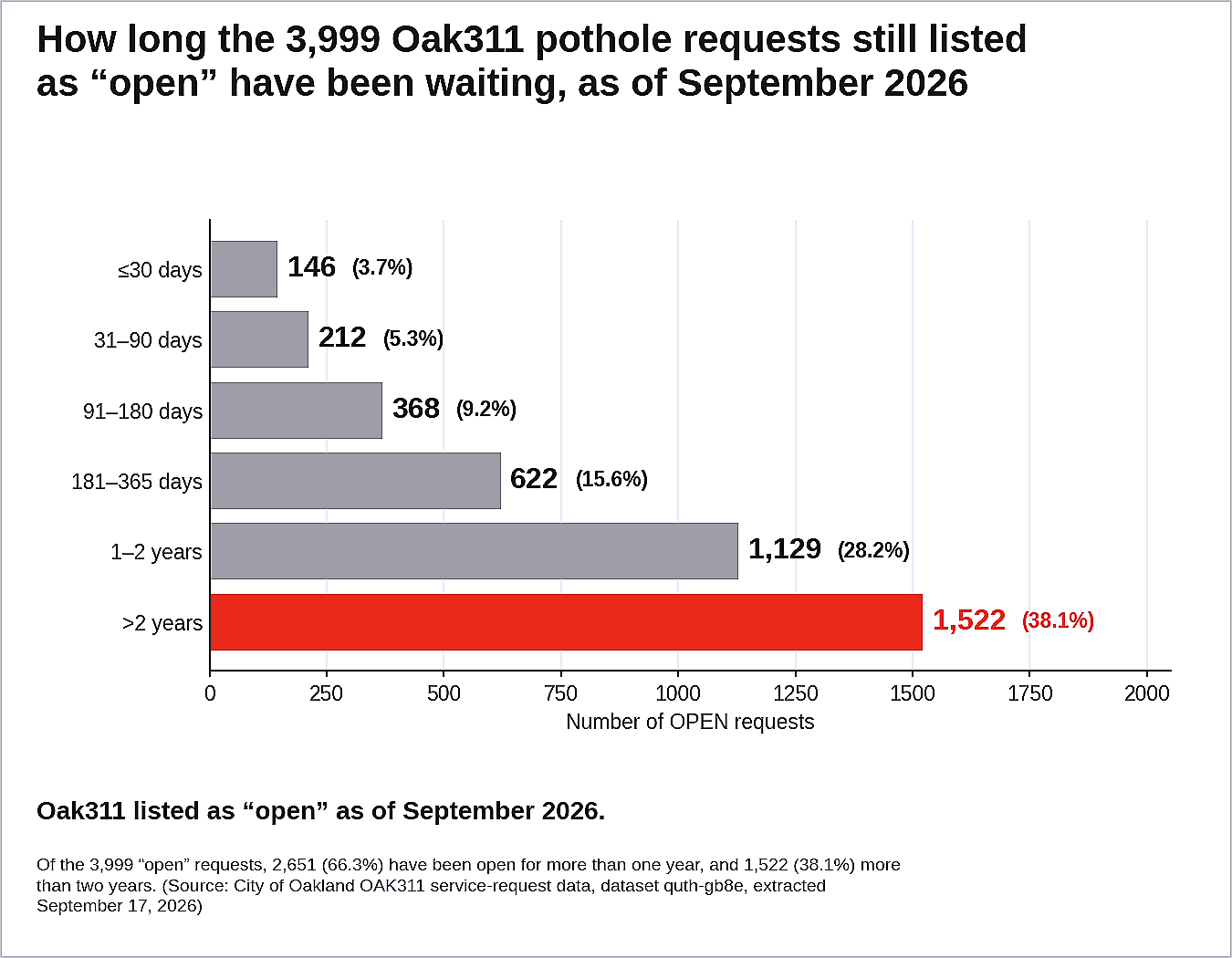
A source of ambiguity is what an “open” request actually means. During a 2024 meeting of the Bicycle and Pedestrian Advisory Commission (BPAC) Policy and Legislative Committee, participants discussed how some pothole requests remained open even after a location had been patched, while other requests were reportedly closed even though the physical problem remained.34 They also discussed locations that had received repeated patches because the underlying pavement continued to fail. This discussion illustrated how for a resident looking at an old 311 request, those distinctions are largely invisible.
Sometimes the pothole is only part of the problem
Oakland’s poor pavement condition is not a new finding. A 2024 analysis by the San Francisco Chronicle put Oakland’s pavement condition in the “at risk” category,5 while a more recent Oakland pavement assessment placed the city’s overall network at “fair.”6
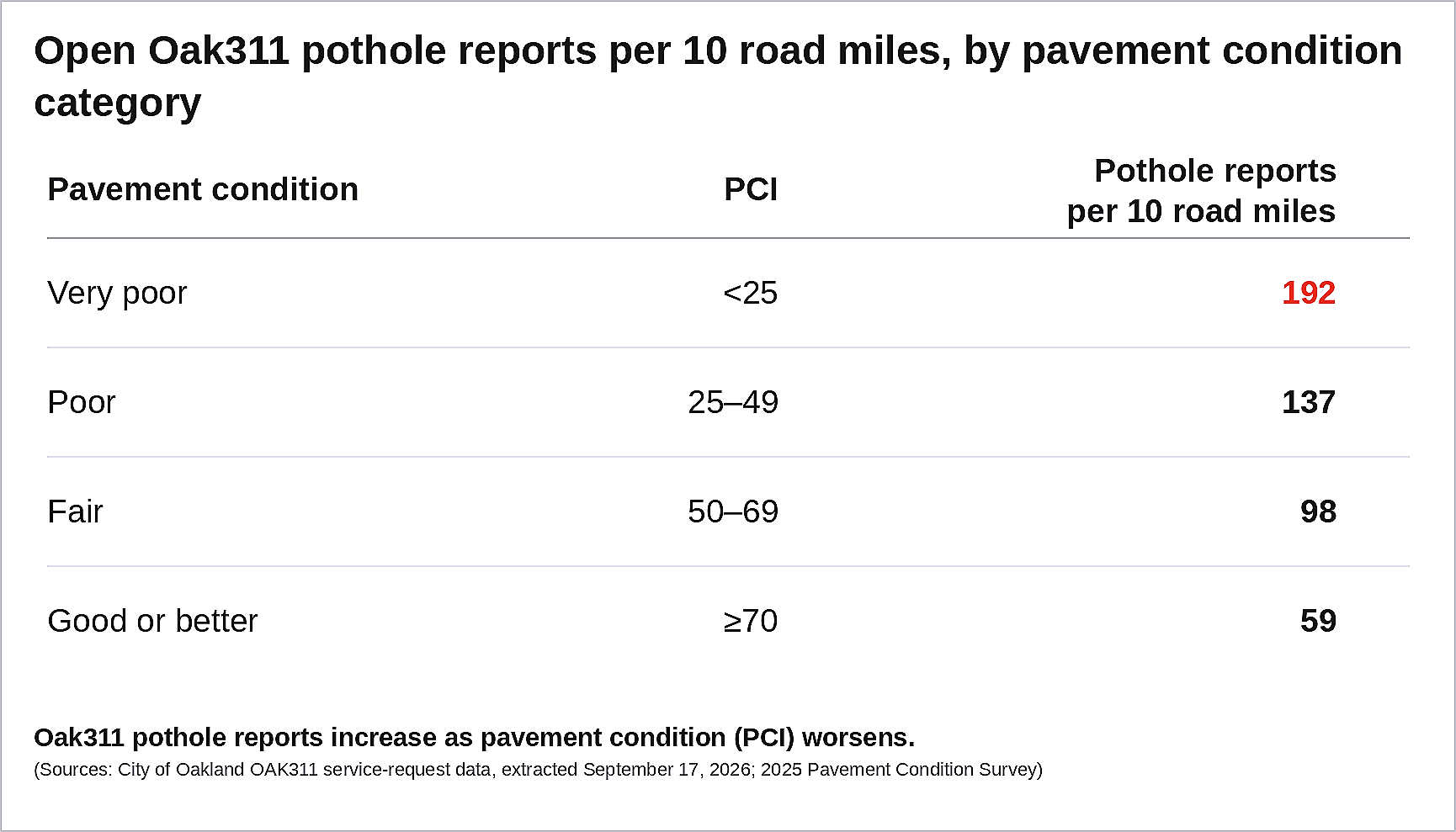
The 311 data shows a strong relationship between pavement condition and pothole reports. Residents reported potholes at more than three times the rate per road mile on Oakland’s most deteriorated streets compared with streets in relatively good condition.

But at some point, patching individual potholes is no longer enough. An OakDOT paving official explained the distinction during an October 2024 BPAC meeting:7
“You do get to a point where there’s enough potholes in a particular location that you’re just like, it’s like with your tooth, right? You’re not going to do two fillings where there’s one cavity. You go, okay, I gotta replace this whole thing now… I think the challenge is prioritizing that citywide.”
— Sara Fine, OakDOT paving program manager, Oct. 17, 2024
Oakland operates a separate multi-year paving program for that larger work. The current Five-Year Paving Plan covers 2022–27, with streets prioritized based on factors including pavement condition, equity and safety.8
Open pothole requests filed from January 2024 through April 2026 were compared with Oakland’s pavement data and paving projects. Of the 3,199 requests matched to a PCI score, two-thirds were on streets with a PCI below 50. More than 4 in 10 of those were on streets with no identified paving project.

This does not mean those potholes have not been patched; an open 311 status does not reliably indicate whether maintenance occurred. But paving does not provide an explanation for many of the open requests on Oakland’s deteriorated streets.
For residents, however, that distinction is largely invisible. A 311 request does not tell them whether the city considers the problem an isolated pothole, a symptom of broader pavement failure, or what treatment is planned.
How are potholes prioritized?
Oakland has previously recognized that some potholes present greater risks than others.
In 2022, the city released a memo titled, “Managing Exposure to Lawsuits Involving Bicyclists and Potholes” which discussed strategies such as prioritizing pothole service requests on bikeways and working with bicycle advocates to identify particularly important hazards.9
Bike East Bay developed an agreement with Oakland in 2012, where they track and elevate 10 high-risk potholes a month for repair.1011 They report that more than 1,000 potholes have been filled through this partnership.
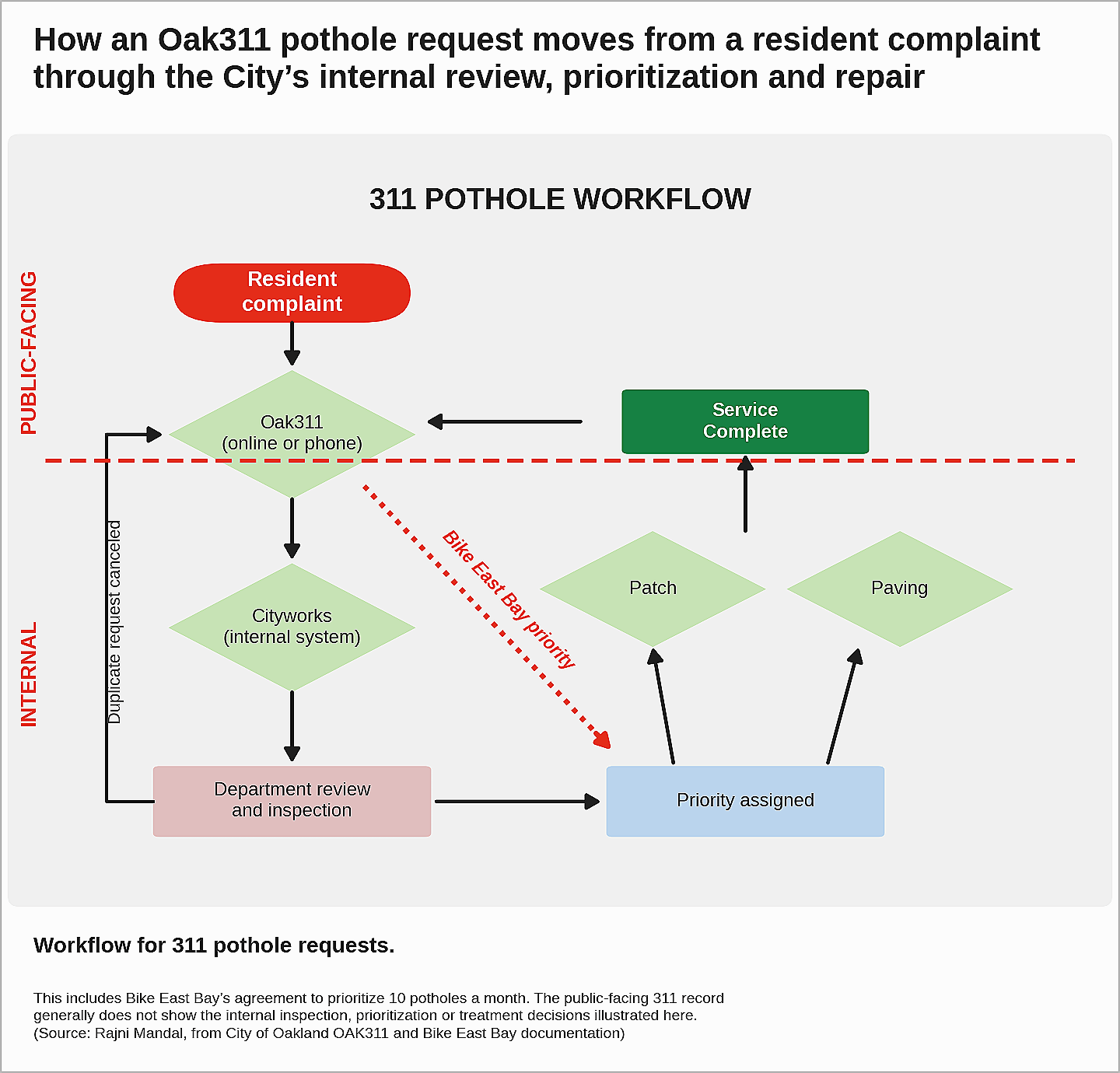
But at BPAC meetings in 2024, participants raised questions about whether the City’s historical prioritization system was still functioning as intended, such as whether bikeway priority routes are being used in city analysis, whether policies are documented or current, and whether Oak311 and Cityworks (the internal tracking software) were communicating reliably.12
The discussion is useful beyond bicycle routes because it raises the same question for every 311 request: What happens after the report is submitted? Oak311 provides the front door: residents report the problem and create a record that the city can route internally. The Alameda County Grand Jury reported that OakDOT seeks to inspect pothole or street damage complaints within three to five business days.13
Inspection, however, is not the same as repair. A pothole may be patched later, prioritized based on risk, or be part of a street requiring more extensive work. The public-facing 311 record generally doesn’t show when an inspection occurred, what was found, what priority was assigned or what action followed. This can leave residents in the dark as to why some requests remain open for months or years.
When potholes cause damage or injury
There are quantifiable financial costs and injuries attributable to potholes and street deterioration. From 2021-2024, Oaklanders filed more than 1,400 vehicle claims involving potholes, resulting in more than $240,000 in payments.14
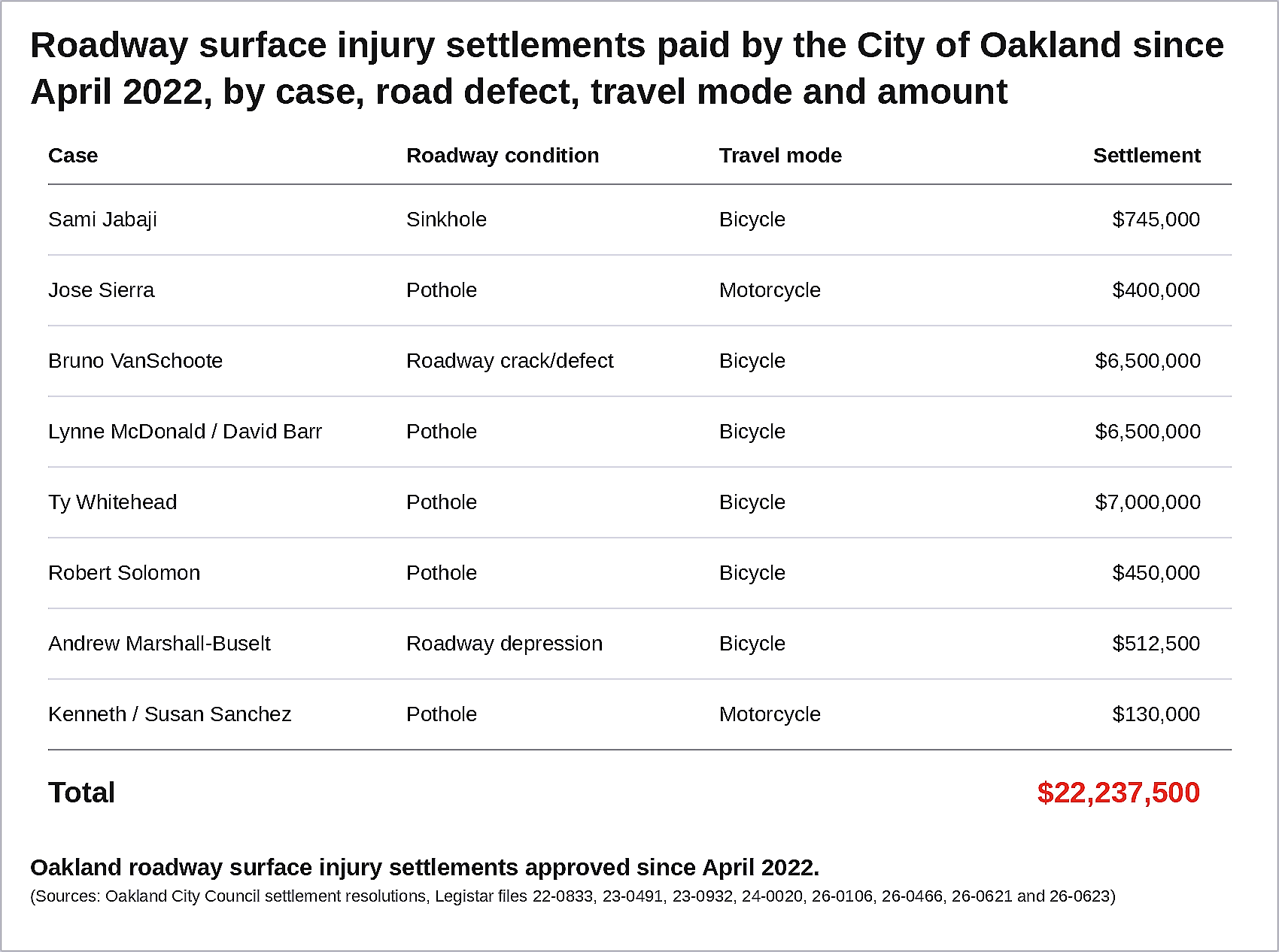
The consequences can be considerably more serious for bicyclists and motorcyclists. Since Oakland issued its 2022 pothole-liability analysis, the city has approved at least $22.2 million in eight settlements involving serious injuries attributed to potholes or comparable roadway-surface defects.1516171819202122
Most potholes will never result in a serious injury or lawsuit. But a system receiving thousands of reports still needs a way to identify risk, assign priorities and ensure that the highest-risk problems don’t disappear into the larger workload.
What happens to my pothole?
Oakland reports repairing more than ten times as many potholes annually compared to residents’ reports through 311. At the same time, thousands of resident requests remain open or otherwise unresolved in the public-facing system.
That is not an argument against using 311, as a 311 request creates a documented record of the problem and gives the city information it can use to identify, prioritize and respond to street defects.
But when a request remains open for months or even years, an “open” status alone provides little useful information about what happened after it was reported.
The longer Oakland asks residents to wait for a pothole request to be resolved, the more important it is to tell them what they are waiting for.

Share this article with someone you know.
Methodology and data notes
311 requests. Pothole requests were identified in Oakland’s OAK311 service-request data using the “Streets - Potholes/Depression” category. “Open” and “closed” reflect the statuses recorded in the public dataset. An “open” request does not establish that a pothole remains physically unrepaired, and a “closed” request does not independently establish that a repair occurred.
Closure times. Closure time was calculated from the request creation date to the recorded closure date. A cluster of bulk closures recorded February 2-4, 2026 was excluded from closure-time calculations because it could distort the measurement of individual request processing times.
Pavement condition. Pothole locations were spatially matched to Oakland pavement segments and their Pavement Condition Index (PCI). PCI measures the overall condition of a street segment; it does not measure individual potholes, whether a pothole was repaired, or the quality or timeliness of a repair.
Paving plan. OPEN pothole requests were compared with streets identified in Oakland’s paving data. Being on the paving plan does not mean an individual pothole is being left for future paving, and being off the plan does not establish that a pothole should have been repaired.
Settlements. Roadway-surface settlements were compiled from City Council resolutions and agenda reports. Settlement payments resolve disputed claims and do not constitute admissions of the city’s liability.
Data sources. City of Oakland OAK311 service-request data (dataset quth-gb8e)23 extracted September 17, 2026 through Transparent.city24; Annual Comprehensive Financial Reports25; 2025 Pavement Condition Survey26; and Pavement Data & Five-Year Paving Plan maps.27
Oakland Report is an experiment in a new form of media: reasoned, data-driven analysis focused on observable and verifiable evidence. We are an independent 501(c)(3) nonprofit organization, not affiliated with any public agency, labor union, corporate interest or political campaign. We present the facts and let the reader decide.
City of Oakland. “Report an issue: OAK 311.” City of Oakland webpage, accessed Oct. 4, 2026. https://www.oaklandca.gov/My-Household/Report-an-Issue-OAK-311
Johnson, Bradley et al. “Annual comprehensive financial report for the year ended June 30, 2025.” City of Oakland, Dec. 30, 2025. https://www.oaklandca.gov/files/assets/city/v/1/finance/documents/financial-reporting/annual-comprehensive-financial-reports/2025-city-of-oakland-acfr_final-123025.pdf
City of Oakland. “Bicyclist and pedestrian advisory commission (BPAC) policy and legislative committee meeting.” BPAC meeting video, Aug. 12, 2024. https://oakland.granicus.com/player/clip/6331
City of Oakland. “Bicyclist and pedestrian advisory commission (BPAC).” BPAC webpage, accessed Oct. 4, 2026. https://www.oaklandca.gov/Government/Boards-Commissions/Bicyclist-and-Pedestrian-Advisory-Commission-BPAC
Cabanatuan, Michael. “Where are the best and worst roads in the Bay Area? New report ranks cities.” San Francisco Chronicle, Oct. 31, 2024. https://www.sfchronicle.com/bayarea/article/bay-area-road-conditions-best-worst-report-19878507.php; https://archive.is/Di980
Adhara Systems, Inc. “MTC P-TAP round 25 pavement management system update: data collection & quality management report.” Report to the Metropolitan Transportation Commission and the City of Oakland, Jan. 21, 2025, p. 2. https://www.oaklandca.gov/files/assets/city/v/1/transportation/documents/streets/street-paving/final-report-oakland-ptap-25.pdf
City of Oakland. “Bicyclist and pedestrian advisory commission (BPAC) meeting.” BPAC meeting video, Oct. 17, 2024. https://oakland.granicus.com/player/clip/6427
City of Oakland. “Pavement data & maps.” Oakland Department of Transportation webpage, accessed Oct. 4, 2026. https://www.oaklandca.gov/Public-Safety-Streets/Streets/Street-Paving/Pavement-Data-Maps
Russo, Ryan. “Managing exposure to lawsuits involving bicyclists and potholes.” Office of the Oakland City Attorney, Apr. 15, 2022. https://cao-94612.s3.us-west-2.amazonaws.com/documents/Info-Memo-Lawsuits-Involving-Bicyclists-and-Potholes-22.04.15-FINAL.pdf
Bike East Bay contributors. “Bike East Bay.” Website, accessed Oct. 4, 2026. https://bikeeastbay.org/
Bike East Bay contributors. “Report a hazard.” Bike East Bay webpage, accessed Oct. 4, 2026. https://bikeeastbay.org/resources/report-a-hazard/
Op cit. (City of Oakland, note 7.)
Cohen, Adam et al. “2024–2025 Alameda County grand jury final report. Oakland’s potholes: a bumpy road and inadequate oversight.” Alameda County Grand Jury, Jun. 20, 2025, p. 27. https://grandjury.acgov.org/wp-content/uploads/2026/03/2024.2025-Alameda-County-Grand-Jury-Final-Report-Remediated.pdf
Ibid. (Alameda County Grand Jury, p. 27.)
Parker, Barbara. “Sami Jabaji v. City of Oakland, et al. — resolution authorizing settlement ($745,000; Department of Transportation – dangerous condition).” Oakland City Council meeting, Oct. 18, 2022. https://oakland.legistar.com/LegislationDetail.aspx?ID=5871832&GUID=E08D1F12-F7CC-42B0-83F6-F2C123ECE228&Options=&Search=
Parker, Barbara. “Jose Sierra v. City of Oakland, et al. — resolution authorizing settlement ($400,000; Department of Transportation – dangerous condition).” Oakland City Council meeting, Jun. 20, 2023. https://oakland.legistar.com/LegislationDetail.aspx?ID=6252142&GUID=A61FB33E-4C79-4437-AFBB-208A8970200B&Options=&Search=
Parker, Barbara. “Bruno VanSchoote v. City of Oakland, et al. — resolution authorizing settlement ($6,500,000; Department of Transportation – dangerous condition).” Oakland City Council meeting, Dec. 5, 2023. https://oakland.legistar.com/LegislationDetail.aspx?ID=6420511&GUID=3CE009A5-1641-4BE8-A5F6-C21E90AAE2A3&Options=&Search=
Parker, Barbara. “Lynne McDonald, et al. v. City of Oakland, et al. — resolution authorizing settlement ($6,500,000; Department of Transportation – dangerous condition).” Oakland City Council meeting, Jan. 16, 2024. https://oakland.legistar.com/LegislationDetail.aspx?ID=6469720&GUID=28030051-60F7-40A8-9C87-AAADC43BBA17&Options=&Search=
Richardson, Ryan. “Whitehead v. City of Oakland, et al. — resolution authorizing settlement ($7,000,000; Department of Transportation – dangerous condition).” Oakland City Council meeting, Oct. 7, 2025. https://oakland.legistar.com/LegislationDetail.aspx?ID=7680849&GUID=3EC30BF3-514E-4D8E-8096-819057426720&Options=&Search=
Richardson, Ryan. “Robert Solomon v. City of Oakland and Does 1-100 — resolution authorizing settlement ($450,000; Department of Transportation – dangerous condition).” Oakland City Council meeting, Mar. 3, 2026. https://oakland.legistar.com/LegislationDetail.aspx?ID=7924016&GUID=43584F6D-7DE2-4039-B06B-F3AD0DDF0BF9&Options=&Search=
Richardson, Ryan. “Andrew Marshall-Buselt v. City of Oakland — resolution authorizing settlement ($512,500; Department of Transportation – dangerous condition).” Oakland City Council meeting, May 5, 2026. https://oakland.legistar.com/LegislationDetail.aspx?ID=7990486&GUID=609E4B1C-12C2-44F0-B3E8-0973321C52C8&Options=&Search=
Richardson, Ryan. “Kenneth Sanchez v. City of Oakland, et al. — resolution authorizing settlement ($130,000; Department of Transportation – dangerous condition).” Oakland City Council meeting, May 5, 2026. https://oakland.legistar.com/LegislationDetail.aspx?ID=7990495&GUID=0DFDEDAC-4AD8-4A75-9C2C-F63A7F704A8D&Options=&Search=
City of Oakland. “Service requests received by the Oakland Call Center (OAK 311).” Oakland Open Data portal (dataset quth-gb8e), extracted Sept. 17, 2026. https://data.oaklandca.gov/Infrastructure/Service-requests-received-by-the-Oakland-Call-Cent/quth-gb8e/about_data
Transparent.city contributors. “Transparent.city.” Website, accessed Sept. 17, 2026. https://transparent.city/
City of Oakland. “Annual comprehensive financial reports.” City of Oakland Finance Department webpage, accessed Oct. 4, 2026. https://www.oaklandca.gov/Government/Finance-Budget/Financial-Reporting/Annual-Comprehensive-Financial-Reports
City of Oakland. “Pavement condition surveys.” City of Oakland Department of Transportation webpage, accessed Oct. 4, 2026. https://www.oaklandca.gov/Public-Safety-Streets/Streets/Street-Paving/Pavement-Data-Maps/Pavement-Condition-Surveys
Op cit. (City of Oakland, note 8)
Josh, thank you for your remarks and insight, but it would be good to know your thoughts on how Oakland’s low PCI ratings (which were in the “At Risk” range for a couple decades through 2023) contribute to the increased number of potholes. You mention water intrusion as a cause (even invoking the underground water table), but not the deleterious effects of sustained deferred maintenance.
From 2005 to 2023, Oakland’s average PCI rating consistently fell within the “At Risk” range between 50 to 59 — a condition in which rapid road deterioration takes hold, and is far more difficult and costly to correct.
By comparison, in 2023 most other Alameda County cities had PCI ratings between 70 and 79 — in the “Satisfactory” range. Alameda County as a whole had an average PCI rating of 67 — in the “Fair” range.
Meanwhile in neighboring Orinda: Back in 2012, Orinda’s PCI rating was even worse than Oakland’s at a dismal 48 — in the “Poor” range. But a decade later in 2023, Orinda’s PCI rating had vastly improved to 84 — in the “Good” range.
This was due to a decade of committed and sustained effort by that city to fulfill the promise it made to its voters who approved sales tax and property tax increases to fix Orinda’s public roads.
If Orinda can do it, why can’t Oakland? It can’t just be the difference in median income and tax revenue between the two cities. The City of Orinda’s operating budget is a fraction of Oakland’s.
https://www.oaklandreport.org/i/180748397/orinda-leaves-oakland-in-the-dust-on-fixing-potholes
City budget records and Grand Jury reports make the cause clear. Spin it any way you want, but Oakland politicians stole the road maintenance budget funds year after year to fund their other priorities. The calculation? By the time the disastrous effects are noticed, the responsible politicians are long gone. The only solution is holding politicians accountable, not reelecting them for their ideological purity.