



Oakland Report examines the data behind the headlines. In this installment, we test the claim that Oakland spends too much on police by reviewing six years of data across 14 neighboring and comparable cities: what cities actually spent on policing, and how much crime their officers actually faced.
Oakland’s police department was the leanest among comparison cities, across six years of data
Oakland’s police spending is a frequent target of criticism. Like most other cities, Oakland’s police department is its largest general fund expense.1
As with every city expenditure, it is reasonable and responsible to ask the question: is the city paying too much for its police?
Oakland Report set out to answer that question by examining six years of data: police expenditures, budgeted sworn officers, city populations, and reported crimes across 14 neighboring and comparable cities.23
This analysis is primarily focused on data from 2024, the most recent year for which authoritative, comparable data are available across all cities and metrics.
We also examined and compared the five previous years of data — which confirmed that the 2024 data are strongly representative of the overall trends and rankings.
We recognize that Oakland is an extraordinary and unique city, and it is virtually impossible to find another city exactly like it in every way. However, even with all the variations, a comparison of these fundamental data across multiple cities and several years offers new insight.
The comparison cities included several of Oakland’s neighbors, as well as other populous, complex, big-budget California cities.
Each city has its own unique factors and there is no perfect comparison to Oakland. But in aggregate, the data from all these cities across multiple years sketch a clear picture.
Key findings
Oakland spent the most per capita on police among the comparison cities. Oakland spent about $809 per resident in 2024, ahead of next-highest Berkeley at $703 per resident and every other comparison city.
Oakland also had the highest crime rate, by far. Its 2024 violent crime rate of 1,961 crimes per 100,000 residents was the highest of the 14 cities, as was its homicide rate. Its property crime rate of 7,364 crimes per 100,000 residents was also the highest — 50 percent higher than the next city’s rate.
Adjusted for workload, Oakland’s police department spending was lowest on nearly every measure. Oakland spent about $41,000 of police budget per violent crime in 2024 — the least among the comparison cities, and a fraction of the $100,000 in Long Beach or the $118,000 in Berkeley. On property crime, Oakland spent about $11,000 per crime, again the least of the comparison cities.
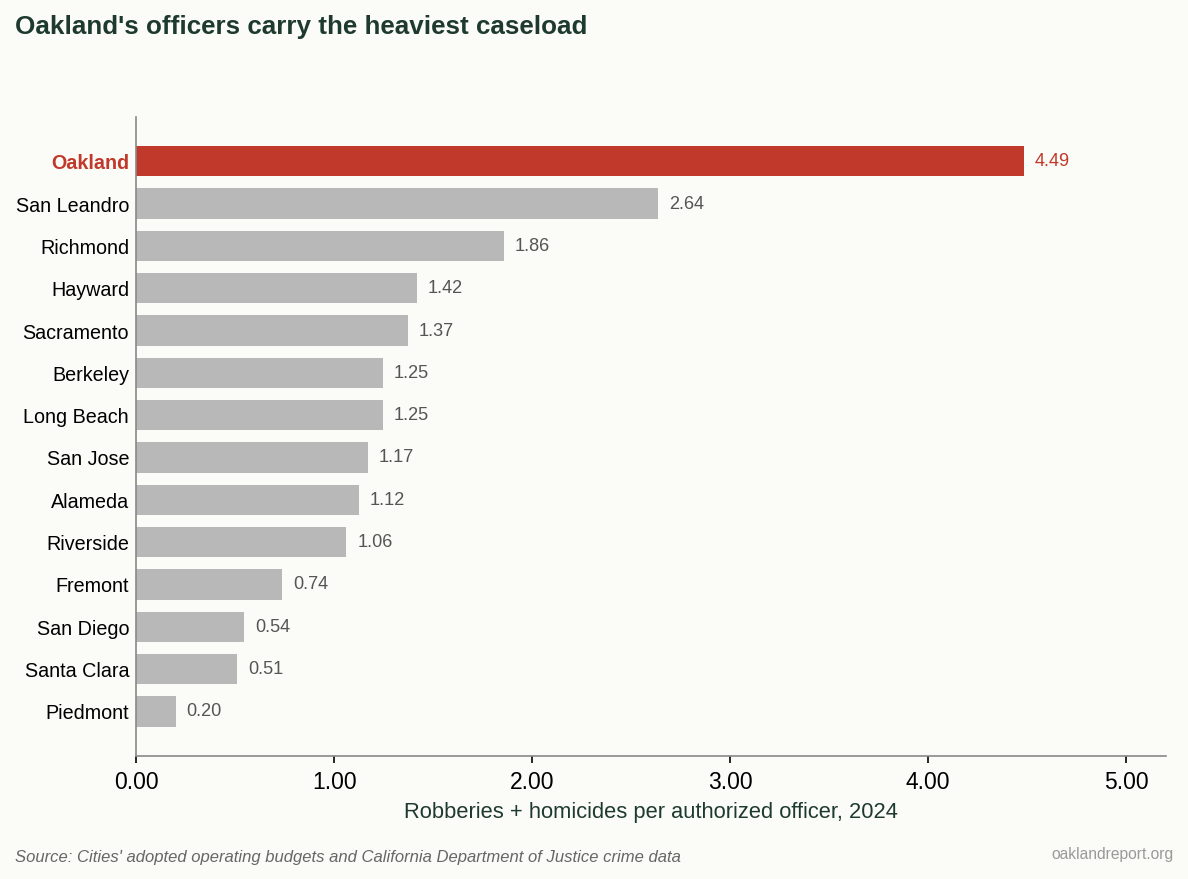
Oakland’s cost was not driven by expensive officers, nor by too many officers. Oakland’s total police spending equated to about $510,000 per budgeted sworn officer — roughly average among the comparison cities. But Oakland experiences far more crime per officer, especially violent crime: 4.5 robberies or homicides per officer, roughly nine times the rate in Piedmont — a city that is surrounded on all sides by Oakland — and well above every other comparison city.
The multi-year data are consistent and representative. Across every year from 2019 through 2024, Oakland ranked first among the 14 comparison cities on property and violent crime rates, including the narrower categories of robbery and homicide.
Oakland had the leanest police department when measured by workload. Using each year’s actual police spending, Oakland ranked the leanest of the 14 comparison cities on cost per robberies and homicides in all six years, first or second leanest on cost per violent crime every year — and the highest per-resident cost in five of six years.
The data confirm that Oakland was both a high-spending police city and an extraordinarily high-crime city — and the two facts are connected.
Oakland spent the most per resident on police
Dividing each city’s 2024 reported police expenditures by its 2024 population,4 Oakland spent the most per capita on policing.
Oakland’s roughly $345.5 million in police spending for approximately 427,000 residents in 2024 equates to around $809 per resident.
Berkeley was second-highest at $703 per resident, then Piedmont at $726 — both smaller cities in which fixed costs are spread across fewer people.
Among larger cities comparable to Oakland’s scale and complexity, none comes close: Long Beach spent $652 per resident, San Jose $494, Sacramento $468, and San Diego $446.
Oakland’s per-resident police spending was close to twice Riverside’s, the least among the comparison cities at $430 per resident.
When taking the per capita spending metric in isolation, the critics of Oakland’s police spending have a valid point. Oakland did spend more per resident on policing than any of the comparison cities.
Read this related article:

However, focusing only on per capita spending tells only part of the story. It shows what each resident theoretically paid for policing, but it does not factor in how much work that money was expected to do.
Oakland had the highest crime rate — by a wide margin
Oakland’s notably high police workload — compounded by a severely understaffed police force — was a significant factor in its police spending.
According to crime data from all the comparison cities, Oakland’s police department consistently had the highest workload in every serious crime measure across all six years, by far.
Violent crime, as the California Department of Justice defines it, comprises four offenses: homicide, robbery, forcible rape, and aggravated assault.
Oakland led the comparison cities on the most serious of these crimes: it reported 81 homicides in 2024, more than San Diego and San Jose combined, despite Oakland having roughly a third of San Diego’s population and less than half of San Jose’s population.
Oakland’s 2,960 robberies were the most of any comparison city — more than San Diego, San Jose, Long Beach, or Sacramento, each of which have larger populations than Oakland.
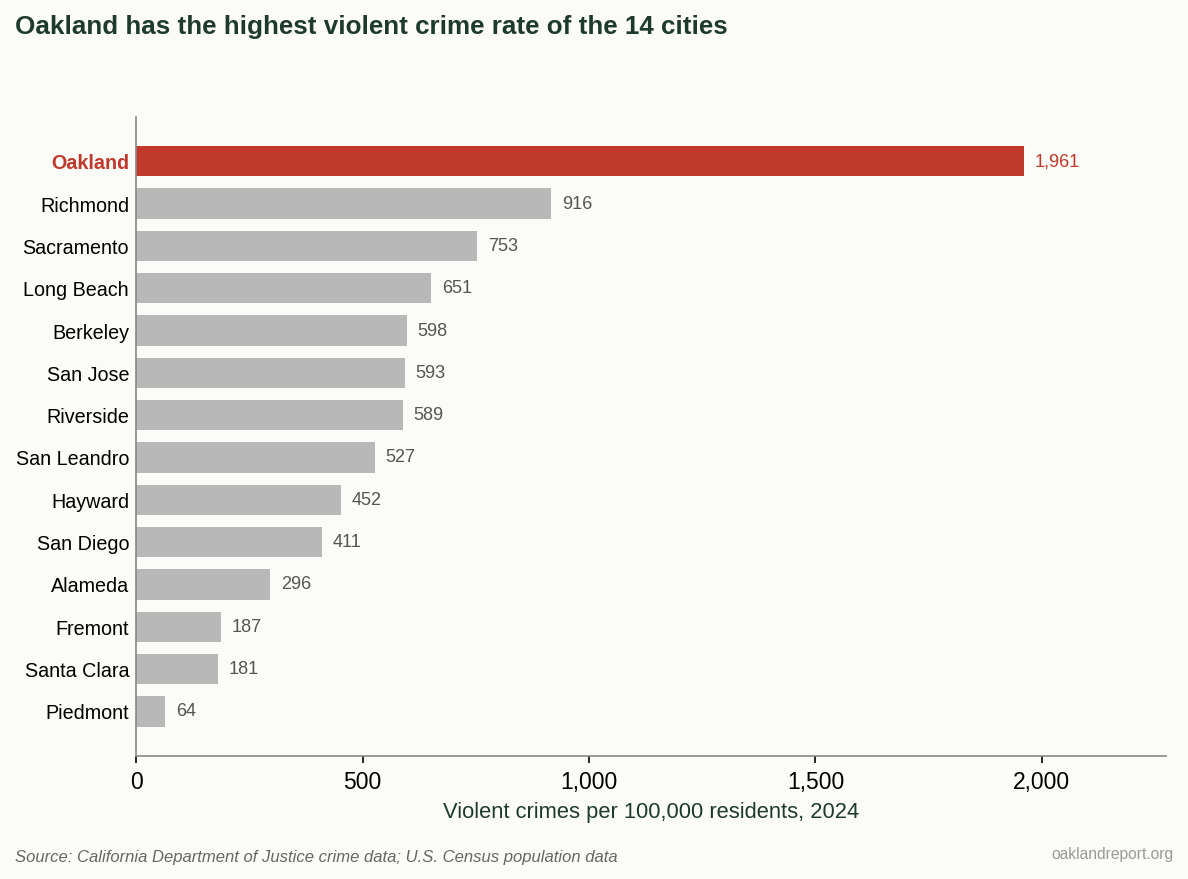
Oakland’s 2024 violent crime rate of 1,961 crimes per 100,000 residents was more than double second-highest Richmond’s 916 crimes per 100,000 residents, and over three times the rate of San Jose’s 593 and San Diego’s 411.
The same held for the category Oaklanders encountered most often: property crime.
Oakland had the highest property crime rate of the 14 comparison cities: 7,364 crimes per 100,000 residents — roughly 50 percent higher than the next-highest city, Berkeley, at 4,894 property crimes per 100,000 residents.
Oakland reported 31,455 property crimes in 2024 — including 9,914 motor vehicle thefts and 18,118 larcenies — trailing only San Diego and San Jose, both far larger cities.
Whether the measure is violence or property crime, Oakland’s officers consistently faced the heaviest and most severe crime environment among the comparison cities.
Read this related article:

None of this is to minimize the toll these crimes took on Oakland residents, which is the real story behind these numbers.
But for the purpose of evaluating the police budget, it offers important context that the per capita spending figures omit: Oakland’s police department consistently operated in the highest-crime environment of any city we examined.
Adjusted for workload, Oakland was the leanest spender per crime
When police spending was measured against the volume and severity of crime it responded to, Oakland was nowhere near the most expensive department among comparison cities — it was the least expensive.
The California Department of Justice defines violent crime as the sum of four offenses: homicide, forcible rape, robbery, and aggravated assault.
Oakland spent about $41,000 in police budget per violent crime in 2024, the lowest figure of all 14 cities. Sacramento, the next-lowest, spent about $62,000 per violent crime, and Richmond $66,000.
By comparison, the more affluent, lower-crime comparison cities spent orders of magnitude more per violent crime than Oakland: Fremont spent $238,000 per violent crime, Santa Clara $354,000, and Piedmont $1.1 million.
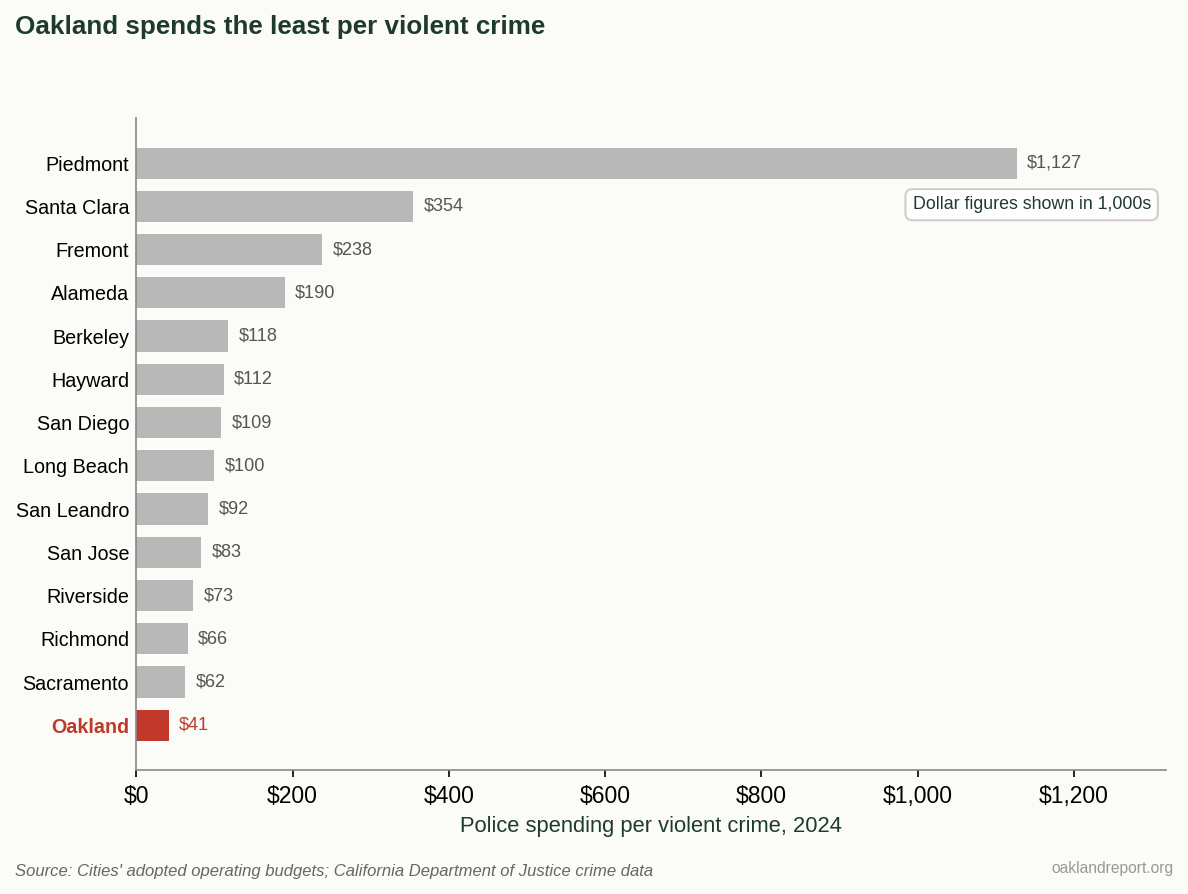
Note: These figures are not intended to say that each individual crime generated these specific dollar amount costs. However, they provide a consistent data point across cities for comparison purposes.
The comparison holds true regardless of which specific violent crimes were counted or how crimes were defined as violent.
Focusing on the two violent offenses defined most consistently over time, Oakland experienced 4.49 robberies or homicides and 12.4 violent crimes overall per budgeted officer.
On this metric, Oakland again spent the least of the 14 comparison cities — about $114,000 per robbery or homicide, compared to $178,000 in second-least San Leandro and $1.97 million in the highest-spending city, Piedmont.
Furthermore, when measured by all reported violent and property offenses combined, Oakland spent $8,674 per crime, again the least in the group.
Property crime data tells the same story
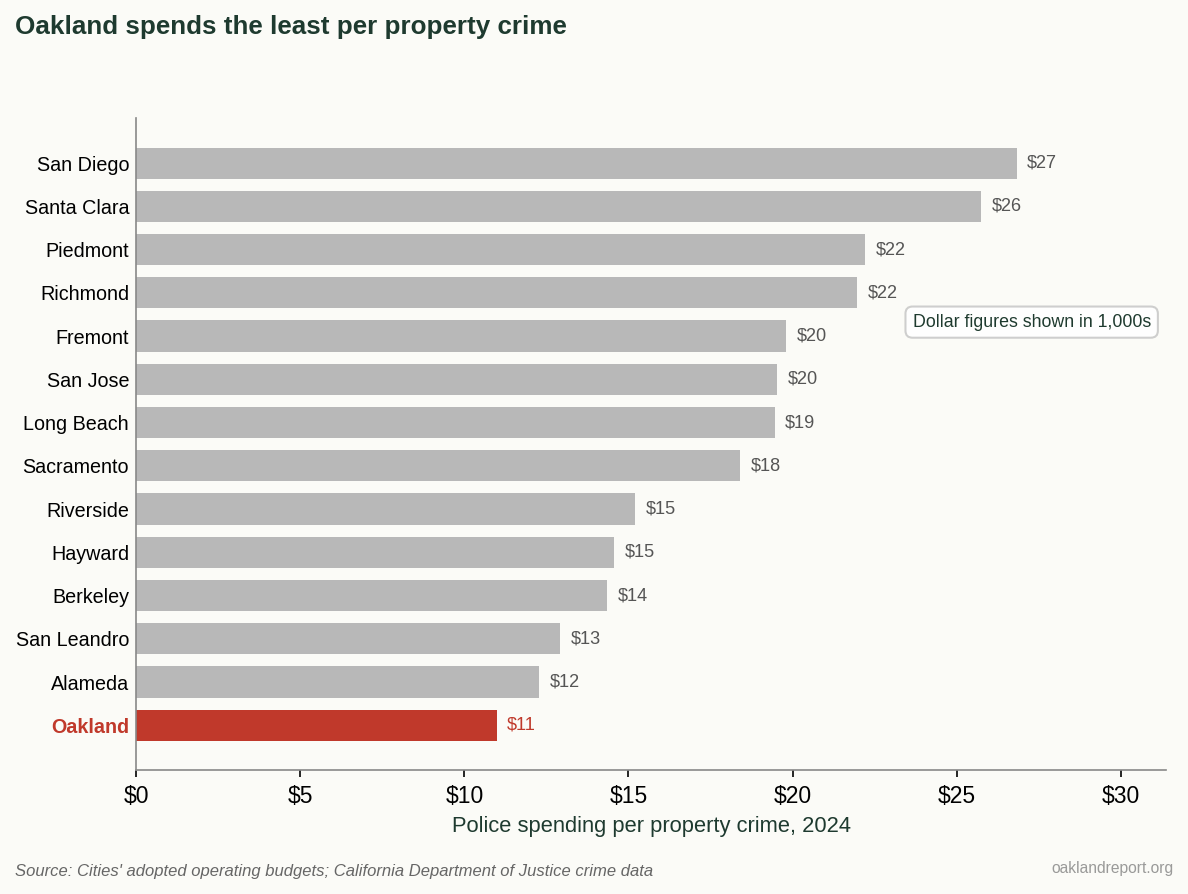
Because Oakland reports so many property crimes, its total police budget spread across them equated to about $10,984 per property crime — the least of the 14 cities, just below Alameda at $12,269 per property crime and San Leandro at $12,913.
At the higher end are the lower-crime cities: San Diego at $26,828 per property crime, Santa Clara at $25,752, and Piedmont at $22,219 each spent more than double what Oakland spends per property crime — likely because those cities experience far fewer crimes compared to their police budgets.
The property crime burden on Oakland police officers is also far higher than in the comparison cities: 46.4 property crimes per authorized officer, again the highest, compared to 11.4 property crimes per officer in San Diego and 17.4 in Sacramento.
No matter the crime denominator used — robbery and homicide, all violent crime, all property crime, or every crime combined — Oakland lands at or near the bottom of the spending-per-crime ranking.
Notably, Oakland’s current number of officers actually on duty is substantially less than its 678 budgeted officers — only around 510 sworn officers were on active duty as of early 2026.5
Measured against officers on active duty rather than against budgeted officers, Oakland’s per-officer caseload — and its cost efficiency per crime — were more extreme still.
Don’t miss a beat. Donate to support our nonprofit work.
Oakland’s police costs were driven by workload, not by expensive officers
A frequent criticism of Oakland’s police spending is that it reflects an unusually expensive police force — high salaries, rich overtime, generous benefits — rather than a high volume of work. But the data appear not to support that criticism.
Dividing each city’s total police spending by its number of budgeted sworn officers put Oakland’s total spending per officer at about $510,000 — roughly average among the comparison cities.
Two cities spent more per officer, including the lower-crime cities of Santa Clara at $555,000 per officer and Alameda at $511,000.
Oakland’s per-officer cost was within a few thousand dollars of Fremont’s $506,000 per officer — a city with roughly a tenth of Oakland’s violent crime rate.
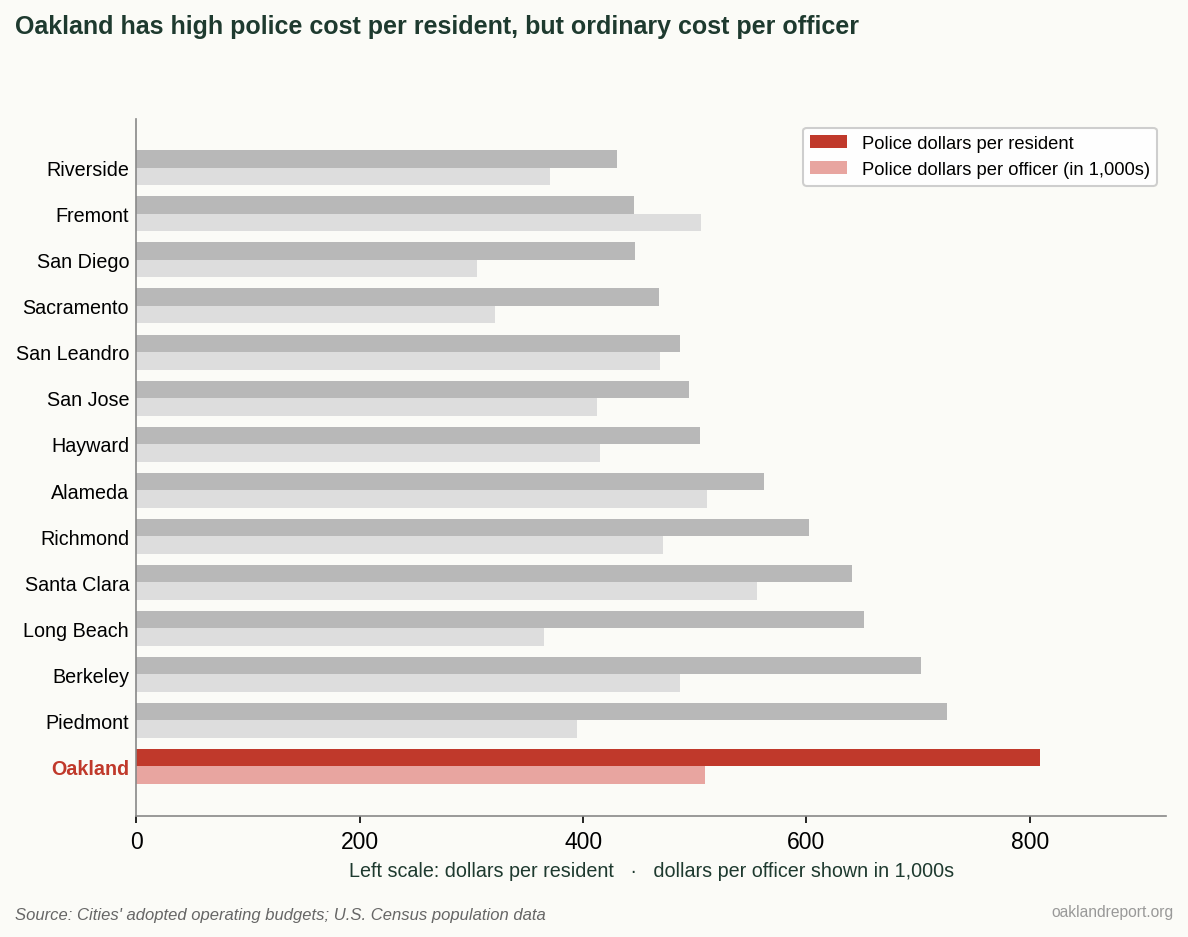
It is reasonable to conclude that if Oakland’s per-officer spending was roughly average among other cities’ per-officer spending, then its higher per-resident spending likely was driven by other factors. The data suggest that Oakland spent more on policing relative to its population because Oakland experienced far more, and more serious, crime.
Methodology
This analysis compared six years of data from 14 neighboring or comparable cities: Oakland, Alameda, Berkeley, Fremont, Hayward, Long Beach, Piedmont, Richmond, Riverside, Sacramento, San Diego, San Jose, San Leandro, and Santa Clara.
Police expenditures were sourced from the California State Controller’s office, which annually compiles and publishes police expenditures.6
Crime data were sourced from the California Department of Justice, which compiles annual crime data reported by cities.
Populations were sourced from the California Department of Finance, which compiles annual population counts per city based on U.S. Census data.
Budgeted sworn officer counts were sourced from each comparison city’s adopted budget documents.
Per-capita figures were calculated by dividing total police spending by population; per-crime figures divided total police spending by reported crimes; and per-officer figures divided total police spending by budgeted sworn officers.
One timing note: the spending and budget data were reported by fiscal year (July 1 to June 30), whereas the crime data were reported by calendar year (January 1 to December 31). However, this timing overlap was consistent across all the comparison cities and all six years of data.
Correlation is not causation
The data indicate a strong correlation between Oakland’s crime workload and its police spending. However, this neither proves nor disproves whether every dollar Oakland spent on policing is efficiently spent.
A police department can face heavy crime and operate inefficiently. Low spending-per-crime can indicate lean efficiency, or it can indicate a department stretched too thin to respond effectively to a heavy caseload.
Oakland’s high overtime spending — which was at least partly driven by a significantly understaffed police force — is a real efficiency question these data do not resolve.
Cost-per-crime calculations measure spending against crime volume, not against outcomes such as clearance rates or response times, which are beyond the scope of this analysis. (Oakland Report will examine those outcomes in a future analysis.)
One of the six years of California crime data used in this analysis, 2023, was affected by a change in the state’s reporting methodology. As a result, Oakland’s reported aggravated assault data jumped from 3,329 in 2022 to 11,169 in 2023, then fell to 5,039 in 2024. Oakland’s 2023 data anomaly has been attributed to data-entry or reporting errors.7 We adjusted for this in our analysis by examining six years of data across all 14 comparison cities and metrics.
The charts in this analysis are focused on 2024, the most recent year for which data is available across all cities and metrics. This was cross-checked against robbery and homicide data — offenses unaffected by the state’s 2023 methodology change — to confirm the consistency of the data across all six years.
The spending data were self-reported by cities to the state controller’s office, and pension, capital, and internal-service costs are treated somewhat differently across cities. To account for these differences, the spending comparisons in this analysis have an aggregate margin of error of plus or minus six percent. Even within that margin of error, Oakland still stood out across every spending metric.
Other considerations
Efficiency per crime is not the only test. This analysis examined the question, “what does Oakland spend per crime?” But another important question this analysis did not examine is, “why is there so much crime to begin with?” Oakland’s high crime rate partly explained its high per-capita spending, but it didn’t address why crime in Oakland was far higher and more severe than in the other comparison cities.
Oakland’s crime fell sharply in 2024. Homicides dropped 32 percent from 2023 (119 to 81), robbery fell 23 percent, and motor vehicle theft fell 40 percent — welcome declines that are consistent with a nationwide trend. If crime continues to fall in future years while police spending remains flat or increases, the spending-per-crime calculation will increase in tandem.
Deployment, not just headcount, drives outcomes. The current gap between Oakland’s 678 budgeted officers and its roughly 510 active duty officers are management and operational question that the per-budgeted-officer calculations do not fully capture.
Oakland’s per-capita police spending was higher because its crime rate was far higher and more severe than other cities
The claim that Oakland spends too much on policing, when measured only on a per-resident basis, is partly true. But the implication of that claim — that Oakland is an outlier in its overall spending on policing — is not supported by the crime and workload data.
Across 14 comparison cities and six years of data, Oakland spent the least per violent crime overall, including in the narrower categories of robberies and homicides, and it spent the least per property crime overall.
Oakland’s police officers carried the heaviest and most severe per-officer caseload among all the comparison cities. At the same time, Oakland’s total police department spending per officer was roughly average.
Based on all the above, a more complete, data-driven assertion is this: Oakland’s police spending was high because its crime was high, not because its policing was too expensive.
Whether that spending resulted in the best outcomes — cases cleared, crimes prevented, response times met — is a separate question. This analysis does not attempt to answer that question, but the question is worthy of study in a future article.
What this analysis does strongly indicate is that on a per-crime basis, Oakland’s police department was among the least expensive in the state — not the most.

If you like our work, please consider becoming a supporting member. We are a 501()(3) nonprofit organization. Your contribution in any amount helps us to continue to produce accurate, well-researched, unflinching articles like this one.
City of Oakland. “Fiscal year 2024-2025 midcycle budget.” City of Oakland budget portal, accessed July 1, 2026. https://www.oaklandca.gov/Government/Finance-Budget/Budget/Fiscal-Year-2024-2025-Midcycle-Budget
California State Controller’s Office. “Cities financial data — 2024.” SCO data portal, accessed July 1, 2026. https://cities.bythenumbers.sco.ca.gov/#!/year/default
California Department of Justice. "Crimes and Clearances — 2024." OpenJustice data portal, accessed July 1, 2026. https://openjustice.doj.ca.gov/exploration/crime-statistics/crimes-clearances
California Department of Finance. “E-4 population estimates for cities, counties, and the state, 2021–2026, with 2020 Census benchmark.” DOF data portal, accessed July 1, 2026. https://dof.ca.gov/forecasting/demographics/estimates/e-4-population-estimates-for-cities-counties-and-the-state-2021-2026-with-2020-census-benchmark/
City of Oakland. “Oakland Police Department update.” Oakland Police Commission meeting agenda, item VI, attachment 2, Feb. 12, 2026. https://www.oaklandca.gov/files/assets/city/v/1/police-commission/agendas/opc-regular-meeting-agenda-2.12.26-fin.pdf
California State Controller’s Office. “Police expenditures 2018-2024, City of Oakland.” SCO data portal, accessed July 1, 2026. https://cities.bythenumbers.sco.ca.gov/#!/year/2024/operating/0/entity_name/Oakland/0/category/General+Government+and+Public+Safety/0/subcategory_1/Public+Safety/0/subcategory_2?vis=lineChart
California State Controller’s Office. “Police expenditures 2018-2024, City of Alameda.” SCO data portal, accessed July 1, 2026. https://cities.bythenumbers.sco.ca.gov/#!/year/2024/operating/0/entity_name/Alameda/0/category/General+Government+and+Public+Safety/0/subcategory_1/Public+Safety/0/subcategory_2/Police_Current+Expenditures/0/line_description?vis=lineChart
California State Controller’s Office. “Police expenditures 2018-2024, City of Berkeley.” SCO data portal, accessed July 1, 2026. https://cities.bythenumbers.sco.ca.gov/#!/year/2024/operating/0/entity_name/Berkeley/0/category/General+Government+and+Public+Safety/0/subcategory_1/Public+Safety/0/subcategory_2/Police_Current+Expenditures/0/line_description?vis=lineChart
California State Controller’s Office. “Police expenditures 2018-2024, City of Fremont.” SCO data portal, accessed July 1, 2026. https://cities.bythenumbers.sco.ca.gov/#!/year/2024/operating/0/entity_name/Fremont/0/category/General+Government+and+Public+Safety/0/subcategory_1/Public+Safety/0/subcategory_2/Police_Current+Expenditures/0/line_description?vis=lineChart
California State Controller’s Office. “Police expenditures 2018-2024, City of Hayward.” SCO data portal, accessed July 1, 2026. https://cities.bythenumbers.sco.ca.gov/#!/year/2024/operating/0/entity_name/Hayward/0/category/General+Government+and+Public+Safety/0/subcategory_1/Public+Safety/0/subcategory_2/Police_Current+Expenditures/0/line_description?vis=lineChart
California State Controller’s Office. “Police expenditures 2018-2024, City of Long Beach.” SCO data portal, accessed July 1, 2026. https://cities.bythenumbers.sco.ca.gov/#!/year/2024/operating/0/entity_name/Long+Beach/0/category/General+Government+and+Public+Safety/0/subcategory_1/Public+Safety/0/subcategory_2/Police_Current+Expenditures/0/line_description?vis=lineChart
California State Controller’s Office. “Police expenditures 2018-2024, City of Piedmont.” SCO data portal, accessed July 1, 2026. https://cities.bythenumbers.sco.ca.gov/#!/year/2024/operating/0/entity_name/Piedmont/0/category/General+Government+and+Public+Safety/0/subcategory_1/Public+Safety/0/subcategory_2/Police_Current+Expenditures/0/line_description?vis=lineChart
California State Controller’s Office. “Police expenditures 2018-2024, City of Richmond.” SCO data portal, accessed July 1, 2026. https://cities.bythenumbers.sco.ca.gov/#!/year/2024/operating/0/entity_name/Richmond/0/category/General+Government+and+Public+Safety/0/subcategory_1/Public+Safety/0/subcategory_2/Police_Current+Expenditures/0/line_description?vis=lineChart
California State Controller’s Office. “Police expenditures 2018-2024, City of Riverside.” SCO data portal, accessed July 1, 2026. https://cities.bythenumbers.sco.ca.gov/#!/year/2024/operating/0/entity_name/Riverside/0/category/General+Government+and+Public+Safety/0/subcategory_1/Public+Safety/0/subcategory_2/Police_Current+Expenditures/0/line_description?vis=lineChart
California State Controller’s Office. “Police expenditures 2018-2024, City of Sacramento.” SCO data portal, accessed July 1, 2026. https://cities.bythenumbers.sco.ca.gov/#!/year/2024/operating/0/entity_name/Sacramento/0/category/General+Government+and+Public+Safety/0/subcategory_1/Public+Safety/0/subcategory_2/Police_Current+Expenditures/0/line_description?vis=lineChart
California State Controller’s Office. “Police expenditures 2018-2024, City of San Diego.” SCO data portal, accessed July 1, 2026. https://cities.bythenumbers.sco.ca.gov/#!/year/2024/operating/0/entity_name/San+Diego/0/category/General+Government+and+Public+Safety/0/subcategory_1/Public+Safety/0/subcategory_2/Police_Current+Expenditures/0/line_description?vis=lineChart
California State Controller’s Office. “Police expenditures 2018-2024, City of San Jose.” SCO data portal, accessed July 1, 2026. https://cities.bythenumbers.sco.ca.gov/#!/year/2024/operating/0/entity_name/San+Jose/0/category/General+Government+and+Public+Safety/0/subcategory_1/Public+Safety/0/subcategory_2/Police_Current+Expenditures/0/line_description?vis=lineChart
California State Controller’s Office. “Police expenditures 2018-2024, City of San Leandro.” SCO data portal, accessed July 1, 2026. https://cities.bythenumbers.sco.ca.gov/#!/year/2024/operating/0/entity_name/San+Leandro/0/category/General+Government+and+Public+Safety/0/subcategory_1/Public+Safety/0/subcategory_2/Police_Current+Expenditures/0/line_description?vis=lineChart
California State Controller’s Office. “Police expenditures 2018-2024, City of Santa Clara.” SCO data portal, accessed July 1, 2026. https://cities.bythenumbers.sco.ca.gov/#!/year/2024/operating/0/entity_name/Santa+Clara/0/category/General+Government+and+Public+Safety/0/subcategory_1/Public+Safety/0/subcategory_2/Police_Current+Expenditures/0/line_description?vis=lineChart
Lofstrom, Magnus et al. “Crime trends in California.” Public Policy Institute of California, February 2025. https://www.ppic.org/publication/crime-trends-in-california/
Amazing work. I bet you won’t see this research cited on The Oaklandside!! And we all know why.
Thank you so much, Alex, for this enlightening and heartening analysis. I've long felt, without any evidence, that OPD and its beleaguered officers get a bum rap on the spending front. It's great to see your data.