


Video clip 1. Oakland’s Reimagining Public Safety Task Force issued a recommendation in 2021 to move most traffic enforcement from police to the transportation department. (Sources: Oakland Department of Transportation; NBC Bay Area; CBS Bay Area; Oakland Police Department; ABC7 Eyewitness News; Simple Minds; Adobe Stock. Video montage by Oakland Report.)
Editors’ note: This article was originally posted by Oakland resident Rajni Mandal on her Substack page. Oakland Report is republishing it with Mandal’s permission for our readers to consider. Subscribe to Rajni Mandal’s Public Safety Updates to receive her articles directly.
Who do you call when a car is abandoned — and who actually is responsible?
At National Night Out events in East Oakland last month, residents raised concerns with police about abandoned and stolen vehicles in their neighborhoods. The police department responded with a targeted operation:1
“In all, 41 abandoned vehicles were towed, two stolen vehicles were recovered, and more than 20 additional vehicles were tagged for towing. Several residents shared that, for the first time in months, they were able to park in front of their homes after the vehicles were removed.”
— Oakland police department, Sept. 1, 2026
However, abandoned auto enforcement on Oakland’s public streets is no longer primarily a police function.
In 2023, Oakland transferred that work from the police department to the Department of Transportation (OakDOT), which created a specialized Vehicle Enforcement Unit (VEU) to respond to abandoned auto complaints and remove vehicles from the public right-of-way.
In other words, the work residents were asking police to perform was work the city had transferred out of the police department three years earlier.
Subscribe for free to Oakland Report.
Oakland’s abandoned auto problem
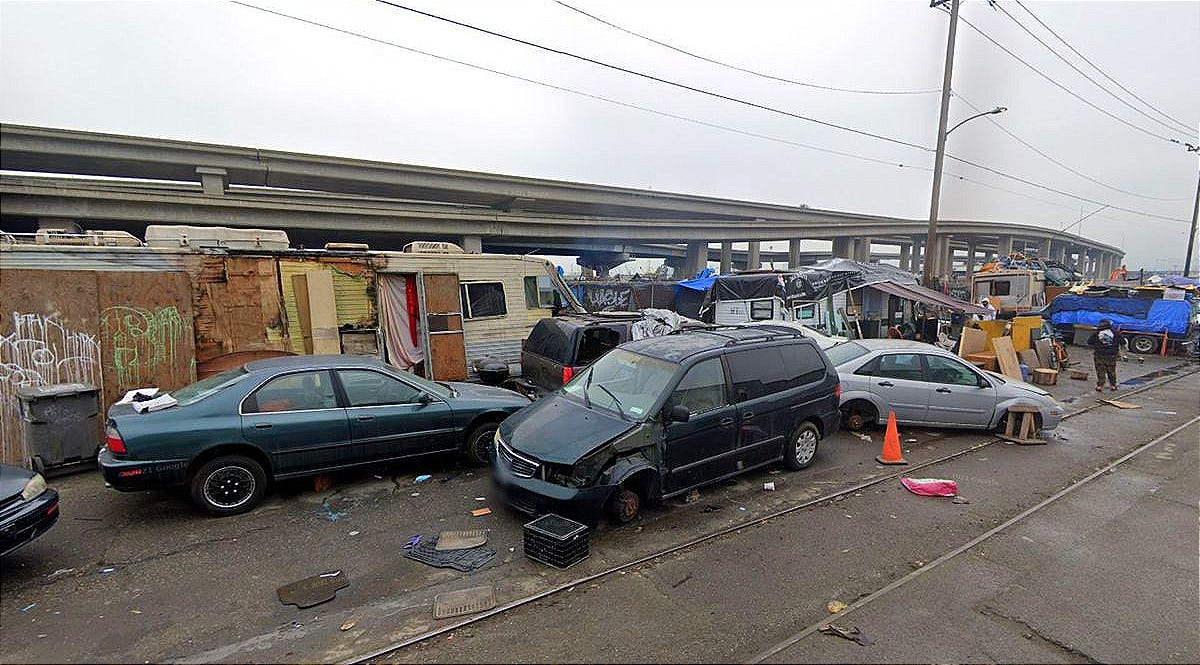
Abandoned vehicles are one of Oakland’s largest categories of service requests, with more than 20,000 requests received in 2025.2
Adjusted for population, Oakland receives nearly twice as many abandoned vehicle complaints as San Francisco.3
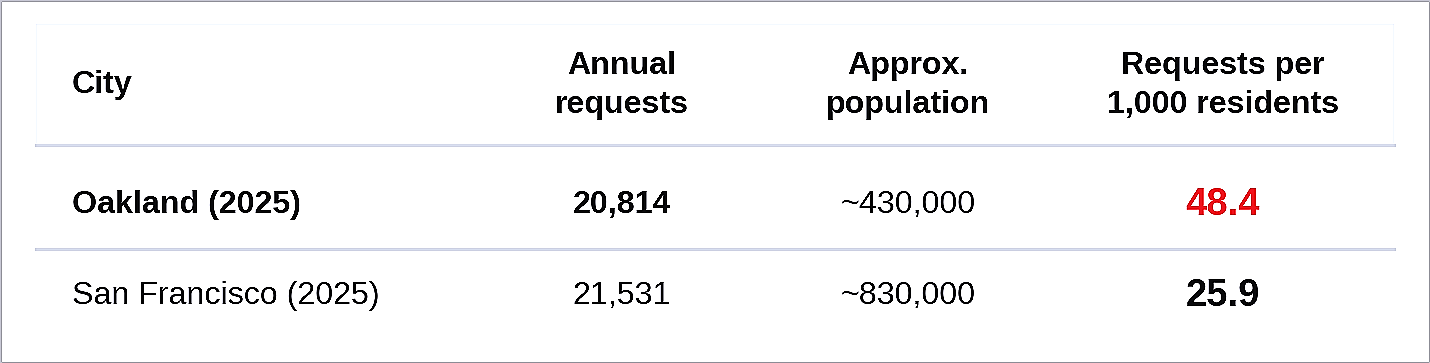
The current backlog is substantial. As of September 16, Oakland’s 311 dataset listed 15,616 abandoned auto requests as “open” or “pending.” Over 10,000 (about two-thirds) of the requests were filed before 2026.
The problem is most concentrated in East Oakland: council districts 6 and 7 account for 58% of the citywide backlog.
Historical background
In 2021, Oakland’s Reimagining Public Safety Task Force issued a recommendation to move most traffic enforcement from police to OakDOT, eliminate pretextual traffic stops, decriminalize most traffic violations and reduce fines and fees.4 It further contemplated leaving police responsible for particularly high-risk violations such as reckless driving and extreme speeding.
Oakland’s two-year 2021–23 budget shifted the police department’s Vehicle Enforcement Units to OakDOT, transferring the equivalent of 10 police services technician positions, adding three parking enforcement supervisors and eliminating three sworn police positions.5
The city described the change as part of an effort to shift services away from the police department and have departments with “civilian” subject matter expertise respond to calls previously handled by police.
The stated goal was to reduce the police department’s visible footprint while reserving police resources for more critical issues.
The operational transfer was completed in February 2023.6 OakDOT’s new Vehicle Enforcement Unit (VEU) took responsibility for abandoned auto enforcement on public streets, along with scofflaw enforcement and vehicle encampments.7 VEU initially relied on existing parking control employees rotating through acting assignments while OakDOT developed permanent specialized positions.
Demand quickly exceeded capacity. By early 2024, OakDOT reported a backlog of approximately 9,600 open or pending abandoned vehicle requests.8 Staff concluded that the size of the problem and the resources devoted to it were “out of alignment.”
In March 2024, the city council appropriated approximately $840,000 for additional personnel, program support and towing technology.9
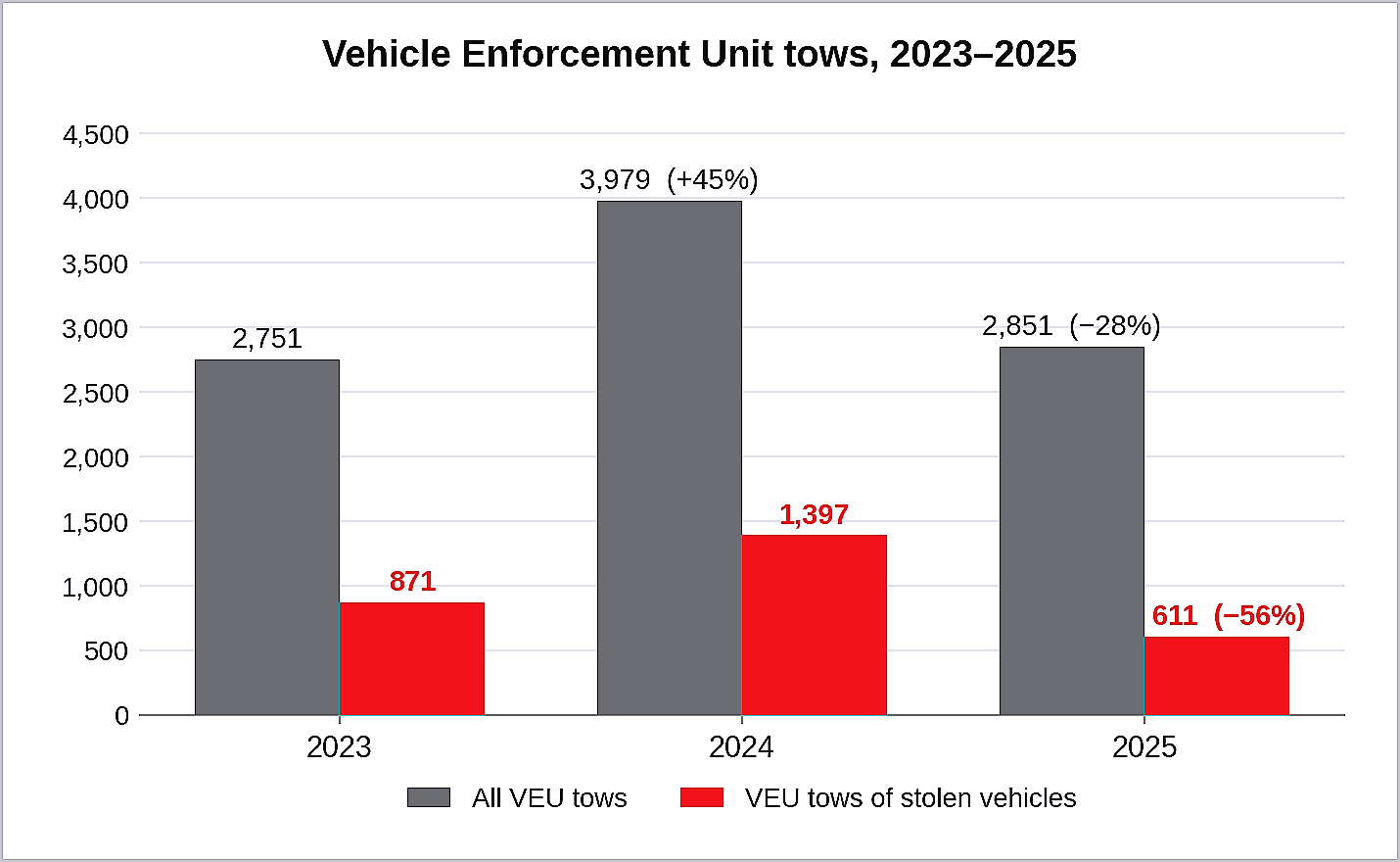
The 311 data show a substantial improvement during the same period. For most of 2024, only a small percentage of each month’s abandoned auto requests remained open or pending, coinciding with the additional funding. The VEU’s tow data show that it towed 2,751 vehicles in 2023 and 3,979 in 2024 — an increase of about 45%.10
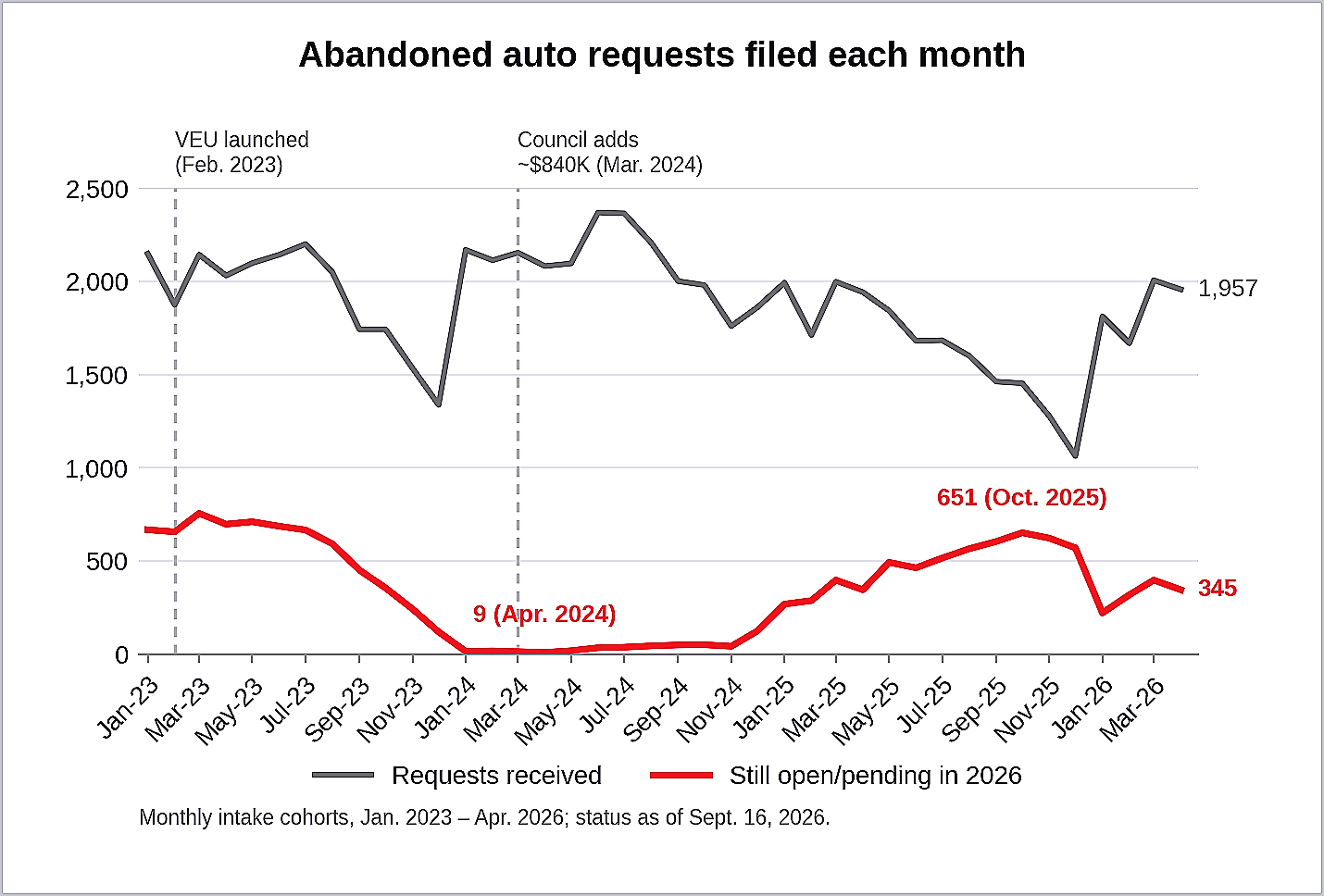
Unfortunately, the improvement did not last. By late 2024, the percentage of unresolved 311 requests began to rise again. The deterioration accelerated during 2025, even as the number of new requests declined: VEU tows fell to 2,851 in 2025; a 28% decline from 2024.
Should abandoned auto enforcement go back to the police department?
In January 2026, the city administration proposed reorganizing Oakland’s parking operations again.11 Administrative and revenue-related functions would move from OakDOT to the finance department, while the Vehicle Enforcement Unit responsible for abandoned autos would move to the police department.
City administration said the changes would better align related functions across departments. For abandoned autos, it noted that the work had previously been housed in the police department and said police were already handling the majority of abandoned auto cases. The proposal would place enforcement and management of the civilian abandoned auto staff under the police department.
Share this story with someone you know
The proposal came before OakDOT had finished implementing the previous reorganization. The city had created a permanent specialized classification for the Vehicle Enforcement Unit, but appointments and recruitment were still underway. The proposal also raised a more fundamental question about how abandoned auto work was already divided between the two departments.
At a February public works and transportation committee meeting, then-city administrator Jestin Johnson said that, “anecdotally, as I understand it, about 70 to 80% of the abandoned auto operation” was already being handled “in many respects” by the police department.12
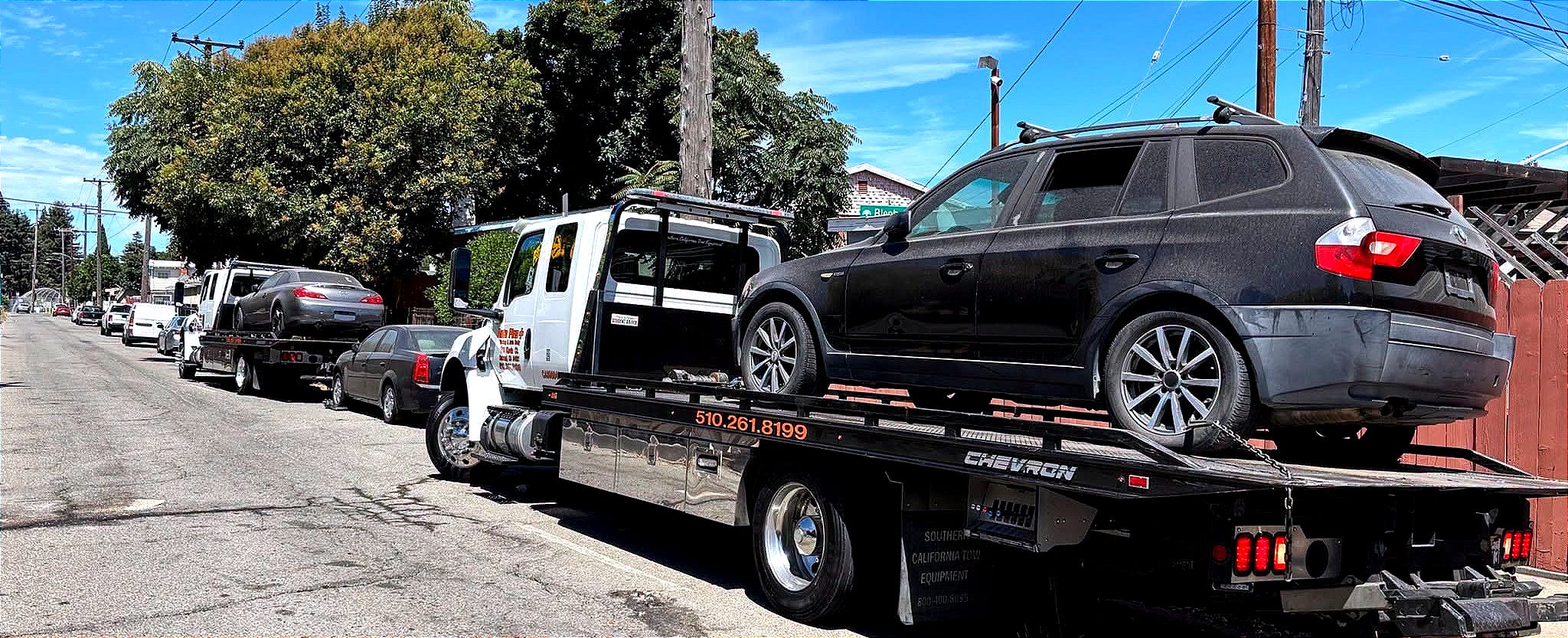
Council members pressed for more details about the proposed division of responsibilities. The discussion included whether stolen vehicles should be distinguished from ordinary abandoned vehicles, what moving VEU to OPD would accomplish, and what would happen to the civilian employees and specialized positions created for the unit.
The administration delayed the proposed transition until mid-May while it continued working through the reorganization.13 By June, the plan had changed again, moving administrative parking functions to the finance department, and retaining parking enforcement and VEU in OakDOT.14
The line between stolen and abandoned
The division between OakDOT and the police department looks relatively straightforward on paper: OakDOT handles abandoned vehicles on public streets, and police investigate vehicle theft.
On the street, the work overlaps. A vehicle can be reported stolen to police, dumped somewhere else, stripped, reported to Oak311 as abandoned and eventually encountered by OakDOT’s Vehicle Enforcement Unit.
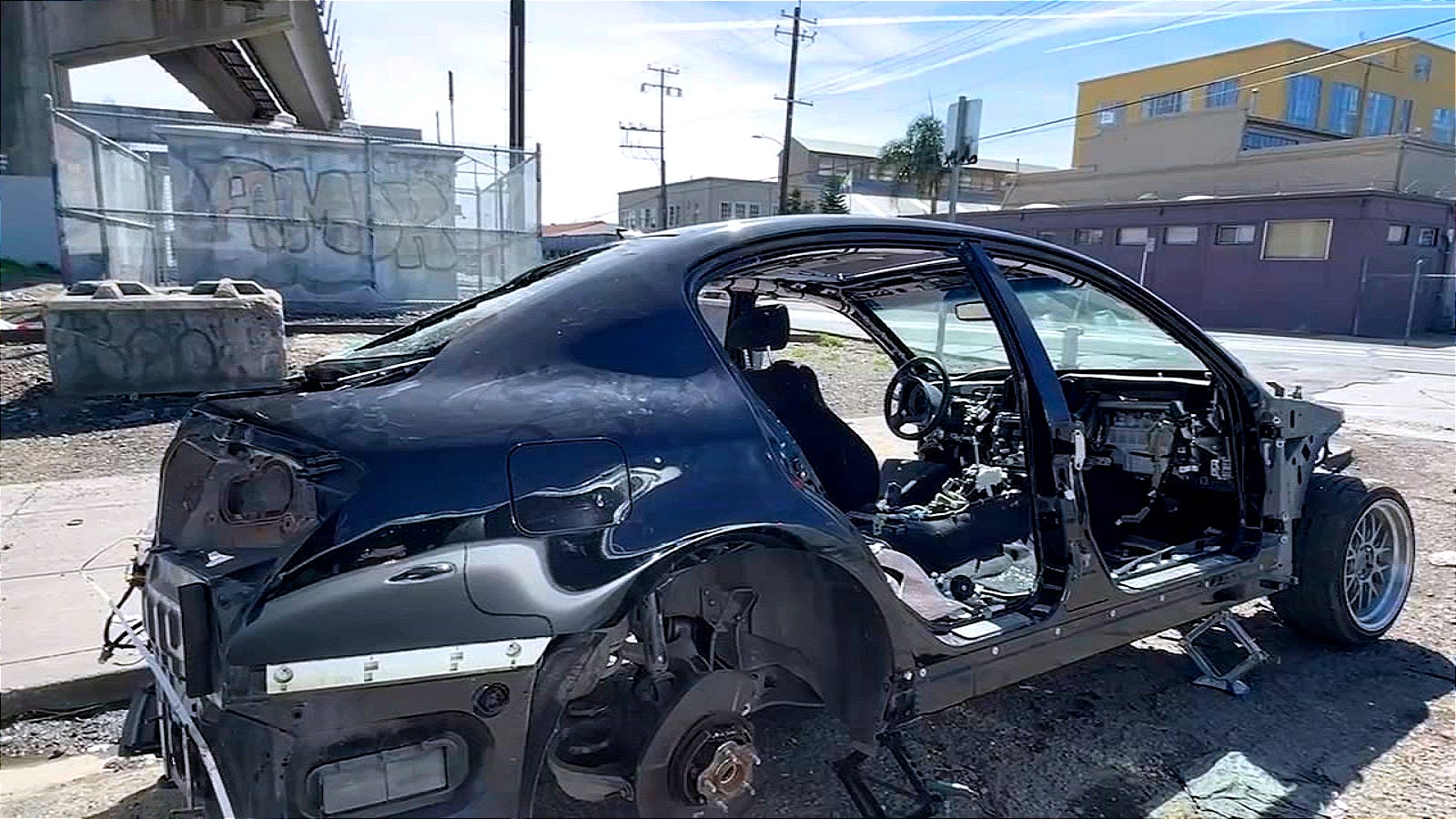
That overlap was built into VEU from the beginning. The city’s 2024 VEU report said that stolen vehicles were being treated as emergency or high priority cases. In the unit’s first nine months, 778 of 2,508 VEU tows (31%) were stolen vehicles.
The report also established a division of responsibility: when VEU encountered a stolen vehicle while responding to a 311 request, the police department was to take the lead if the vehicle had an associated felony warrant.
Measurements remain unclear
Oakland ultimately kept the VEU in OakDOT. However, abandoned auto enforcement crosses departmental lines, particularly when abandoned vehicles are also stolen. What is less clear is how that coordination is working today and how its performance is measured.
That matters significantly in East Oakland, where districts 6 and 7 account for nearly 60% of Oakland’s current open and pending abandoned auto requests. This is the same area where residents voiced their concerns to police department representatives at the National Night Out event — and police responded with a targeted vehicle removal operation.
The question may no longer be whether abandoned auto enforcement belongs in OakDOT or the police department. It is whether Oakland can make the two departments work together effectively.

Oakland Report is an experiment in a new form of media: reasoned, data-driven, well-sourced analysis focused on observable and verifiable evidence. We present the facts and let the reader decide. Do you have an idea for a story on local government issues? Learn more at oaklandreport.org/about.
Endnotes
See the methodology and source data for this story here.
City of Oakland. “OPD tows 60+ abandoned and stolen vehicles.” City of Oakland news release, Sept. 1, 2026. https://www.oaklandca.gov/News-Releases/OPD-Tows-60-Abandoned-and-Stolen-Vehicles
City of Oakland. “Service requests received by the Oakland call center (Oak311).” City of Oakland open data portal, accessed Sept. 16, 2026. https://data.oaklandca.gov/Infrastructure/Service-requests-received-by-the-Oakland-Call-Cent/quth-gb8e/about_data
City and County of San Francisco. “311 online services.” SF.gov webpage, accessed Sept. 16, 2026. https://www.sf.gov/topics--311-online-services
City of Oakland. “Reimagining public safety task force report and recommendations.” Community policing advisory board, Apr. 29. 2021. https://www.oaklandca.gov/files/assets/city/v/1/boards-amp-commissions/documents/cpab/oakland-rpstf-report-final-4-29-21.pdf
City of Oakland. "Adopted policy budget, fiscal years 2021–23." City of Oakland budget portal, accessed Sept. 16, 2026. https://stories.opengov.com/oaklandca/published/3fGcp45Oz
City of Oakland. "Report on status of implementing policy directives: vehicle enforcement unit transition." Oakland city council meeting, May 29, 2024. https://oakland.legistar.com/View.ashx?GUID=6F1937C1-7B05-4C04-A1AA-B30D3AB1F8BC&ID=12960037&M=F
City of Oakland. “Abandoned auto unit / vehicle enforcement unit.” Oakland Department of Transportation webpage, accessed Sept. 16, 2026. https://www.oaklandca.gov/Government/Departments/Transportation-OakDOT/abandoned auto-Unit
City of Oakland. "FY 2022-23 policy directives: transfer of vehicle enforcement functions from OPD to Oakland Department of Transportation." Oakland Legistar, file document ID 12723393, 2024. https://oakland.legistar.com/View.ashx?M=F&ID=12723393&GUID=83CB3935-4FA0-4F28-8E4A-6BA25246E1EA
City of Oakland. "Abandoned auto program funding." Oakland city council meeting, Mar. 19, 2024. https://oakland.legistar.com/LegislationDetail.aspx?GUID=BF8E1D7A-1A7C-4B13-A5F6-877155C77ADB&ID=6565602
Johnson, Bradley. "Supplemental: reorganizing of the parking division." Oakland city council meeting, Feb. 26, 2026. https://oakland.legistar.com/View.ashx?M=F&ID=15297209&GUID=6659885F-E87A-4B3E-B771-83A9F6FB9A15
Johnson, Bradley. "Reorganizing of the parking division." Oakland city council meeting, Jan. 29, 2026. https://oakland.legistar.com/View.ashx?GUID=4D10021B-AA0F-4331-950D-D4E9AD693702&ID=15158185&M=F
City of Oakland. “Receive an informational report from the city administrator on the proposed reorganization of the department of transportation’s parking division.” Council public works and transportation committee meeting, Feb. 10, 2026. https://oakland.legistar.com/MeetingDetail.aspx?ID=1382373&GUID=B7DA7F3D-0A94-4D03-9C0B-CDECF40D19E7&Options=info|&Search=
City of Oakland. "Receive an informational report from the city administrator on the proposed reorganization of the department of transportation’s parking division.” Oakland city council meeting, Jun. 16, 2026. https://oakland.legistar.com/LegislationDetail.aspx?ID=7803655&GUID=0CF2640A-FEFF-40DF-A548-4C315824FCC4
Johnson, Bradley. "Supplemental: reorganizing of the parking division." Oakland city council meeting, Mar. 5, 2026. https://oakland.legistar.com/View.ashx?M=F&ID=15576613&GUID=DCD2D9CE-E185-415B-BC8A-34BD20D76CA0
I think it would be an interesting exercise to compare the abandoned auto numbers with other cities. This wasn’t even a discussion in Atlanta. Also, it would be an interesting exercise to compare Oakland to SF. When it comes to towing, SFMTA is the lead agency, and all tow related activities go through their dispatch center. It’s an impressive facility, and they have been gracious to take time to show us how they do things. OakDOT doesn’t have the dispatch center. It doesn’t even have a dispatcher.
This is a worthwhile conversation. Unfortunately, a scan of the public record misses quite a bit of nuance related to this matter. Here are the comments I left on Rajni’s substack. The thing that concerns me the most is the high risk related to this work, especially at night. I think you will see what I mean from my own experience noted below.
Rajni…this was an insightful article. I may need to get you to show me how you pulled the data. When I arrived, we started measuring two simple metrics - service requests received and service requests fulfilled. That ratio has tended to be around 4:1 with annual tow around 3k-3.5k. Those numbers are off the top of my head. So, there is some margin of error.
Here is what the data you shared doesn’t show, and I would welcome any and all input. Some items have been addressed:
- the AAU (abandoned auto unit) has historically been involved with encampment operations and engaged in tasks ranging from placing closure signs to using our with vehicles (with flashing lights) for traffic control purposes; the encampment management team within the CAO has never had their own resources, and we help where we can; maybe this isn’t the right approach, and we should just focus the abandoned autos
- the AAU also supports a number of city special events and OPD operations with printing and placing the advance warnings for No Parking; this is another area where we filled an operational gap, but we aren’t towing when we are installing signs
- for the safety of the team, I made the operational decision that we do not engage with occupied vehicles; I believe this to be the correct operational and legal decision as we are not LEOs
- in 2025, 70% of the AAU team returned to parking enforcement as part of some temporary CAO operational changes
- prior to spring 2026, the permanent AAU positions did not exist; this means we are bound by the MOU with labor partners and had to rotate acting assignments every six months; basically, every six months we had a new team; fortunately, we now have people hired into permanent positions
- when the AAU was moved from OPD to DOT, the funding came from OPD’s general fund budget; an operational change was made to use Measure BB funding to pay for AAU, thereby freeing up the OPD general fund budget
- we have a good partnership with OPD and have been implementing “tow sweeps” that have been quite successful; OPD leads the tow sweeps; DOT is a financial partner; I’m sure you heard CM Houston talking about how effective it was at 105th, and a tow sweep was recently completed in D6; I think this is high ROI work; the efforts will remove 40 - 100 vehicles at one time
- we continue to struggle with stolen vehicles; the process is what the process is, but the numbers of stolen vehicles left in Oakland continues to rise; I had a personal experience with an “abandoned auto” on E14 / 86th Ave; I called the team to report it. By the time I got off the phone, two gentlemen were stripping the car; they were kind enough to show me their guns so I could leave; they left an auto frame in the street; I called that in; the frame was gone by the time the AAU team arrived; stolen vehicles are a challenge and can be dangerous; that is an area where we do need to learn more from OPD.
The AAU team does good work. Can our process improve? Yes. Can we remove more autos? Yes. I am always amused with the vehicle/person comparison with S.F. How many should we be able to remove on an annual basis? How do we prevent them from coming here in the first place?
I’m sure you know that an urbanist nerd like me leans into prevention like we did at Courtland Creek. We are now removing zero abandoned autos after redesigning and rebuilding the street. These answers we seek are in the data. I’d welcome input in goal setting. Right now, it seems like we are trying to get out of the “just do more” mode.