



Editors’ note: This article was posted by Oakland resident M. Ballard on his Substack page. Oakland Report is republishing it with Ballard’s permission, with section headers and illustrations added, for our readers to consider.
BY M. BALLARD
What happened to city services after Measure E failed
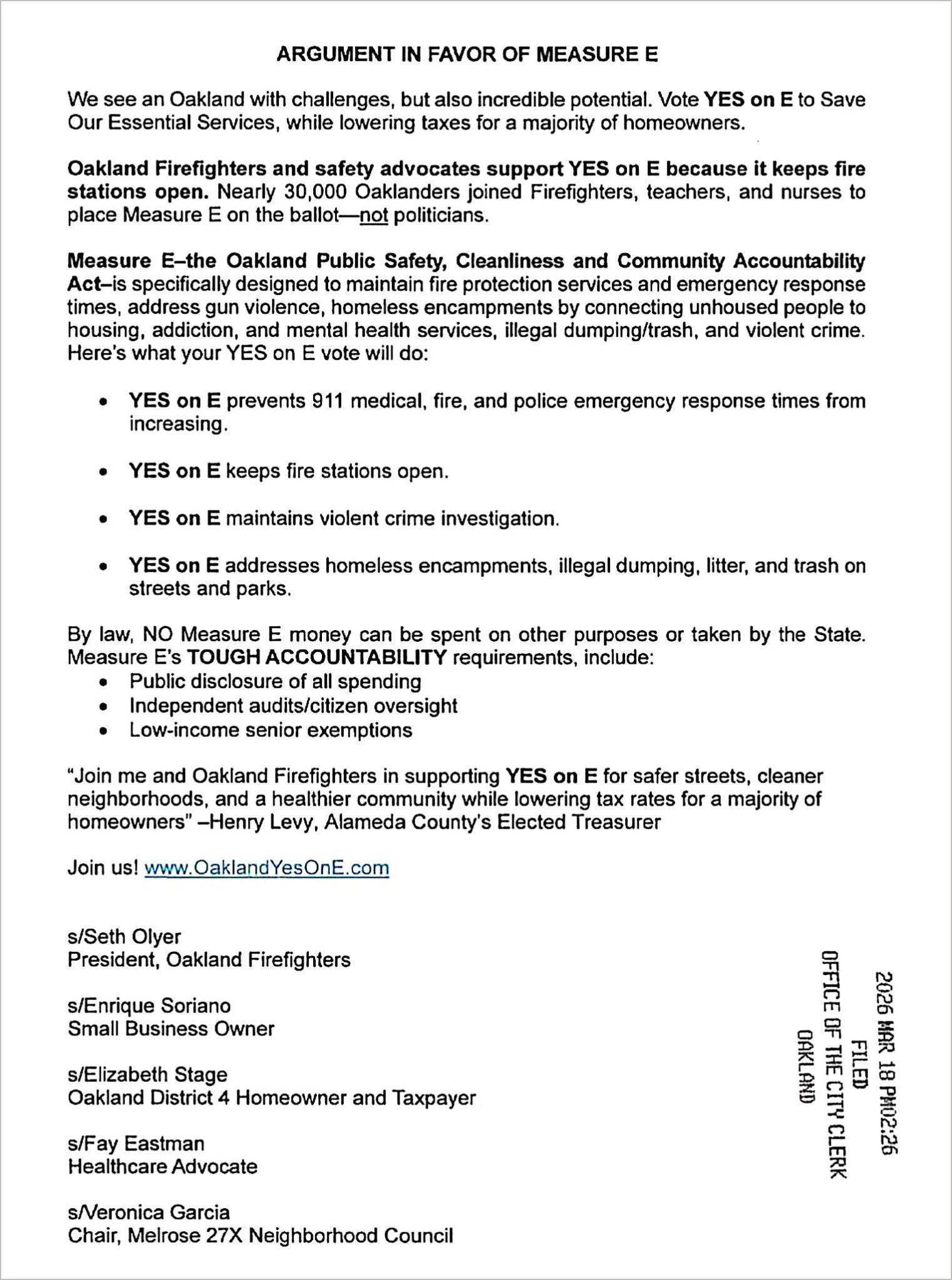
Oakland voters rejected Measure E, and that much is settled. Certified Alameda County results show the parcel tax failed in the June 2, 2026 election, 54.07 percent against and 45.93 percent in favor.
The measure would have raised roughly $34 million a year for nine years, spread across 911 response, fire protection, police services, violence prevention, homelessness response, and illegal dumping cleanup.
What happened after the vote is harder to pin down, and it matters more.
What survived: Oakland’s budget held core services without Measure E
The easy read is that Oakland lost the money and therefore cut the services. The city’s own records tell a stranger story.
Oakland adopted its FY 2026-27 midcycle budget on June 12 and balanced it with no Measure E revenue assumed.
Baseline police, fire, dispatch, and violence-prevention operations survived. Twenty-five operational fire engine companies stayed in service.
Homelessness outreach, dumping cleanup, environmental enforcement, street sweeping, recreation centers, libraries, and housing staff all remained funded at some level.
For a resident who needs an ambulance, a shelter bed, a cleared lot, an open branch library, or a staffed rec center, that floor is worth something.
Don’t miss a beat. Subscribe to Oakland Report.
Where the Oakland budget falls short: specialized policing, fire fleet replacement, and shelter beds
A funded floor is not a functioning city, though, and the records make the gap plain.
City staff flagged real limits on specialized and proactive policing: sideshow enforcement, Ceasefire investigations, targeted enforcement, human trafficking, burglary, vice, and commercial-corridor work.
Fire operations held at baseline, but staff warned that fleet replacement has no dedicated ongoing funding behind it.
Homelessness programs faced a $5 million state Continuum of Care gap, with roughly 190 shelter or housing beds at risk across six programs.
One-time money, fund balances, and waived voter mandates
Council patched where it could. Amendments restored money for two fire engines, illegal-dumping equipment, and emergency shelter.
Measure Q fund balance covered park bathrooms, tree and vegetation work, trash and litter and dumping, and more shelter restoration. Useful moves, all of them, and also a map of where the pressure sits.
What the city assembled reads less like a stable system than a set of scarce dollars shuffled from one weak point to the next.
That gap is what the “cuts versus no cuts” argument hides. Oakland avoided an outright collapse, but the fix it chose is fragile by design: one-time revenues, fund balances, and waivers from spending rules that voters themselves approved.
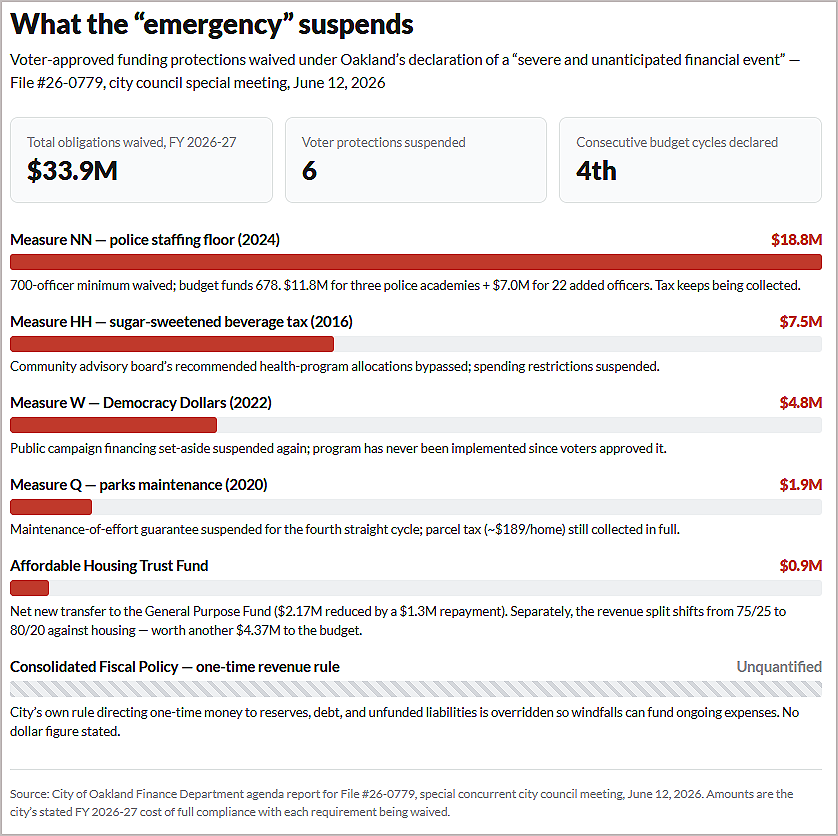
In a separate budget resolution, staff asked the council to declare a severe fiscal necessity, to budget below the 700-officer threshold tied to Measure NN, to suspend park-maintenance obligations under Measure Q, to pause Democracy Dollars set-asides under Measure W, to set aside advisory limits on sugar-sweetened beverage tax spending, and to redirect Affordable Housing Trust Fund revenue.
Fully honoring the relevant maintenance-of-effort and minimum-funding requirements, staff estimated, would have cost about $33.9 million in FY 2026-27.
Waiving that many voter commitments at once amounts to a public admission that Oakland’s promises now outrun what it can pay.
Why Oakland voters rejected the Measure E parcel tax
Voters had their reasons for the no vote. Property owners in Oakland already carry a heavy load. Residents have sat through budget emergencies before, watched officials pledge stability, then watched the next crisis arrive on schedule.
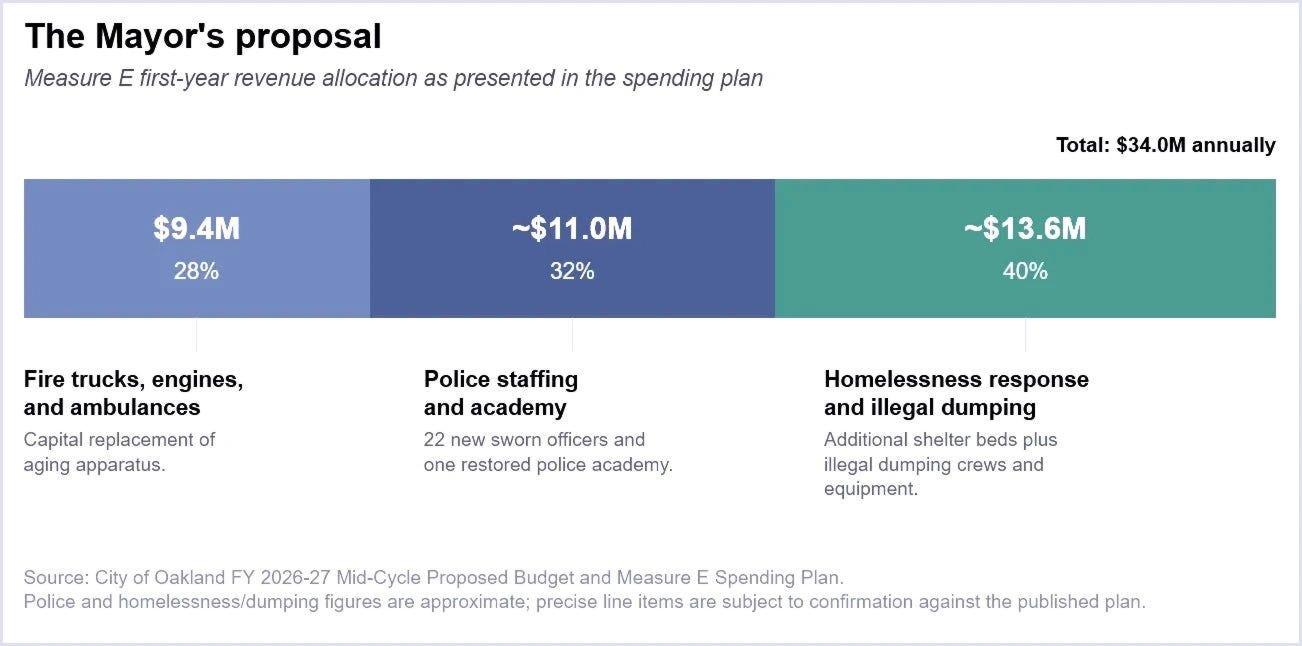
KQED reported that Mayor Barbara Lee, after the election, said the city could not carry out the Measure E spending plan, while describing the budget as built on reliable revenue, free of layoffs, and committed to core services.
Council President Kevin Jenkins read the result as a demand to deliver efficient service with what the city already has.
Both points hold up. No city can keep asking for more money without showing it manages what it has. But a rejected tax does not retire the underlying need.
The fire fleet keeps aging. Homelessness contracts are expiring, and outside funding stays uncertain. Illegal dumping still greets residents on their own blocks, less an accounting line than a daily signal that public order is slipping. And the police-staffing floor written into a voter measure remains, one the city now says it cannot meet without declaring an emergency.
Share this article with someone you know.
The service-by-service accounting Oakland residents deserve
“Services preserved” and “services cut” both flatten this. Residents deserve the version told service by service: what is funded, what is delayed, what is held together with one-time money, what is suspended by waiver, and what is already failing on the ground.
Take fire. The useful number is not whether 25 engine companies exist on a roster, but whether the yard holds enough working engines, ladder trucks, and ambulances.
For homelessness, residents should learn which of those 190 exposed beds were still open after July 31, which closed, and which got a temporary reprieve.
Dumping calls for published complaint volume, cleanup times, crew capacity, and the equipment that sits broken.
Policing calls for funded positions set against filled positions, and both set against what can actually be deployed once vacancies, academies, leave, and special assignments are subtracted from the authorized sworn count.
None of this means punishing city leaders for avoiding layoffs or holding basic services steady. Those were the right calls. It does mean refusing to let a patched budget be sold as a solved one.
A fiscal problem and a political problem on the same ledger
Measure E exposed a fiscal problem and a political one in the same stroke.
Oakland’s service demands outrun its reliable revenue, and, just as damaging, a majority of voters would not hand the city another parcel tax even when the money was pinned to services those same residents routinely say they want.
Neither problem cancels the other, and both now land on the same ledger.
The city’s next move cannot be to repackage the old ask and hope the mood has shifted. It has to show residents the arithmetic in plain terms: the real cost of one fire engine and one shelter bed, how much a crew can clear in a week, what a 700-officer requirement means once vacancies and academies and leave and special assignments are counted honestly, and which voter-approved promises are being waived right now to make the budget close.
Slogans will not cover it. Oakland needs a public balance sheet that ties dollars to outcomes.
The vote went one way and the budget went the other, and the crisis outlasted both. What remains to be seen is whether City Hall will level with residents before the next emergency takes the choice out of their hands.
📖
The views expressed in our Commentaries do not necessarily reflect the editorial views of Oakland Report or its contributing writers.
ABOUT THE AUTHOR
M. Ballard is a political writer whose work examines power, accountability, and the distance between public promises and real-world consequences.
His essays often begin with a local question and widen from there, connecting municipal politics to debates about democracy, economic power, racial inequality, public institutions, corporate influence, and emerging technology.
Rather than treating politics as a contest of personalities or party loyalty, Ballard is interested in who holds power, who benefits from it, who bears the cost, and whether the institutions involved are doing what they claim to do.
He is particularly drawn to subjects where political rhetoric obscures practical consequences, whether the issue is public spending, voting rights, corporate power, artificial intelligence, or civic responsibility. At the center of his work is a persistent belief that democracy requires more than participation. It requires scrutiny, historical memory, and a willingness to hold leaders and institutions accountable.
Born in New Zealand to expatriate parents, raised in Walnut Creek, California, and an Oakland resident since 1998, Ballard writes with a perspective shaped by both the Bay Area’s political culture and the lived realities of a city where policy decisions are rarely abstract.

M. Ballard

WE ARE 100% SUPPORTED BY YOU
Oakland Report is an experiment in a new form of media. We provide reasoned, deep-dive, data-driven reporting and analysis that you will find nowhere else. If you value our work, please donate.
References and further reading
Election result and Measure E terms
Alameda County Registrar of Voters, June 2, 2026 Direct Primary Election official results https://alamedacountyca.gov/rovresults/259/
City of Oakland parcel tax measure (Measure E) ballot text, Alameda County voter information guide https://acvote.alamedacountyca.gov/acvote-assets/02_election_information/PDFs/20260602/cityofoaklandparceltaxmeasure.pdf
Oakland primary election results: Measures E, C, and D (Oaklandside) https://oaklandside.org/2026/06/02/primary-election-results-oakland-ballot-measures/
Oakland voters will decide June parcel tax measure to fund police, fire and city services (Local News Matters) https://localnewsmatters.org/2026/03/05/oakland-voters-will-decide-june-parcel-tax-measure-to-fund-police-fire-and-city-services/
2026 election results for Oakland Measure E (KQED) https://www.kqed.org/elections/results/alameda/measure-e
Midcycle budget adoption, police reductions, and preserved services
City of Oakland, Fiscal Year 2026-2027 Midcycle Budget (official budget page and documents) https://www.oaklandca.gov/Government/Finance-Budget/Budget/Fiscal-Year-2026-2027-Midcycle-Budget
Oakland budget reduces police overtime after Measure E fails (East Bay Express) https://eastbayexpress.com/oakland-budget-reduces-police-overtime-after-measure-e-fails/
Oakland City Council approves mid-cycle budget after tense meeting (Local News Matters) https://localnewsmatters.org/2026/06/15/oakland-mid-cycle-budget-approved/
At vague preview of Oakland budget, officials pledge no layoffs or service cuts (Oaklandside) https://oaklandside.org/2026/05/14/barbara-lee-budget-proposal-oakland-measure-e/
Council amendments and one-time funding
Oakland City Council approves mid-cycle amendments to $4 billion budget without layoffs (ABC7) https://abc7news.com/post/oakland-city-council-approves-mid-cycle-amendments-4-billion-budget-layoffs-measure-failure/19292791/
Oakland council members propose one-time amendments to fund failed Measure E goals (Piedmont Exedra) https://piedmontexedra.com/2026/06/oakland-council-members-propose-one-time-amendments-to-fund-failed-measure-e-goals
Homelessness funding and statements from Mayor Lee and Council President Jenkins
Oakland’s Measure E tax is failing, threatening a push to boost ailing city services (KQED) https://www.kqed.org/news/12086350/oaklands-measure-e-tax-in-trouble-threatening-a-push-to-boost-ailing-city-services
Voter-approved spending rules and fiscal-necessity waivers
City of Oakland Budget Advisory Commission, FY 2026-27 agenda packet (compliance with Measure NN, Measure Q, Democracy Dollars, and other voter mandates) https://www.oaklandca.gov/files/assets/city/v/1/public-meetings/budget-advisory-commission/2026/bac-2026-27-05-agenda-packet_2.pdf
Oakland June ballot measures E and C explained, including the Measure NN 700-officer requirement and fiscal-necessity clause (Local News Matters) https://localnewsmatters.org/2026/05/01/oakland-june-ballot-measures-e-c-tax/
Oakland’s unanticipated financial emergency set to enter its fourth year (Oakland Report). https://www.oaklandreport.org/p/oaklands-unanticipated-financial-fourth-year
This is such a clearly thought-out and presented analysis -- fresh air blowing through a long-shut up house. Thank you! I want to know what happened with renegotiating the Waste Management contract such that citizens could -- without financial penalty -- get the size of containers they really need to dispose of their actual trash output so that they're not tempted to dump.
Thank you M. Ballard and Oakland Report. Excellent article. You are so right we do not need another slogan. If Oakland keeps doing this budget dance, it will become Oaklands last dance. The patching and cutting mentality has to stop. Oakland needs a complete outside audit, at the same time Oakland needs a plan to raise real productive revenue, which means bringing back our small and medium businessess, cleaning up the crime, and attracking new apprentice jobs. Revenue comes from being productive, not more taxes and handing out speeding tickets like it is candy. Oakland does not have a money problem, we have a leadership crisis and a thinking problem. Mindy Pechenuk, for Oakland Mayor, electmindy.com