


Video clip 1: Warning: graphic content. Compilation of unsanctioned after-hours party scenes in the streets near the official First Friday event. (Source: Instagram / various accounts)
PART ONE OF A SERIES
Editors’ note
Oakland Report is launching a multi-part series this summer that will take a closer look at Oakland’s First Friday festivals and the neighboring Uptown district, and the efforts by festival organizers and the city to maintain safety and order during and after the official event.
We’ll examine data and evidence related to the increase in criminal activity that takes place during unofficial after-hours gatherings in the streets near the First Friday street festivals — much of them focused in the neighboring Uptown arts and entertainment district.
The city of Oakland has long struggled to contain these unsanctioned gatherings, and announced this week a new plan to curb them.
We’ll also delve into the rich history and importance of the Uptown neighborhood, including marquee destinations like the Fox and Paramount theaters, and the ecosystem of eateries, bars and other venues around them.
As we move through the series, we plan to take deeper dives into the economic vitality and development of arts and entertainment in Uptown — and follow up on the city’s safety efforts at the First Friday festivals and unsanctioned after-parties throughout the summer.
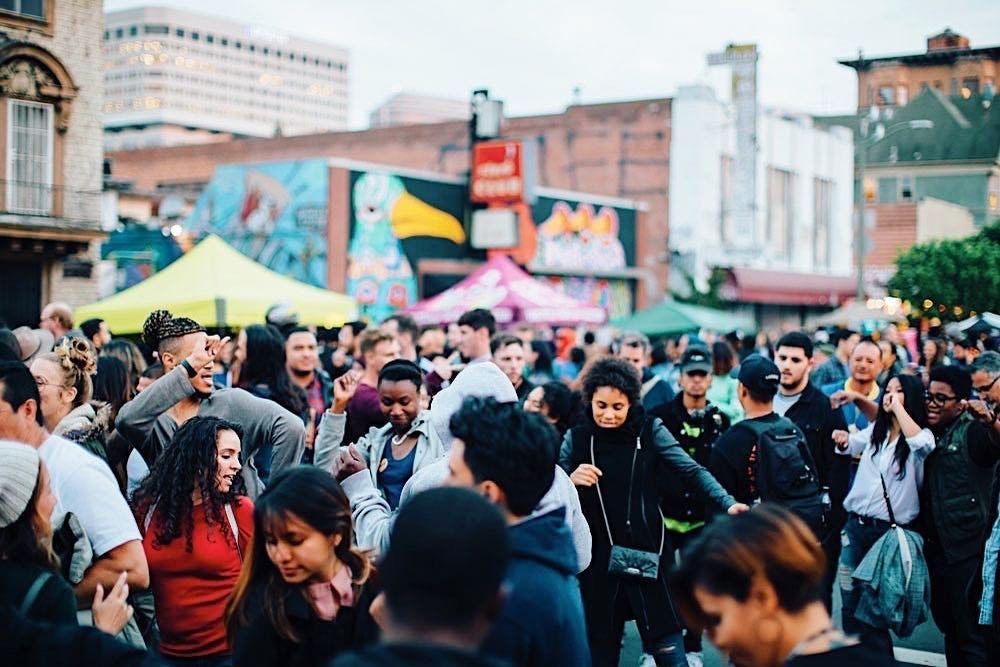
A cherished street festival and community asset
Oakland First Fridays is a long-running street festival held on the first Friday of each month in the Koreatown-Northgate (KONO) neighborhood. The official festival is held from 5:00 p.m. to 9:00 p.m. on Telegraph Avenue from West Grand to 27th Street, and features food, art, performances, and other attractions.
The free event draws up to 30,000 people depending on the season and weather, according to the official First Fridays website.1
A 2014 economic impact report concluded that the festival generated an estimated $52,000 per month in revenue (in 2014 dollars) for participating merchants and vendors — well above the average revenue on non-festival Fridays.2
First Fridays is a cherished event that celebrates Oakland’s vibrant culture, art, and business communities, and introduces thousands of people across the Bay Area region to the extraordinary and unique city of Oakland.
But this success has not been without its challenges. Almost since the festival’s beginning in 2013, unsanctioned after-hours gatherings in nearby neighborhoods have posed persistent public safety problems.

Late-night crime increased 44% during unsanctioned street gatherings after the First Friday festivals
Oakland Report analyzed Oakland Police Department (OPD) crime data to test whether crime actually does increase during the unsanctioned late-night street gatherings that routinely occur a few blocks south of the official First Friday festivals.
Our analysis found consistent, significant spikes in crime during these unofficial after-hours gatherings — concentrated just south of the official festival event area.

The landmark Fox Theater at 1807 Telegraph Avenue is located a few blocks south of the official First Fridays festival area, and appears to be the (unofficial, unwilling) focal point of the unsanctioned after-hours street gatherings.
Oakland Report analyzed every crime incident recorded within a quarter-mile radius of the Fox Theater between 5:00 p.m. Fridays and 6:00 a.m. Saturdays from January 2007 through May 2026.3
We then compared crime incidents on the first Fridays of each month and the Fridays one week before and one week after, regardless of whether a First Friday festival was held.
We then focused on just the 150 dates when official First Friday festivals took place, excluding the years before the festival came into being in 2013, and periods when the festival was on hiatus.4
Key findings:
Late-night crime incidents increased an average 44% during unsanctioned street parties a few blocks away and shortly after First Friday festivals. On the nights of First Friday festivals, the quarter-mile radius area around the Fox Theater averaged 5.6 crime incidents a night, as opposed to 3.8 crime incidents on the Friday nights in the previous and following weeks. The crime increases occurred almost entirely in the late hours past 9:30 p.m.
Crime was higher during the late-night hours after the official festivals ended. Festival nights averaged 3.6 incidents after 9:30 p.m., compared to 2.1 incidents on non-festival Fridays. Meanwhile, the earlier evening hours of 5:00 p.m. to 9:30 p.m. showed almost no difference.
Crime in the study area a few blocks south of the festival was consistently lower on the first Fridays of the month when there were no festivals. The first Fridays of the month when no festivals were held experienced roughly the same baseline rate of crime as other non-festival Fridays (around 3 to 4 incidents per non-festival Friday night).
Crime incidents skewed more violent in the late-night hours after First Friday festivals. Assaults, robberies, weapons, and threats made up around 32% of festival-night crime incidents, compared to approximately 20% of crime incidents on non-festival Fridays.

Correlation is not causation
Several important caveats apply to this data.
The data is composed of reported crimes, and does not include crimes that occurred but were not reported to police.
Approximately 5% of the crime records in the dataset were timestamped at exactly midnight, suggesting that these may have been default system settings for crimes that occurred at other times on their respective dates. This relatively small percentage of reported crimes were excluded from the data.
Correlation is not causation. There are likely other factors at play, aside from the festivals, that contribute to the statistics shown in the crime data. While the increased late-night crime is clearly correlated to the First Friday festivals, no causal link is established by the data itself.
However, it stands to reason that when a large number of people are in a given area it is likely to result in more property crime independent of any one cause. Notably, auto burglary and theft are the most frequently reported crimes in the data used for this analysis.
It also is reasonable to consider the possibility that some high-spirited festival attendees may choose to linger in the area after the festival, and that new attendees may arrive shortly after the festival ends in order to participate in the unsanctioned after-hours street gatherings that routinely follow it.
Additionally, the correlation between festival dates and a spike in crime in the area during the late-night unsanctioned street gatherings that follow the festivals is such that it can reasonably be construed to be at least partly due to the presence of large crowds at the festivals, which take place on a memorable recurring event date — and public awareness and notoriety, built over many years, that unsanctioned late-night street gatherings routinely follow the festival.
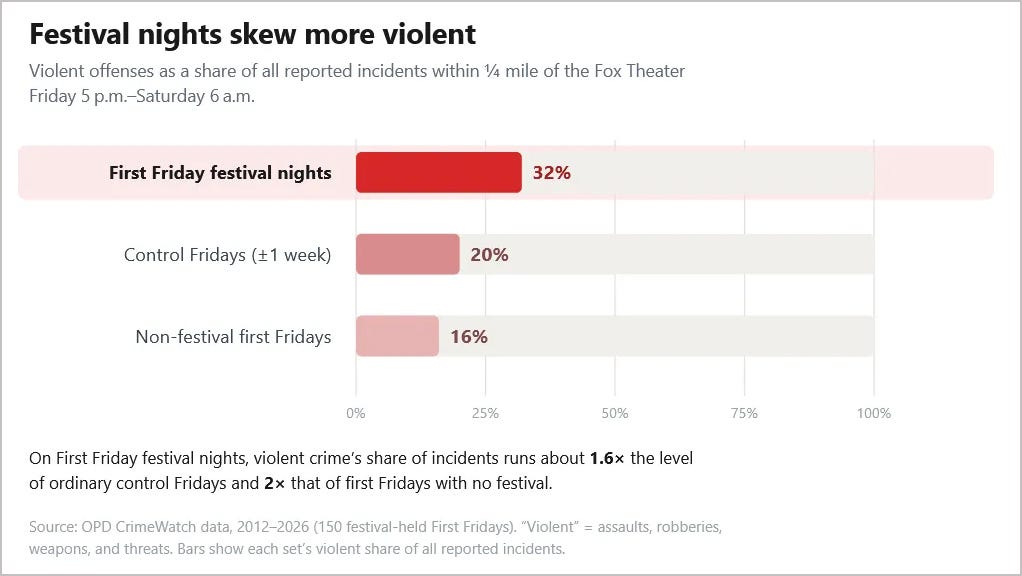
Data indicates that late-night crime skewed more violent on festival nights after the official events ended
On the nights of First Friday festivals, violent offenses — battery, robbery, weapons, and related violent crimes — made up about 32 percent of reported crime incidents, compared to roughly 20 percent on the Fridays in the preceding and following weeks, and 16 percent across all non-event first Fridays of the month.
A partial list of notable violent incidents that have occurred during the late-night hours after First Friday festivals includes:
May 2, 2026: Seven pedestrians, including a juvenile, were hospitalized after a reckless driver crashed onto the sidewalk near the Fox Theater around 1:30 a.m. Oakland police said the victims were allegedly targeted after a street brawl. The driver fled the scene on foot but was stopped by bystanders and later arrested.56
April 18, 2026: Two people were killed in a shooting and a subsequent retaliatory shooting in East Oakland (about five miles from the festival). Authorities said the violence stemmed from a dispute that began at the First Friday festival.7
September 6, 2025: Two people were killed and at least four others wounded in a series of early-morning shootings across downtown Oakland, not far from the festival area. Police said the initial investigation found no evidence connecting the violence to the festival. Police union representatives blamed the crowds for fostering the incident, and understaffed police for limiting the ability to curb and enforce the violence. First Friday organizers objected to suggestions that the crimes were linked to the festival.89
July 5, 2024: A woman was fatally shot at approximately 10:45 p.m. on the 1900 block of Telegraph Avenue — a few blocks south of the festival area, and not long after that night’s First Friday festival had ended.1011
May 5, 2022: A sideshow (reckless driving street takeover) erupted at Broadway and Thomas L. Berkley Way alongside the First Friday area during the festival. Police recovered a firearm, made multiple arrests, and towed dozens of vehicles.12
October 6, 2018: Five people were injured in a shooting around three hours after the festival and a few blocks away near 19th Street and Telegraph Avenue, prompting organizers to cancel the following month’s event to review security measures.1314
February 1, 2013: A man was fatally shot and three other people were wounded on the 2000 block of Telegraph Avenue near the festival shortly after the festival ended. Police described it as a targeted shooting. The city and festival organizers responded by shrinking the festival’s footprint, shifting the festival end time to earlier in the night at 9:00 p.m., and restricting alcohol.15
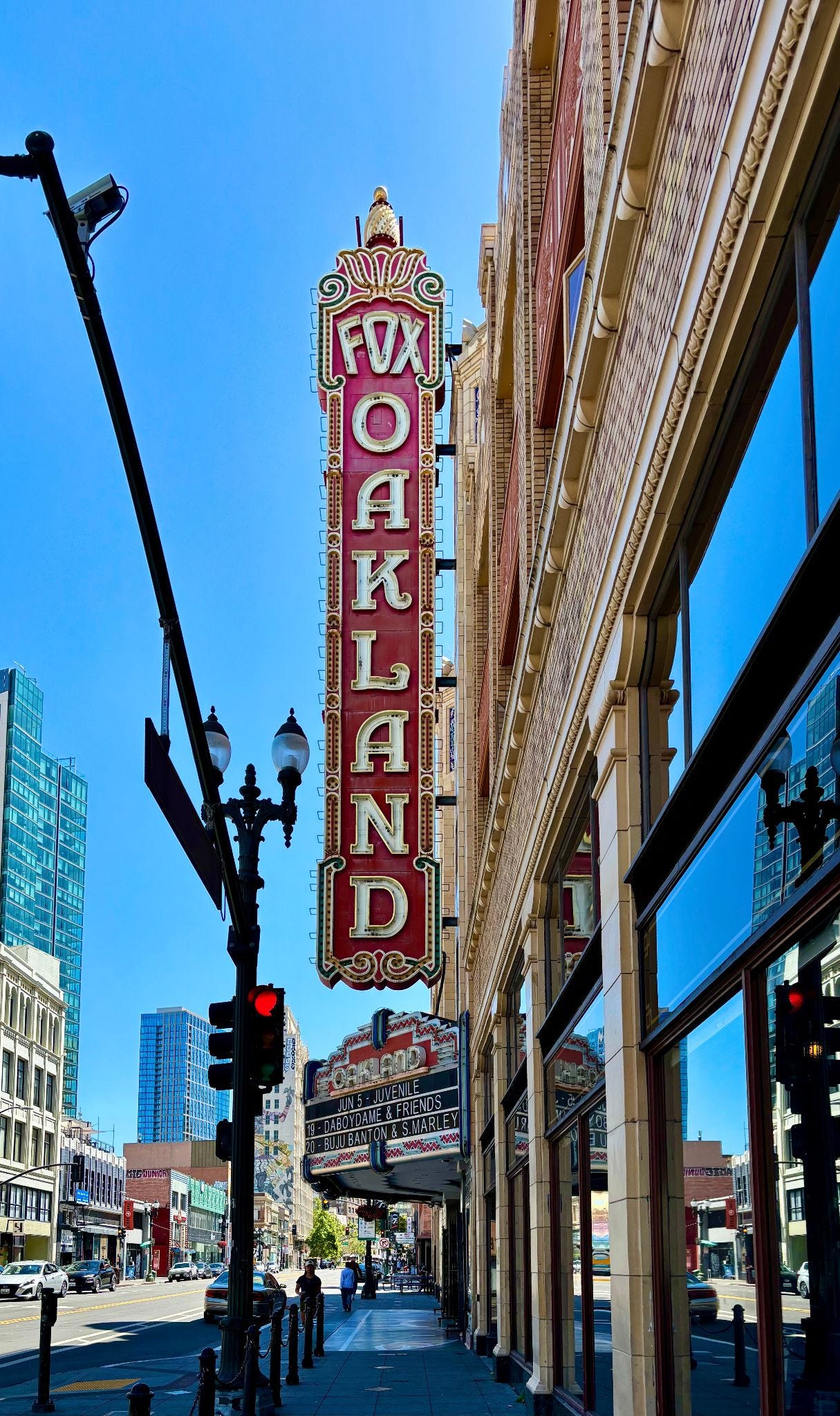
The city this week rolled out a new public safety strategy intended to curb the chaotic after-hours gatherings
The City of Oakland distributed a community safety plan at a Wednesday town hall meeting held in Fox Square Park on 19th Street and Telegraph Avenue across from the Fox Theater. (The new park is currently under development in partnership with Oakland School for the Arts, which is located in the Fox Theater building.)
The safety plan outlines coordinated crowd control and public safety operations for Friday and Saturday nights along Telegraph Avenue and Broadway, focused on the First Friday festival on June 5.
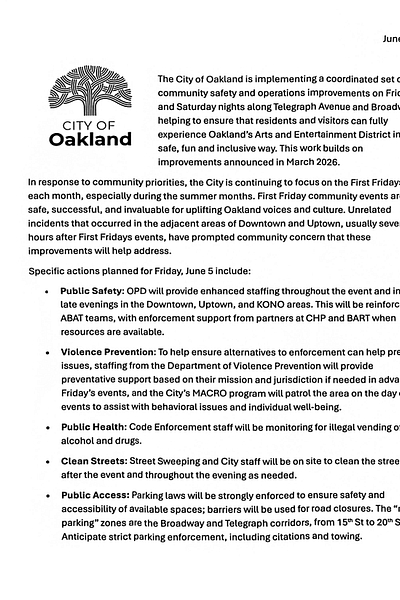
The plan also was described in a press release the city issued yesterday, along with supportive quotes from city officials.16
It describes the safety measures as building on operational efforts the city previously announced on March 5.17
The new plan asserts that the First Friday festivals are “safe, successful, and invaluable,” and attributes community concerns to “unrelated incidents” in adjacent Uptown and Downtown areas that occur “usually several hours after” the festivals end.
The plan outlines five categories of action for the June 5 festival:
Public safety. OPD to provide enhanced staffing during the festival and into late evening across Downtown, Uptown, and KONO, reinforced by California Highway Patrol and Bay Area Rapid Transit Police “when resources are available.” Additional enhanced activities to include enforcement of unpermitted vendors, alcoholic beverage sales, and illegal parking.
Violence prevention. The Department of Violence Prevention to “provide preventative support based on their mission and jurisdiction if needed in advance,” and Mobile Assistance Community Responders of Oakland (MACRO) to provide patrols for behavioral and well-being issues.
Public health and substance use. Code Enforcement, Alameda County Health, and Oakland Fire Marshal to provide enhanced monitoring of illegal alcohol and drugs.
Clean streets. City crews to provide street sweeping and clean up after the event.
Public access and transportation. City to conduct strict parking enforcement, road closures and “no parking” zones on Broadway and Telegraph Avenue from 15th to 20th Streets.
Four intersections will close to through traffic (16th/Telegraph, 19th/Broadway, 17th/San Pablo, and 17th/Telegraph), with barriers used for street closures.
The city recommends taking BART, AC Transit, or rideshare services if traveling to or through the area, and notes the availability of the Telegraph Plaza and Franklin Plaza parking garages.
Personnel categories and geographic enforcement areas are outlined in the plan without quantifying staffing levels, budget, or duration beyond the single June 5 date. The plan does not define any metrics for evaluating the effectiveness of the measures.
The safety plan, and the city’s proactive communication of it, signals that after years of escalating challenges and community concerns from residents and businesses, the city appears to be taking an all-hands-on-deck approach to curb the unofficial late-night street gatherings that routinely occur after the festival.
Don’t miss a beat. Donate to support our nonprofit work.
The next installment in this series will focus on the history and business operations of the Fox Theater and the central role it plays in the economic growth and vitality of the Uptown arts and entertainment district.
Future installments will focus on other notable venues and businesses in the area, and will follow the First Friday festivals, the unsanctioned after-hours street gatherings, and the city’s efforts to contain them throughout the summer.
We also plan to take a closer look at the Oakland Arena, the city’s largest and arguably best-known sports and entertainment venue.
Do you have something to say about this topic, or the broader topic of economic development in Oakland? We want to hear from you! Write to us.

WE ARE 100% SUPPORTED BY YOU
Oakland Report provides accurate, unflinching, data-driven reporting and analysis that you will find nowhere else. If you value our work, please donate. All contributions go directly to sustaining and growing our 501(c)(3) nonprofit work:
Oakland First Fridays contributors. “About.” OFF website, accessed Jun. 5, 2026. https://www.oaklandfirstfridays.org/about
Swift, Victoria et al. “Economic impact of Oakland First Fridays.” Mills College, Jan. 10, 2024. https://www.scribd.com/doc/219465502/199399474-Oakland-First-Friday-Economic-Report
City of Oakland. “Crimewatch data.” Oakland Police Department open data portal, accessed June 3, 2026. https://data.oaklandca.gov/Public-Safety/CrimeWatch-Data/ppgh-7dqv/about_data
Citizens Oakland contributors. “First Fridays incident data.” Citizens Oakland website, accessed June 5, 2026. https://www.citizensoakland.org/first-fridays-incident-data
Lee, Henry et al. "7 injured in Downtown Oakland after car mounts sidewalk following First Friday brawl." KTVU, May 2, 2026. https://www.ktvu.com/news/7-injured-downtown-oakland-after-car-mounts-sidewalk-following-brawl-during-first-friday-celebrations
Hassan, Anser. “7 injured after hit by car near Fox Theater in Oakland; arrests made.” ABC 7 Eyewitness News, May 4, 2026. https://abc7news.com/post/7-injured-hit-car-fox-theater-oakland-arrests-made-police-looking-driver/19030153/
Seldon, Aja and Henry Lee. "First Fridays dispute sparks deadly shooting, revenge killing in East Oakland." KTVU, Apr. 28, 2026. https://www.ktvu.com/news/first-fridays-dispute-sparks-deadly-shooting-revenge-killing-east-oakland
Hughes, Thomas. "Oakland First Fridays push back against police union's finger pointing.” Local News Matters, Sept. 8, 2025. https://localnewsmatters.org/2025/09/08/oakland-first-fridays-push-back-against-police-unions-finger-pointing-in-wake-of-shootings/
Katsuyama, Jana. “Oakland hit by series of shootings that left 2 dead.” KTVU, Sept. 9, 2025. https://www.ktvu.com/news/five-shootings-downtown-oakland-saturday-leave-two-people-dead
Mayer, Phil. "San Francisco woman killed near First Fridays festival in Oakland." KRON 4 News, July 9, 2024. https://www.kron4.com/news/bay-area/san-francisco-woman-killed-near-first-fridays-festival-in-oakland/
CBS News contributors. "San Francisco woman dies of injuries after being shot in Oakland." CBS News, July 9, 2024. https://www.cbsnews.com/sanfrancisco/news/san-francisco-woman-dies-of-injuries-after-being-shot-in-oakland
Goss, Emma. “Oakland First Fridays fill street where Cinco de Mayo sideshow chaos erupted” KTVU, May 7, 2022. https://www.ktvu.com/news/oakland-first-fridays-fill-street-where-cinco-de-mayo-sideshow-chaos-erupted
NBC News contributors. “Oakland First Fridays organizers cancel event following shooting.” NBC News, Nov. 2, 2018. https://www.nbcbayarea.com/news/local/Oakland-First-Fridays-Organizers-Cancel-Event-Following-Shooting-499395511.html
Green, Matthew and Peter Von Shuler. "Oakland's 'First Fridays' group cancels November event after recent shooting." KQED, Oct. 9, 2018. https://www.kqed.org/news/11700145/oaklands-first-fridays-group-cancels-november-event-after-recent-shooting
CBS San Francisco contributors. “Oakland scales back First Friday after fatal shooting.” CBS News, Feb. 27, 2013. https://www.cbsnews.com/sanfrancisco/news/oakland-scales-back-first-friday-after-fatal-shooting/
City of Oakland. “Oakland increases safety enhancements in Downtown and Uptown areas.” City of Oakland press release, June 4, 2026. https://www.oaklandca.gov/News-Releases/Oakland-Increases-Safety-Enhancements-in-Downtown-and-Uptown-Areas
City of Oakland. “Oakland announces community safety enhancements on Telegraph Ave.” City of Oakland press release, Mar. 5, 2026. https://www.oaklandca.gov/News-Releases/Oakland-Announces-Community-Safety-Enhancements-on-Telegraph-Avenue-Broadway
Another story you won’t see in the oaklandside, for reasons that should not need explanation.
Once again, the "leaders" of Oakland continue to allow a very small number of people to terrorize a city of at least 400,000 people.
OPD and these "leaders" know who they are but because of ideology, these "leaders" keep offering carrot upon carrot to the criminals while residents and small businesses are negatively impacted.
Former OPD chief Howard Jordan wanted to implement gang injunctions against a very small number of people because residents and small businesses along the 35th ave corridor have been terrorized (ie new parents too frightened to go out in the dark to get milk for their new borns).
Instead, former mayor Jean Quan told chief Jordan to not implement those injunctions. Also, Jean invited these gang members to her office to talk and of course, she bought their bullshit in that there werent any jobs for them.
Think about that, Jean invited gang members to her office but not the residents (and new parents) and small businesses. The altruism of these "leaders" keep criminals out of jail and as a result, residents are "jailed" in their homes because of fear and small businesses suffer because customers are too afraid to walk the streets to their stores.