


Video clip 1. A proposed data center has sparked a controversy in Oakland, with council member Carroll Fife proposing a moratorium on a modest data center in her district amid a burgeoning protest effort and conflicting definitions of what qualifies as a data center. (Sources: City of Oakland; NBC Bay Area; Instagram @nodatacenteroakland; KISS. Video montage by Oakland Report)
Oakland Agenda Watch provides summaries of upcoming public meeting agenda items that catch our attention. In this installment, we examine council member Carroll Fife’s proposed moratorium on data centers in Oakland.
A modest proposal draws a ‘mega’ controversy
Council life enrichment committee, Sept. 22, 2026, agenda item #5
On August 14, council member Carroll Fife (District 3) held a community meeting and press conference with the developer of a proposed artificial intelligence (AI) computing and “innovation campus” site in downtown Oakland. The proposed data center would re-use a vacant commercial property that formerly housed a Lawrence Berkeley National Lab supercomputing facility.
At the meeting, Fife emphasized her definition of the proposed project:1
“I want it to be absolutely, critically clear, this is not the large-scale mega facility that people have expressed.”
— Council member Carroll Fife, Aug. 14, 2026a
Four weeks later, Fife introduced an emergency moratorium that would pause city approvals of data centers for 45 days.2 State law allows moratoriums to be extended up to two years.3 The city council’s life enrichment committee will review Fife’s proposed moratorium tomorrow, Tuesday, September 22.
Among the ordinance’s findings are that “large data centers consume an exorbitant amount of water, up to 5 million gallons per day, to prevent servers from overheating.”
Oakland Report examined the text of the proposed moratorium, the proposed amendments submitted by council member Charlene Wang (District 2), and the sources they cite. We then estimated the amounts of water and electricity the proposed project would use.
Key findings
The moratorium’s sponsor, Carroll Fife has publicly stated that the project ‘is not a mega facility.’ Meanwhile, her proposed moratorium’s findings describe mega facilities — not the relatively smaller Oakland data center project.
Every statistic cited in the moratorium is national or statewide in scale. The report that accompanies the moratorium says the city “has not yet evaluated” whether local systems can serve data centers.
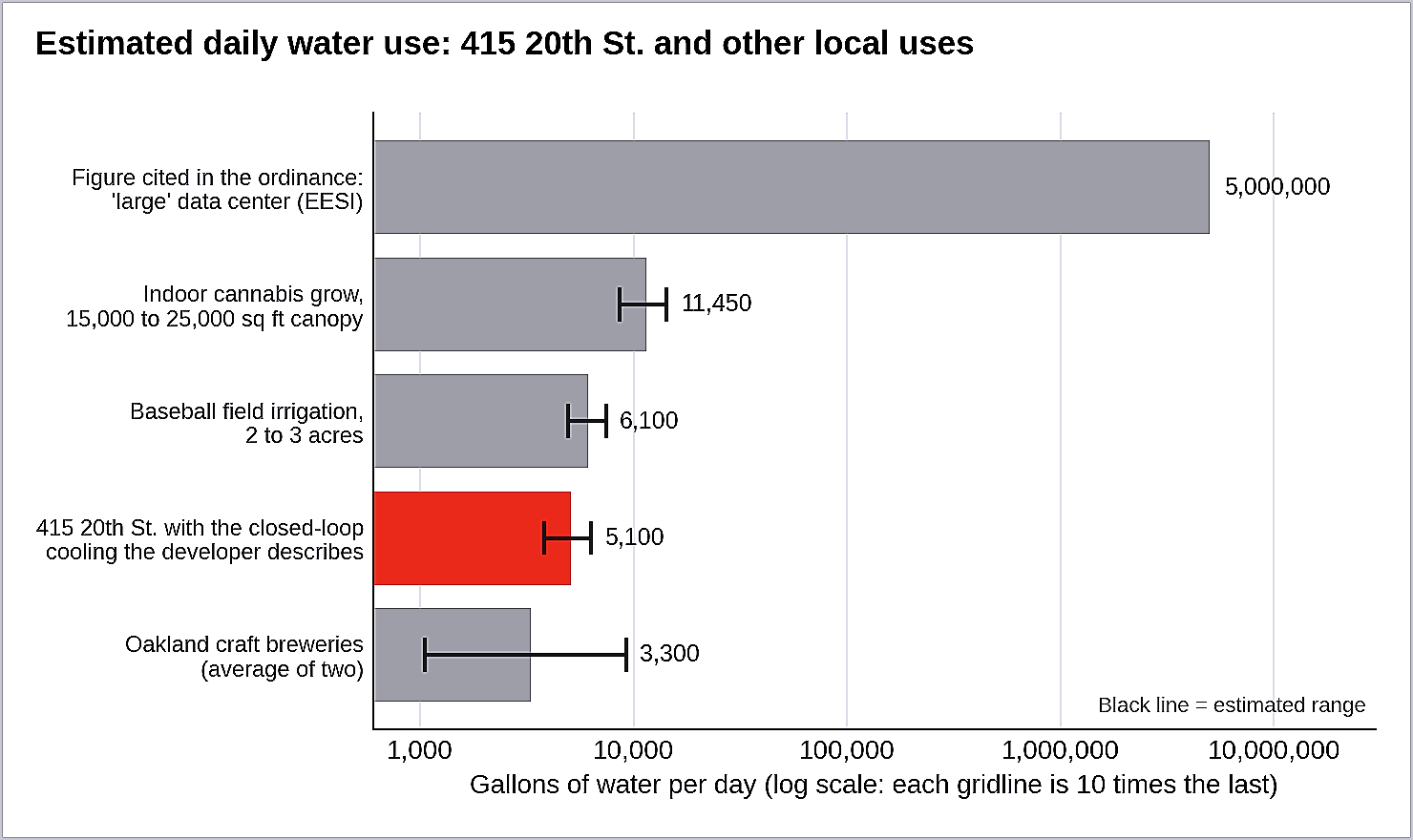
Water usage at the proposed 415 20th Street site likely would be about 5,100 gallons a day. If the project uses the closed-loop cooling its developer describes, the project would use only an estimated 5,100 gallons of water per day, a fraction of the 5 million gallons per day cited in the moratorium. The 5,100 gallons per day figure is comparable to to the amount of water a regulation-sized natural turf baseball field consumes for irrigation.
Electricity usage would be anywhere from 12 to 20 megawatts (MW) on average. This would be around 0.9% to 1.5% of all the electricity consumed in Alameda County in 2024. By that measure, the project’s consumption would be significant.
The moratorium appears to include public agencies (and the city’s own data centers). The city runs its own smaller data center, and said in 2023 that its 911 system would move to a commercial one in Oakland. The city also uses several third-party data systems that run through large offsite data centers. The proposed moratorium doesn’t say whether city or public safety facilities are exempt. (The state bill it cites does exempt them.)
The “no data center” campaign’s case appears to rest less on this specific Oakland building than on concerns about AI generally. The “no data centers” campaign fact sheet concedes that the Oakalnd project is not hyperscale, and argues that data centers create harm on a national scale.
What Oakland’s ordinance calls a “data center”
A data center is a building full of computers that store and move information. Data centers have become ubiquitous in modern society as people’s reliance on electronic information has expanded into many aspects of everyday life.
By one commercial directory’s count, there are 296 data centers in California. Only one is in Oakland.4
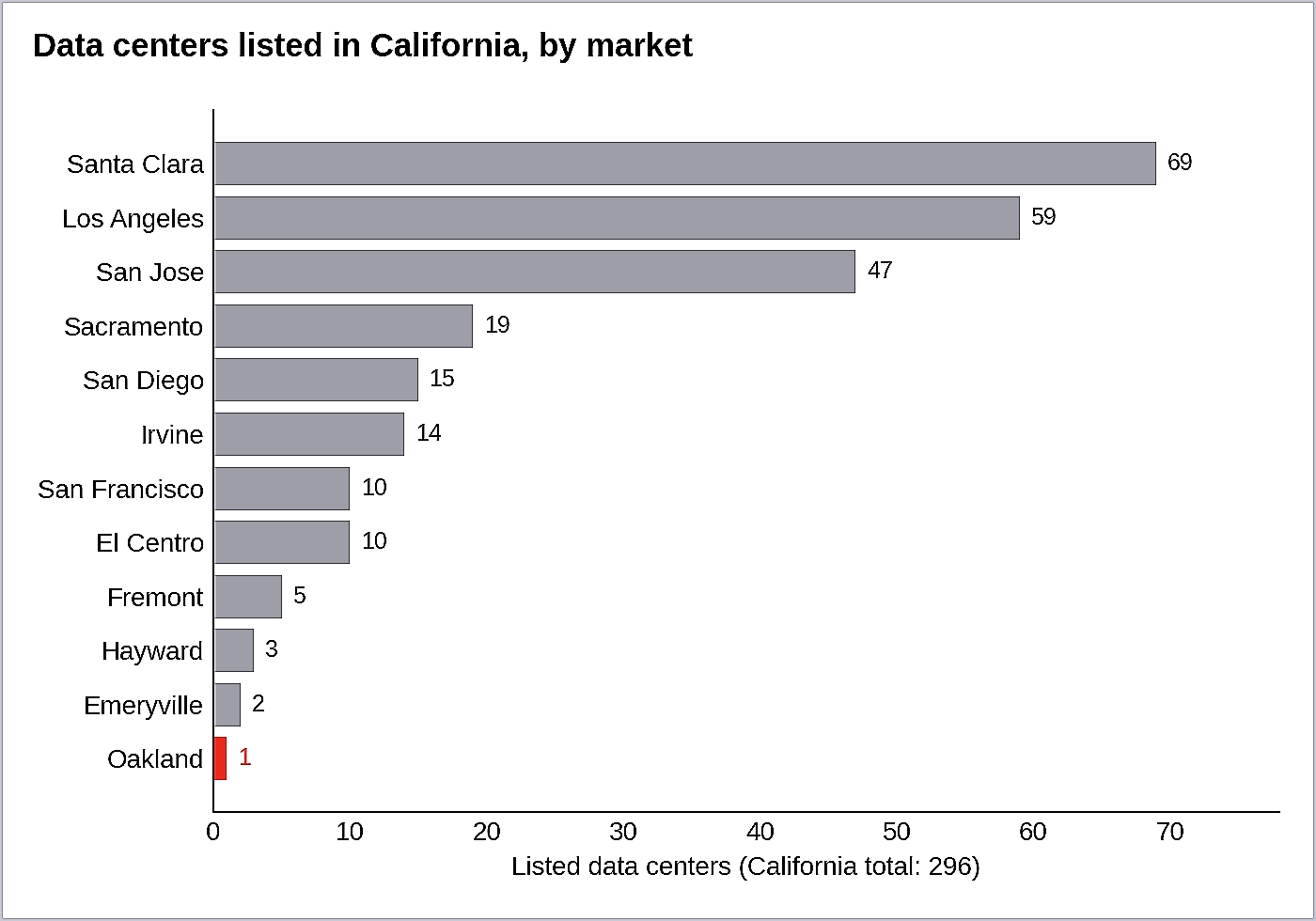
The proposed moratorium under review by the committee on September 22 includes any “building, facility or structure used for the storage, management, processing, and transmission of digital data.” It exempts only in-house server rooms. It applies to “any private or public entity” and does not exempt any existing sites.
State Assembly Bill (AB) 1577, which the moratorium cites, is narrower in scope. It covers facilities whose “primary purpose” is data. It excludes sites under 10 MW, and it excludes public and telecom buildings entirely.5 The governor has not acted on AB 1577 as of this writing.6
The building previously was a government supercomputer site, and is currently vacant
Neither the proposed moratorium nor the accompanying reports name a specific targeted project. But news reports strongly suggest that the intended target is a proposed data center at 415 20th Street.7
Lawrence Berkeley National Laboratory ran supercomputers there from 2001 to about 2015. Behring Companies bought the empty building in December 2025 for a reported $6.8 million. A prior owner paid a reported $36 million in 2019.8
(For more information on the developer, see Appendix A: Behring Companies.)9
Behring is marketing the over 20,000 square feet ground floor of the 415 20th Street building for AI computing. Chief executive Colin Behring describes it as “really strong computers in your office.”10
The building currently has 4.5 MW of power. Behring says his firm plans to increase that to 20 MW.
Behring told NBC Bay Area that a data center is typically an unstaffed room of racks serving outside parties, but this site would be different. The way the moratorium is worded, that distinction doesn’t matter: space rented to outside tenants appears to fit its definition whether or not people work nearby.
Water usage: the moratorium’s stated figure describes a ‘mega’ facility about 20 times larger
Data centers generate heat, requiring cooling systems to allow the computers to function. These systems commonly use water-cooled methods to transfer heat away from the equipment, sort of like a car’s radiator. Behring said in August that the 415 20th Street site would use a closed-loop cooling system, which recirculates water rather than evaporating it.11
(No engineering drawings have been made public yet.)
Taking the developer’s claim at face value, we estimated the site’s potential water use by multiplying the site’s computing energy by a standard water ratio for that cooling type, drawn from Lawrence Berkeley lab’s 2024 national study.12 We assumed 20 MW of computing running at 80% of capacity.
The result is that the proposed Oakland data center would use roughly 5,100 gallons of water per day. That is more or less equivalent to the quantity of water a regulation-sized natural turf baseball field uses for irrigation. It is more than the roughly 3,300 gallons a day used by two Oakland craft breweries we examined, and less than the water consumed per day by a mid-sized indoor cannabis growing facility with the same floor area.
Here’s how we calculated the estimates:
The ‘large,” hyperscale data center cited in the moratorium (which this project appears not to come close to in scale) would use an estimated 5 million gallons of water per day.
The proposed Oakland data center’s range was estimated based on computing at 60% to 100% of capacity using a closed-loop cooling system. The result is around 5,100 gallons of water per day.
Indoor cannabis growing averages 209 gallons per square foot per year. Therefore, a 15,000 to 25,000 square foot growing facility uses around 11,450 gallons of water per day.13
Irrigating the natural turf on a regulation-sized, 2- to 3-acres baseball outfield can use around 6,100 gallons of water per day.14
Craft beer breweries use about four to 13 gallons of water per gallon of beer, or seven gallons of water per gallon of beer on average.1516 We examined two Oakland breweries that make roughly 1,800 to 8,500 barrels a year: they use an estimated 3,300 gallons of water per day on average.1718
All figures except the ‘mega facility’ one cited in the moratorium are Oakland Report’s calculated estimates, not actual metered use.
To consume 5 million gallons of water per day (the figure cited in the moratorium), a site would need roughly 440 MW of ‘mega facility’ computing power — or around 20 times more than the 415 20th Street facility’s proposed electricity use.19
(Our estimate was calculated based on the developer’s verbal assurance that they plan to use closed-loop cooling, not a measurement based on a submitted engineering plan and specifications for this site.)
The amount of water used depends on the cooling equipment actually installed. If the building used evaporative cooling towers, like the Lawrence Berkeley lab once used to cool its supercomputers at this same site,20 our estimate rises to about 182,600 gallons of water per day — significantly higher than what the developer stated in August.
A specific cooling system plan submittal would settle the question of water use by this project. The moratorium doesn’t ask for one.
Electricity usage: by this measure, the project is large
Electricity usage would be much more significant at 20 MW, but still far less than in the ‘mega facilities’ commonly associated with the term, data centers. (The “no data centers” campaign materials concede this point.)21
The data show that at 20 MW running 60% to 100% of the time, the Oakland site would use roughly 105 to 175 gigawatt-hours per year. (One gigawatt is 1,000 megawatts.) For scale, that would be 0.9% to 1.5% of all electricity used in Alameda County in 2024 — a substantial amount.22 The entire Bay Area Rapid Transit (BART) system uses about 368 gigawatt-hours per year.23 The Port of Oakland’s utility sold about 84 gigawatt-hours to all its customers (for example, docked cargo ships) in 2020, the most recent year the state has verified.24
Behring told NBC Bay Area that electrical power would not be a problem for the Oakland site because California discards about 3.5 million megawatts of solar and other clean energy each year for lack of storage.
Increasing power capacity from 4.5 to 20 MW at the 415 20th Street building would require substantial new utility service. Neither the proposed moratorium nor the accompanying reports mention Pacific Gas and Electric or ask what the local grid can carry, nor do they estimate what the city would collect in utility tax.
Fife’s draft does not say whether the city would examine these questions during the moratorium’s 45-day pause on new data centers. Wang’s proposed amendments would require a study of local energy and water impacts.25
Subscribe for free to Oakland Report.
What the “no data centers” campaign says, and what the record shows
The “No Data Centers in Oakland” campaign publishes a fact sheet answering what it describes as “myths.” Oakland Report examined its four main claims.
1. The campaign says AI destroys jobs rather than creating them. The fact sheet cites a Tufts University analysis projecting 9.3 million US jobs eliminated in two to five years, including around 196,000 (8.5%) of Bay Area jobs.
What we found: The projection of 9.3 million eliminated jobs represents the Tufts study’s median scenario, within a range of 2.7 million to 19.5 million.26 However, that study actually is a forecast about AI adoption across the economy, not about data centers, and its authors say they left out any new jobs AI may create.
The fact sheet’s stated income figure, “$24.6 million” lost regionally, appears not to square with 196,000 jobs; that would be about $125 per job. The Tufts study projects income losses of at least $20 billion a year for the San Francisco area, so the fact sheet figure is likely meant to be billions, which would work out to around $125,000 per job.27
The campaign’s underlying point is that data centers employ relatively few people for the space and power they consume, compared to other industries. For his part, Behring has said the project would provide up to 2,300 jobs. That projection is worth noting, but it comes from an interested party, and hasn’t been independently verified.
2. The campaign says AI development will displace Black and working-class residents. It cites Oakland’s loss of nearly half its Black population between 1990 and 2011, a 13% rise in one-bedroom rents over the past year, and evictions up 4%.
What we found: The historical displacement is well documented, and the rent and eviction figures are sourced to reporting by the San Francisco Chronicle.28 A closer look reveals that the cited 4% figure is eviction filings across Alameda County, not evictions just in Oakland, and the same report says Oakland’s one-bedroom rents remain about 34% below their early-2020 level after inflation. The 13% one-year rise is a figure from the rental site Apartment List.29
Causation is also not established in this specific case. A 20,000-square-foot computing floor with few employees is a different kind of development from an office tower full of well-paid workers. If AI firms drive up Oakland rents, it is more likely through offices and residents than through server rooms.
The campaign is describing a real pattern here, but it doesn’t show how or to what extent this building would contribute to it.
3. The campaign says Oaklanders have had no say, and that Behring is avoiding public review. The fact sheet says that Behring claims that the building needs no new permit because it previously housed a supercomputer.
What we found: This is the strongest of the fact sheet’s four main claims, and the one the council can act on. It is partly correct in that the project actually may need no public approval. But we could find no record of Behring saying so, and the decision is the city’s, not the developer’s.
A later section on permits cites a July 2026 poll by the Public Policy Institute of California finding 73% of Californians oppose a data center in their community. That figure is accurate, and the survey found 63% of the respondents were concerned about environmental effects, with Bay Area residents most concerned.30 However, the poll was statewide and general. It did not ask about this project.
4. The campaign says size does not matter. The fact sheet says that because the Behring facility would run AI models trained at large data centers elsewhere, “all the environmental destruction from other data centers is the price other communities pay.”
What we found: The fact sheet does concede that the 415 20th Street building is not a hyperscale ‘mega facility.’ The national energy claims are mostly accurate, with one apparent error. Morgan Stanley projects a 45-gigawatt national power shortfall by 2028,31 and Reuters found that about 60% (13 of 23) of the fossil fuel plants slated to retire in the largest US power market had postponed or cancelled those plans. Most of these are small ‘peaker’ plants that run only at times of highest demand.32 The fact sheet inaccurately describes all of them as cancelled.
The size question matters more than the “no data centers” campaign suggests
The “no data centers” campaign’s reasoning on the size question may proves more than intended. If a facility is objectionable because models are trained elsewhere, it stands to reason that the same objection would apply to every device and app that uses those models — including the Instagram account where the campaign organizes.
It is also an argument against any local approval anywhere, which a city council cannot weigh against a specific site. It essentially concedes the point the moratorium’s own findings glide past: that the local harms here are unproven. As the fact sheet puts it, the developer “still hasn’t disclosed the actual environmental impacts.”
On that last point, the campaign and this analysis agree. The disclosures that would settle the question have not been released yet, either by the developer or the city.
The apps and websites used to organize the “no data centers” campaign run on data centers
The campaign against the Oakland data center project — which seems to have led to council member Fife’s moratorium proposal — was organized largely on Instagram.33
Meta (the company formerly known as Facebook which owns Instagram) says each user request goes first to a nearby ‘edge’ site, then to data center regions holding up to a million servers.34
Instagram uses AI to decide what each user sees on its platform. Meta says it runs more than 1,000 machine-learning models — a type of AI — to rank what content users are served.35 Most of that equipment is outside Oakland, in other communities, some of which are grappling with outsized, unanticipated impacts.
The campaign’s website runs on data centers as well. The site’s source code identifies it as a Squarespace site, which stores customer sites “in Tier III data centers across the United States” and delivers images through content delivery networks.3637 It does not say where those data centers are.
The “no data centers” website’s petition form also uses Google’s reCAPTCHA service to screen out automated submissions, which runs on Google’s servers, some of which would fall into the category of ‘mega facilities.’
The main takeaway here is that nearly any group that organizes or publishes online depends on data centers somewhere else.38 Especially with major platforms, these data centers often are ‘mega facilities’ of the type the “no data centers” campaign objects to — yet the campaign has centered much of its organizing activities around those very platforms.
City Hall runs its own data center, and relies on large-scale data centers in other communities
The proposed moratorium would apply to “any private or public entity.” That appears to include the City of Oakland, a public entity.
The city’s information technology (IT) department says it maintains “both on-premise data center and multi cloud environments.” Its public safety teams maintain the “911 Dispatch Centers, Emergency Operations Center,” as well as the police and fire radio system.39
The city has not published how many data servers it owns, where they are located, or how much power they use.
A significant portion of the city’s computing runs through other companies’ data centers:
Police body-camera video is stored in a cloud service run by the camera maker, Axon.40
License-plate data from the city’s nearly 300 Flock Safety cameras is held by the vendor.41
Building permits run on Accela, a commercial permitting platform.
The city’s financial system is moving to Oracle’s cloud.
911 dispatch. In September 2023, after outages blamed on a power failure, city officials said the new dispatch system “would be hosted in a commercial data center in Oakland with redundant power and cooling systems.”42
A ransomware attack in February 2023 shut down city systems and led to a local state of emergency. The mayor then proposed $10 million to modernize the city’s defenses.43 Upgrades of that kind often involve new equipment, wiring, cooling, and backup power, which need permits.
Neither the proposed moratorium nor the accompanying report materials say whether these facilities are exempt, either the ones the city owns, or the ones it runs its data through via service agreements.
The state assembly bill the moratorium cites exempts public safety, publicly owned, and telecom facilities, but in its current form, Oakland’s draft moratorium doesn’t.
Share this article with someone you know.
Does the Oakland data center project need a permit? It depends on one label
Routine permits: yes. Increasing electrical capacity from 4.5 to 20 MW would require city building, electrical, mechanical, and fire permits, plus air district permits for backup generators. None of these permits appear to require a public hearing, and state law exempts such ‘ministerial’ permits from environmental review.44
Notably, the council cannot review such permits case by case. Oakland’s charter gives it no administrative powers and bars members from influencing administrative actions.45 Its available tools for intervention are legislative, such as a moratorium.
Public review: unclear. The building sits in the D-DT-C downtown commercial zone.46 Oakland’s Planning Code has no ‘data center’ category, so city planning staff must pick the existing label that “most closely portrays” the use. The planning director’s choice can be appealed.47
In the base zone, office and research uses are allowed by right, and industrial research and light manufacturing need a conditional use permit with public notice and a hearing. But this parcel also carries an ‘Employment Priority’ overlay, whose rules “supersede” the base zone’s. Under it, the office-type uses are still allowed by right. The two industrial labels are prohibited, apart from a narrow exception for a use expanding from an adjoining lot.48
Thus, the decision appears to be between approval with no hearing and a use the site does not allow. If that reading holds, current zoning may offer no route to a public hearing. That may help explain why opponents have pressed for a moratorium.
(The city has confirmed a zoning determination request for the site.49 We could find no determination that has been made public as of this writing.)
The earlier supercomputer use likely is irrelevant. Under the code, a use that is not otherwise permitted loses its right to continue after one year of disuse — and computing at 415 20th Street appears to have stopped around 2015.50
On the claim itself: Behring has argued that the building would be used as it was before. We found no statement from Behring that it needs no permit or seeks to avoid review. The classification is the city’s decision.
The moratorium would bar building permits, not only land-use approvals. For a project that may need nothing else, that is likely the provision that would stop it.
What the agenda report does not weigh: downtown vacancies and the city’s urgent financial needs
The moratorium report’s fiscal section is one sentence: “There is no direct fiscal impact.” But that description seems to rest on a somewhat loose definition of those words.
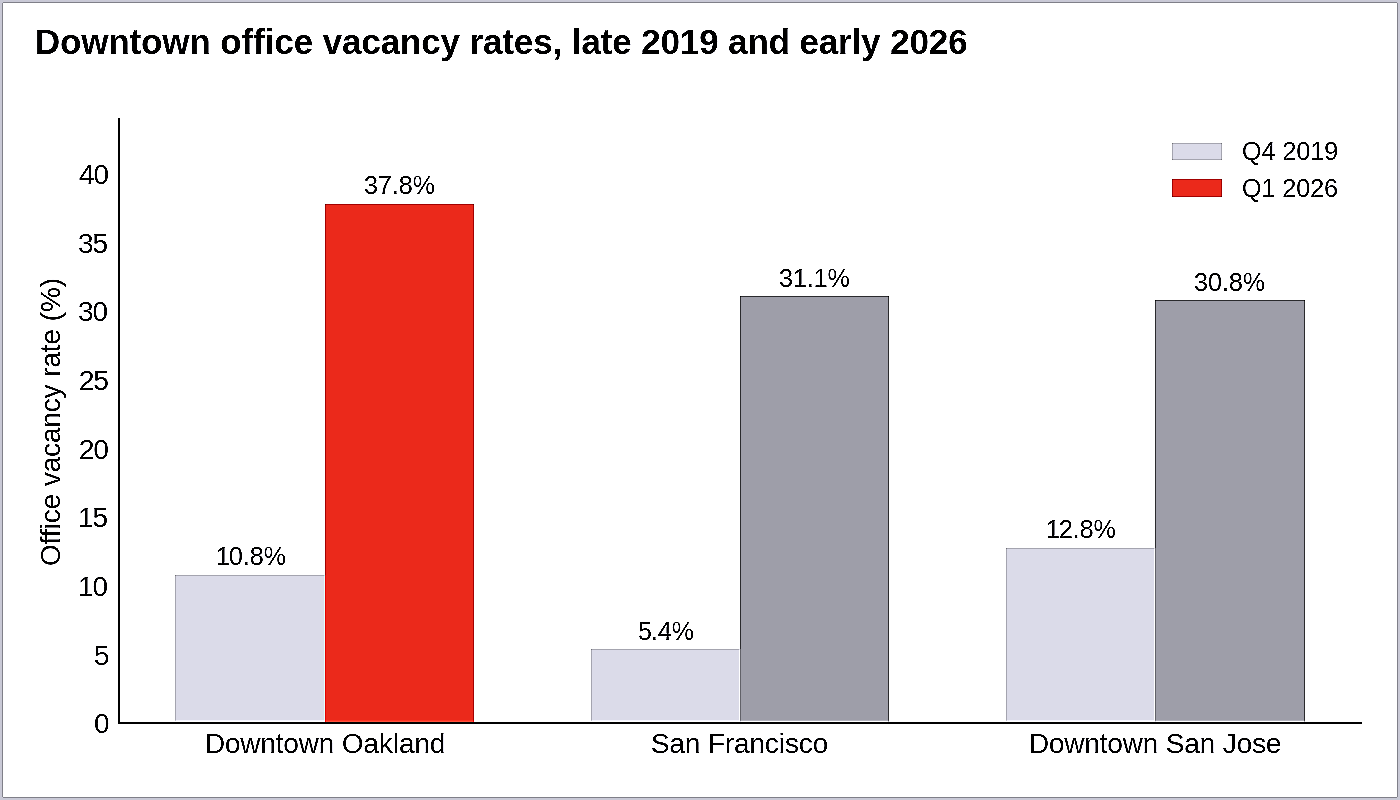
Downtown office vacancies increased from 10.8% in late 2019 to 37.8% in early 2026.51 The city’s five-year forecast projects a General Purpose Fund shortfall of roughly $115 million to $130 million each year through 2029-30.52
Oakland taxes electricity at 7.5% of charges.53 At published large customer rates, that would equate to an estimated $1.7 million to $3.2 million per year in tax revenue for a site this size. However, the code caps the tax for any one commercial or industrial location. The cap was initially set at $350,000 a year and has risen with Bay Area consumer prices since 1993.[55] A customer this large would reach the cap, so the city would collect the capped amount of tax — by our calculation, around $870,000.
A full room of public speakers is not the whole city, and council does not always follow the mood in the room
More than 70 people spoke against data centers on Sept. 15. The item was not on the posted agenda; speakers made their comment during the meeting’s open forum section.54
The “no data centers” campaign appears to be primarily led by the Party for Socialism and Liberation. The campaign website’s settings list the Bay Area chapter’s Instagram account as the site’s social profile.
(For information about the “no data centers” campaign organizers, see Appendix B: The Party for Socialism and Liberation in the Bay Area.)55
The campaign reports more than 6,000 petition signatures on its website and about 7,000 in press accounts. The petition form requires a name, phone number, and email address. ZIP code and city are optional, and the count cannot be verified as to how many signers are unduplicated Oakland residents.
Political scientists have long studied this pattern. American founder James Madison called it ‘faction.’ Morris Fiorina described how open meetings give extra weight to the few who attend.56 Some studies of public meetings have found that speakers don’t necessarily reflect the views of typical residents, and such speakers tend to lean against what is proposed.57
Oakland’s council does not always yield to this approach. At the same Sept. 15 meeting when the “no data center” campaign rallied and spoke during open forum, the council approved the police union contract 7-1 over numerous public speakers’ objections.58 In April, the council approved an encampment abatement policy 5-1, again over most public speakers’ objections. (That policy took around nine months to come to fruition, and the final version was softened.)59
Council member Fife’s own evolving statements on data centers appear to track with the volume and intensity of public speakers who oppose them. At the August 14 press conference, she said she knew the concerns about very large facilities moving into low-income communities and communities of color, and that she wanted to be sure average residents would ‘benefit.’ She also said she wanted it to be clear that this project was not such a ‘mega facility.’ She said stated that the Oakland project could help downtown.
After expressing her apparent openness to potentially approving the Oakland data center while ensuring that the city extracted value from it, Fife reported that she received death threats. A “no data centers” campaign organizer called the threats “unacceptable” and said the group was not behind them.60
Then on September 10, Fife signed an agenda report and submitted a proposed moratorium calling for an emergency freeze on all data centers, citing the risks of large ones. Fife says she had worked on data center rules since July.
The two positions can be squared. A council member can believe one project is modest and still want rules in place before larger ones arrive.
But the proposed moratorium doesn’t make that explicit. It has no size threshold, and its findings rest on the kind of facility its sponsor said this isn’t. The record doesn’t show or prove why her emphasis changed.
Other considerations and counterpoints
Twenty megawatts objectively is a larger-than-usual load for one downtown city block.
Fife’s August statement and her September ordinance are not necessarily at odds. The ordinance says the city has received inquiries about other sites, and a pause can be aimed at what comes next.
The city’s planning code has no data center-specific rules. A pause to write them is a common tool when new industries emerge, and state law permits it.
The developer’s closed-loop cooling system claim is unverified. If the site used evaporative cooling towers instead, summer water use likely would be substantially higher.
The city administrator can issue interpretations of the moratorium, within limits, and could exempt city and public safety facilities without an amendment.
Richmond, Oakley, and Gilroy have passed similar moratoriums.61 Hayward and San Francisco are considering them.
Petitioning and public comment are protected speech. The “no data centers” campaign disavowed the threats Fife says she received, and it is candid that the 415 20th Street building is not a hyperscale facility.
A 2026 statewide poll found 73% of Californians oppose a data center in their own community.
Council member Wang’s amendments would require a study of local impacts within six months. That could provide the hard evidence about this specific project which the record currently lacks.
Don’t miss a beat. Become a supporting member of Oakland Report.
What the record supports
Oakland’s code has a real gap, and very large, hyperscale data centers have caused real and significant impacts in other communities. But the proposed moratorium describes those ‘mega facilities,’ not this one. Its sponsor, Carroll Fife, said as much in August, and the “no data centers” campaign’s fact sheet concedes it while arguing that harm is occurring on a national scale.
By our estimate, the Oakland project would use relatively little water if built as its developer describes — and it would use a great deal of electricity either way. But neither figure appears in the city’s record.
The definition also reaches further than its authors may intend. As written, it does not separate a 20 MW computing floor from the data centers that run the city’s own 911 system.
The “no data centers” campaign and this analysis converge on one point: the disclosures and data that would settle the question have not been made.
All the above leads to several questions for the life enrichment committee when it takes up the proposed moratorium:
How will planning staff classify the use, and when?
What cooling system is planned?
Has the PG&E utility been asked about capacity?
Why no size threshold?
Are the city’s own data center, its 911 systems, and the commercial sites that host them exempt, and where does the text say so?
What will the consultant cost?
What happens with fewer than seven votes?
SUPPORT OUR WORK - DONATE TO OAKLAND REPORT
Oakland Report is an experiment in a new form of media: reasoned, data-driven, well-sourced analysis focused on observable and verifiable evidence. We present the facts and let the reader decide.
We are an independent 501(c)(3) nonprofit organization, not affiliated with any public agency, labor union, corporate interest or political organization. Your voluntary donation is needed to continue to produce accurate, well-researched, data-driven articles like this one.
Gutierrez, Hilda. “Proposed innovation center in downtown Oakland triggers questions, concerns.” NBC Bay Area, Aug. 14, 2026. https://www.nbcbayarea.com/news/local/proposed-innovation-center-downtown-oakland/4128395/
Fife, Carroll. “Moratorium on data centers.” Council life enrichment committee meeting, Sept. 22, 2026. https://oakland.legistar.com/LegislationDetail.aspx?ID=8203751&GUID=4775CA8D-0CB2-4BC8-BC13-DCCDA9352E08
Justia contributors. “California Government Code section 65858.” Justia website, accessed Sept. 20, 2026. https://law.justia.com/codes/california/code-gov/title-7/division-1/chapter-4/article-2/section-65858/
Data Center Map. “California data centers.” Accessed Sept. 20, 2026. https://www.datacentermap.com/usa/california/
California Legislature. "Assembly Bill 1577, data centers: reporting." Enrolled Sept. 1, 2026, sections 2 and 3. https://leginfo.legislature.ca.gov/faces/billTextClient.xhtml?bill_id=202520260AB1577
CalMatters contributors. “AB 1577: data centers: reporting.” Digital Democracy, accessed Sept. 20, 2026. https://calmatters.digitaldemocracy.org/bills/ca_202520260ab1577
Romero, Roselyn. “Data center moratorium sought by Oakland councilmember Carroll Fife.” The Oaklandside, Sept. 11, 2026. https://oaklandside.org/2026/09/11/data-center-temporary-moratorium-oakland-carroll-fife/
Swinhoe, Dan. "Former LBNL supercomputing facility in Oakland, California, targeted for 20MW data center." Data Center Dynamics, Aug. 12, 2026. https://www.datacenterdynamics.com/en/news/former-lbnl-supercomputing-facility-in-oakland-california-targeted-for-20mw-data-center/
Montana, Alex. "Appendix A: Behring Companies." Oakland Report, Sept. 21, 2026. https://oaklandreport.news/p/appendix-a-behring-companies
Lara, Juan Carlos. "Developer, councilmember say proposed Oakland data center isn't what you might think." KQED, Aug. 14, 2026. https://www.kqed.org/news/12095308/developer-councilmember-say-proposed-oakland-data-center-isnt-what-you-might-think
White, Maddie. “Oakland councilmember addresses pushback to proposed AI data center downtown.” CBS San Francisco, Aug. 15, 2026. https://www.cbsnews.com/sanfrancisco/news/oakland-ai-artificial-intelligence-downtown-data-center/
Shehabi, Arman et al. “2024 United States data center energy usage report.” Lawrence Berkeley National Laboratory, Dec. 2024. https://eta-publications.lbl.gov/sites/default/files/2024-12/lbnl-2024-united-states-data-center-energy-usage-report_1.pdf
MMJ Daily contributors. “Water use efficiency in large-scale cannabis cultivation.” MMJDaily, Mar. 4, 2021. https://www.mmjdaily.com/article/9299773/water-use-efficiency-in-large-scale-cannabis-cultivation/
Oakland Report estimate: turf water needs about 33 inches a year, multiplied by 27,154 gallons per acre-inch.
Foster, Kristen. “Changing tides: how breweries are combating water shortages and working towards sustainability.” Good Beer Hunting, Jan. 27, 2020. https://www.goodbeerhunting.com/blog/2020/1/27/changing-tides-how-breweries-are-combating-water-shortages-and-working-towards-sustainability
Peterson, S. D. et al. “Material and energy flow analysis of craft brewing: a case study at a California microbrewery.” Frontiers in Sustainable Food Systems, Nov. 10, 2022. https://www.frontiersin.org/journals/sustainable-food-systems/articles/10.3389/fsufs.2022.1028520/full
US Manufacturing Report contributors. "Ghost Town Brewing." US Manufacturing Report, Nov. 13, 2022. https://usmanufacturingreport.com/article/ghost-town-brewing/
Brewbound contributors. “Original Pattern Brewing Company breaks ground in Oakland.” Brewbound, Sept. 12, 2017. https://www.brewbound.com/news/original-pattern-brewing-company-breaks-ground-oakland. (Original Pattern has not published its annual output; Oakland Report estimated two to four batches a week on its 17-barrel brewhouse.)
Yañez-Barnuevo, Marcela. “Data centers and water consumption.” Environmental and Energy Study Institute, Jun. 25, 2025. https://www.eesi.org/articles/view/data-centers-and-water-consumption
Lawrence Berkeley National Laboratory contibutors. "Edison electrifies scientific computing." Computing Sciences news archive, Jan. 31, 2014. https://cs-newsarchive.lbl.gov/news/2014/edison-electrifies-scientific-computing/
No Data Centers in Oakland contributors. “Fact sheet.” No Data Centers in Oakland webpage, accessed Sept. 20, 2026. “Fact sheet.” Accessed Sept. 20, 2026. https://www.nodatacenteroakland.com/
California Energy Commission contributors. “California electricity consumption dashboard: consumption by county, 2024.” California Energy Commission, accessed Sept. 20, 2026. https://www.energy.ca.gov/data-reports/energy-almanac/california-electricity-data/california-energy-consumption-dashboards-0
Bay Area Rapid Transit contributors. “Energy use.” BART webpage, accessed Sept. 20, 2026. https://www.bart.gov/sustainability/energy
Chin, Gregory et al. “Renewables portfolio standard verification results: Port of Oakland, compliance period 3 (2017–2020).” California Energy Commission, Nov. 7, 2023. https://efiling.energy.ca.gov/GetDocument.aspx?tn=252998
Wang, Charlene. “Amendments to the moratorium on data centers.” Council life enrichment committee meeting, Sept. 22, 2026. https://oakland.legistar.com/LegislationDetail.aspx?ID=8203751&GUID=4775CA8D-0CB2-4BC8-BC13-DCCDA9352E08
Chakravorti, Bhaskar et al. "Will wired belts become the new rust belts? AI and the emerging geography of American job risk." Digital Planet, The Fletcher School, Tufts University, 2026. https://digitalplanet.tufts.edu/ai-and-the-emerging-geography-of-american-job-risk-page/
Talerico, Kate. “Oakland renters had the upper hand. Now, the market is turning against them.” San Francisco Chronicle, Aug. 6, 2026. https://www.sfchronicle.com/eastbay/article/oakland-rent-housing-market-22372084.php; https://archive.is/hmy72
Warnock, Rob. “San Francisco’s rental market is booming again.” Apartment List, Jul. 29, 2026. https://www.apartmentlist.com/research/san-franciscos-rental-market-is-booming-again
Baldassare, Mark et al. “PPIC statewide survey: Californians and the environment.” Public Policy Institute of California, Jul. 2026. https://www.ppic.org/publication/ppic-statewide-survey-californians-and-the-environment-july-2026/; https://calmatters.org/newsletter/data-center-ppic-survey/
Baldassare, Mark et al. “PPIC statewide survey: Californians and the environment.” Public Policy Institute of California, Jul. 2026. https://www.ppic.org/publication/ppic-statewide-survey-californians-and-the-environment-july-2026/; https://calmatters.org/newsletter/data-center-ppic-survey/
MLQ.ai contributors. “Morgan Stanley warns of looming 45-gigawatt U.S. power shortage driven by AI data center boom.” MLQ.ai, Nov. 12, 2025. https://mlq.ai/news/morgan-stanley-warns-of-looming-45-gigawatt-us-power-shortage-driven-by-ai-data-center-boom/
Kearney, Laila. “AI data centers are forcing obsolete ‘peaker’ power plants back into service.” Reuters, Dec. 23, 2025. https://www.reuters.com/business/energy/ai-data-centers-are-forcing-obsolete-peaker-power-plants-back-into-service-2025-12-23/
Fuwad, Ahamad. “A movement against data centers gains steam in Oakland.” The Oaklandside, Sept. 11, 2026. https://oaklandside.org/2026/09/11/data-centers-ai-oakland-protest-opposition/
Tang, Chunqiang. “Meta’s hyperscale infrastructure: overview and insights.” Communications of the ACM, Jan. 2025. https://cacm.acm.org/research/metas-hyperscale-infrastructure-overview-and-insights/
Levis, Luke et al. “Journey to 1000 models: scaling Instagram’s recommendation system.” Engineering at Meta, May 21, 2025. https://engineering.fb.com/2025/05/21/production-engineering/journey-to-1000-models-scaling-instagrams-recommendation-system/
No Data Centers in Oakland contributors. "Home page HTML source." No Data Centers in Oakland website, accessed Sept. 21, 2026. https://www.nodatacenteroakland.com/
Squarespace contributors. "Where does Squarespace store my data?" Squarespace Help Center webpage, accessed Sept. 21, 2026. https://support.squarespace.com/hc/en-us/articles/115012540827-Where-does-Squarespace-store-my-data
Disclosure: Oakland Report also depends on data centers. It is published on Substack and is moving to its own website hosted by Cloudflare, starting with Newsstand (oaklandreport.news). Its parent nonprofit Citizen Oakland’s website uses Squarespace.
City of Oakland. “Information Technology Department: department information.” City of Oakland adopted policy budget 2025-27, accessed Sept. 21, 2026. https://stories.opengov.com/oaklandca/published/gGFYLlITNl
Bondgraham, Darwin. "New Oakland police body cameras turn on automatically when officers draw their guns." The Oaklandside, Mar. 16, 2022. https://oaklandside.org/2022/03/16/new-oakland-police-body-cameras-turn-on-automatically-when-officers-draw-their-guns/
Bondgraham, Darwin. “New Oakland police body cameras turn on automatically when officers draw their guns.” The Oaklandside, Mar. 16, 2022. https://oaklandside.org/2022/03/16/new-oakland-police-body-cameras-turn-on-automatically-when-officers-draw-their-guns/
CBS San Francisco contributors. “Oakland announces $2.5M investment to improve troubled 911 system.” CBS San Francisco, Sept. 11, 2023. https://www.cbsnews.com/sanfrancisco/news/oakland-911-system-improvements-2-5-m-updgrades-hiring-call-takers/
Freed, Benjamin. “Oakland, Calif., mayor seeks $10M increase in cyber spending after ransomware.” StateScoop, May 8, 2023. https://statescoop.com/oakland-calif-mayor-seeks-10m-increase-in-cyber-spending-after-ransomware/
State of California. "Public Resources Code section 21080(b)(1)"; "California Environmental Quality Act Guidelines section 15268" (ministerial projects).
City of Oakland. “The Charter of the City of Oakland,” sections 207 (powers of the council) and 218 (non-interference in administrative affairs), accessed Sept. 21, 2026. https://cao-94612.s3.amazonaws.com/documents/A-Oakland-City-Charter_2022-04-15-204856_hoik.pdf
City of Oakland. “Land information report: 415 20th St., APN 008-0638-007-11.” Planning and zoning map, accessed Sept. 20, 2026. https://gisapps1.mapoakland.com/oakgis/rest/services/Prod/CEDA_App_PRODGIS/MapServer/6
City of Oakland. “Planning Code, Title 17,” section 17.10.090 (classification of unlisted uses) and chapter 17.132 (administrative appeals), accessed Sept. 21, 2026. https://www.oaklandca.gov/files/assets/city/v/19/planning-amp-building/documents/zo/planning-code-title-17.pdf
Ibid. Table 17.101K.01, pp. 562–567, D-DT-C and Employment Priority columns; section 17.102.110 (expansion of use into adjacent zones), p. 602; chapter 17.134 (conditional use permit procedure).
Wolfe, Eli, and Natalie Orenstein. “Is a data center coming to downtown Oakland?” The Oaklandside, Aug. 17, 2026. https://oaklandside.org/2026/08/17/oakland-data-center-ai-tesla-bezos/
Ibid. City of Oakland. “Planning Code, Title 17,” section 17.114.050(A) and (E) (nonconforming activity, discontinuance).
Avalos, George. “Sky-high office vacancy levels haunt Bay Area’s three major downtowns.” The Press Democrat, Apr. 21, 2026. https://www.pressdemocrat.com/2026/04/21/sky-high-office-vacancy-levels-haunt-bay-areas-three-major-downtowns/
Roseman, Eric. “Fiscal year 2026-30 five-year financial forecast.” City of Oakland, May 14, 2025. https://www.oaklandca.gov/Government/Finance-Budget/Financial-Reporting/Five-Year-Financial-Forecasts
City of Oakland. “Municipal Code, chapter 4.28, utility users tax,” sections 4.28.040 and 4.28.110. https://library.municode.com/ca/oakland/codes/code_of_ordinances?nodeId=TIT4REFI_CH4.28UTUSTA; U.S. Bureau of Labor Statistics. “Consumer price index for all urban consumers: all items in San Francisco-Oakland-Hayward,” Dec. 1992 (144.3) and Dec. 2025 (358.568). https://fred.stlouisfed.org/series/CUURA422SA0
Tavares, Steven. “Oakland weighs data center moratorium as opposition mounts.” East Bay Insiders, Sept. 17, 2026. https://eastbayinsiders.substack.com/p/oakland-weighs-data-center-moratorium
Montana, Alex. “Appendix B: The Party for Socialism and Liberation in the Bay Area.” Oakland Report, Sept. 21, 2026. https://oaklandreport.news/appendix-party-for-socialism-and-liberation-bay-area
Madison, James. “The Federalist No. 10.” 1787; Fiorina, Morris P. “Extreme voices: a dark side of civic engagement.” In “Civic engagement in American democracy.” Brookings Institution Press, 1999.
Einstein, Katherine Levine et al. “Neighborhood defenders: participatory politics and America’s housing crisis.” Cambridge University Press, 2019.
Romero, Roselyn. "Police union's new contract approved by Oakland City Council." The Oaklandside, Sept. 16, 2026. https://oaklandside.org/2026/09/16/opoa-city-council-contract-approved/
Orenstein, Natalie. “Ken Houston’s homeless encampment policy passes in Oakland.” The Oaklandside, Apr. 14, 2026. https://oaklandside.org/2026/04/14/ken-houston-encampment-abatement-policy-passes-oakland/
Martin, Kyle. “Billionaire-backed data center proposals cause rift in Oakland.” The Press Democrat, Aug. 30, 2026. https://www.pressdemocrat.com/2026/08/30/billionaire-backed-data-center-proposals-cause-rift-in-oakland/
Contra Costa News contributors. “Richmond City Council agrees to 45-day moratorium on data centers.” Contra Costa News, Sept. 16, 2026. https://contracosta.news/2026/09/16/richmond-city-council-agrees-to-45-day-moratorium-on-data-centers/

I appreciate Council member’s Fife approach to this issue - it shows the complexity of the situation. Yes, the downtown Behring proposal is for a small center intended to serve and support the creation of jobs in nearby buildings - jobs that would be in Oakland. This is very different from the mammoth data centers you see in other parts of the country that power other communities and cities and create almost no jobs for the local jurisdiction in which they’re located. While I think the Behring proposal should proceed I also think Oakland needs a strict policy on the larger mega data centers. This Behring proposal has forced the issue, which is good. I hope the planning department catches up soon on how to classify mega data centers. I think there needs to be some sort of findings for approval that quantify the jobs created by the data center for the local jurisdiction .