


PART ONE OF A SERIES
Oakland Report examines the data behind the headlines. In this series, we will examine the “Cancel Piedmont” campaign — and its mirror image: what Oakland would look like if it was broken into seven smaller cities, one for each council district.
A thought experiment — not a political proposal
I hella love Oakland. The Town is a unique and intoxicating city, filled with nearly a half-million extraordinary people, and gifted with a wealth of culture, entrepreneurship and verve. There is no other city quite like it.
Oakland is my home of many years — my forever home, after growing up in nearby Hayward — and I doubt that I will ever willingly leave it.
I don’t have strong feelings about Piedmont one way or the other. I rarely go there, except to pass through it on my way from one Oakland destination to another, and to occasionally stop by a hardware store I like.
Although Piedmont is a nice place in many ways, I personally would not choose to live there, even if I had the means to do so — which I don’t. This is not to throw shade at Piedmont. It’s just that Piedmont’s vibe is not my vibe. To each their own.
[Editors’ note: Some readers may wonder whether Oakland Report receives financial support from Piedmonters — who are referred to in some circles by the mostly inaccurate pejorative, “Piedmont billionaires.” The short answer is: hardly at all. The vast majority of our donors reside in Oakland — over 85%, to be precise. Only 2.4% of our donors live in Piedmont, and Piedmonters have contributed only 1.5% of total donations received by this publication since its founding in late 2023.]
I personally would not want Oakland to be broken up into smaller cities.
I worked for local governments in San Mateo County, where there are many small cities and towns packed together, for nearly a decade. Some of those cities and towns are wealthier per capita than Piedmont, and some of them have less wealth and fewer resources per capita than Oakland.
From that experience, I came to the personal and professional conclusion that having many separate small cities and towns on the Peninsula (not to mention a multitude of overlapping school and special districts) is nowhere near as efficient as fewer, larger cities would be. But if you were to ask the people who live there, most of them almost certainly would say that they don’t want their cities and towns “cancelled” or annexed into other cities.
As for me, I love Oakland’s geography and scale as it stands now — warts and all. I neither want it broken up nor expanded further.
However, recent articles in the media about the “Cancel Piedmont” campaign led Oakland Report to look closer at the data behind the slogan.12
Oakland is a populous and geographically large city by most measures. In many ways, it’s more like several different cities mashed together than one cohesive place. This led us to the question:
Rather than annexing Piedmont, what if Oakland were broken up into several smaller, but still fairly large cities — say, seven distinct cities, one for each of its council districts?
This series will look at the main points the Cancel Piedmont proponents raised in recent media coverage: racial demographics, housing, and historic segregation.
It also will look at other nuts-and-bolts aspects of local governance if Oakland were to annex Piedmont, and if Oakland itself were broken up into smaller cities — such as council representation, tax revenues, economic opportunity, crime, infrastructure, and service delivery.
This first installment in the series summarizes our initial findings on some of these aspects.
Don’t miss a beat. Subscribe to Oakland Report.
Key findings
Piedmont is a demographic outlier — but Oakland’s council districts differ from each other almost as much. For example, Piedmont is roughly 67% White and 4% Hispanic. By comparison, Oakland’s District 1 (Rockridge / North Oakland) is around 51% White and 13% Hispanic; while District 7 (Deep East Oakland) is around 8% White and 57% Hispanic.
Piedmont has about 21 times more elected representation per resident than Oakland. Piedmonters have one elected city council member for roughly every 2,200 residents. Oaklanders have one elected official (there are eight city council members plus an elected mayor) for around every 48,800 residents. From the perspective of increasing representation, breaking up Oakland into seven separate cities would result in a sevenfold increase in representative power per resident.
Both cities exceeded their last round of topline state housing goals. Oakland permitted 128% of its 14,765-unit housing goal — though it fell short in every affordable category. Piedmont permitted 160% of its housing goal — but its goal was a mere 60 units, and nearly everything it built was a backyard accessory dwelling unit (ADU).
The wealth divides result, in part, from historic segregation in both cities. Piedmont’s 1907 incorporation to avoid annexation by Oakland, the 1924 expulsion of the Dearing family from Piedmont, racially discriminatory deed covenants in Oakland hills neighborhoods like Rockridge, and the 1937 federal redlining maps in Oakland largely trace today’s lines of wealth and racial disparity.
Annexing Piedmont would barely move the needle on most measures. Because Piedmont is such a small city in comparison to Oakland, annexing it would shift Oakland’s demographics by less than one percentage point, add a mere 2.2% to its housing stock, increase its tax revenue by only 2.8%, and leave its state housing goal progress essentially unchanged.
Piedmont is a demographic outlier — but Oakland’s council districts differ from each other almost as much
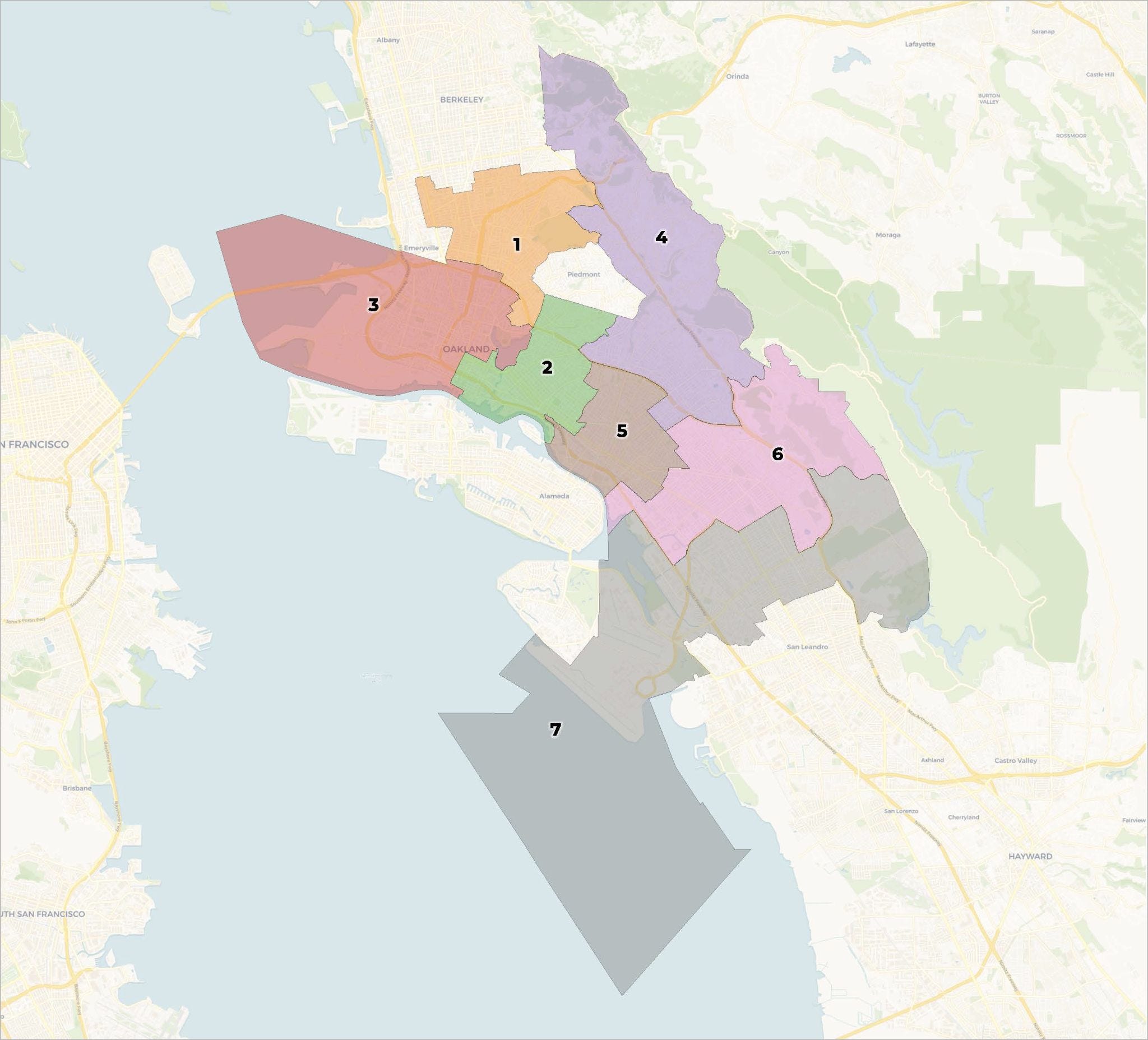
Oakland’s districts demographically differ from each other nearly as much as Piedmont differs from Oakland.
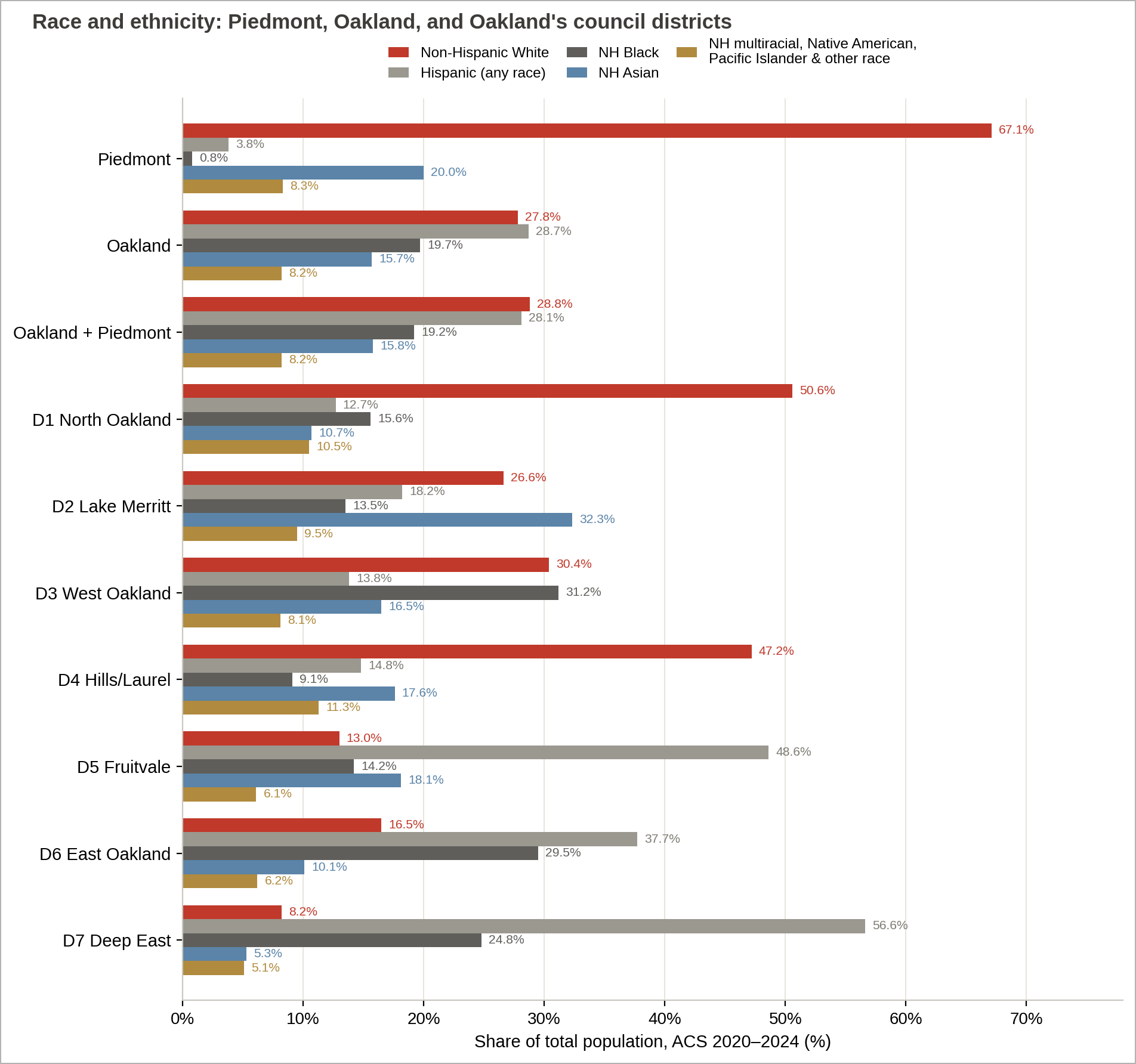
According to the most recent available Census survey data, Piedmont is 67% non-Hispanic White, 20% Asian, 4% Hispanic, and 1% Black.
By comparison, Oakland overall has no majority group: 29% Hispanic, 28% non-Hispanic White, 20% Black, and 16% Asian.3
But individual districts’ demographics diverge significantly from one another.
District 1 (North Oakland) is 50.6% non-Hispanic White — the closest thing Oakland has to a Piedmont.
District 4 (the hills, Montclair, and the Laurel) is 47.2% White and just 9.1% Black — the smallest Black share of any district in the city.
District 7 (Deep East Oakland) is 8.2% White and majority Hispanic at 56.6%.
Districts 3 (West Oakland) and 6 (East Oakland) are the most heavily Black (31.2% and 29.5%).
District 2 (Lake Merritt) is the most Asian (32.3%).
Annexation would barely move the demographic needle. Piedmont holds only 2.4% of the combined population of both cities. Adding it would shift Oakland’s citywide shares by less than one percentage point in every category.
Council representation per resident is more powerful in smaller cities
Annexing Piedmont into Oakland without significantly expanding the number of seats on Oakland’s current council would barely move the representation needle.
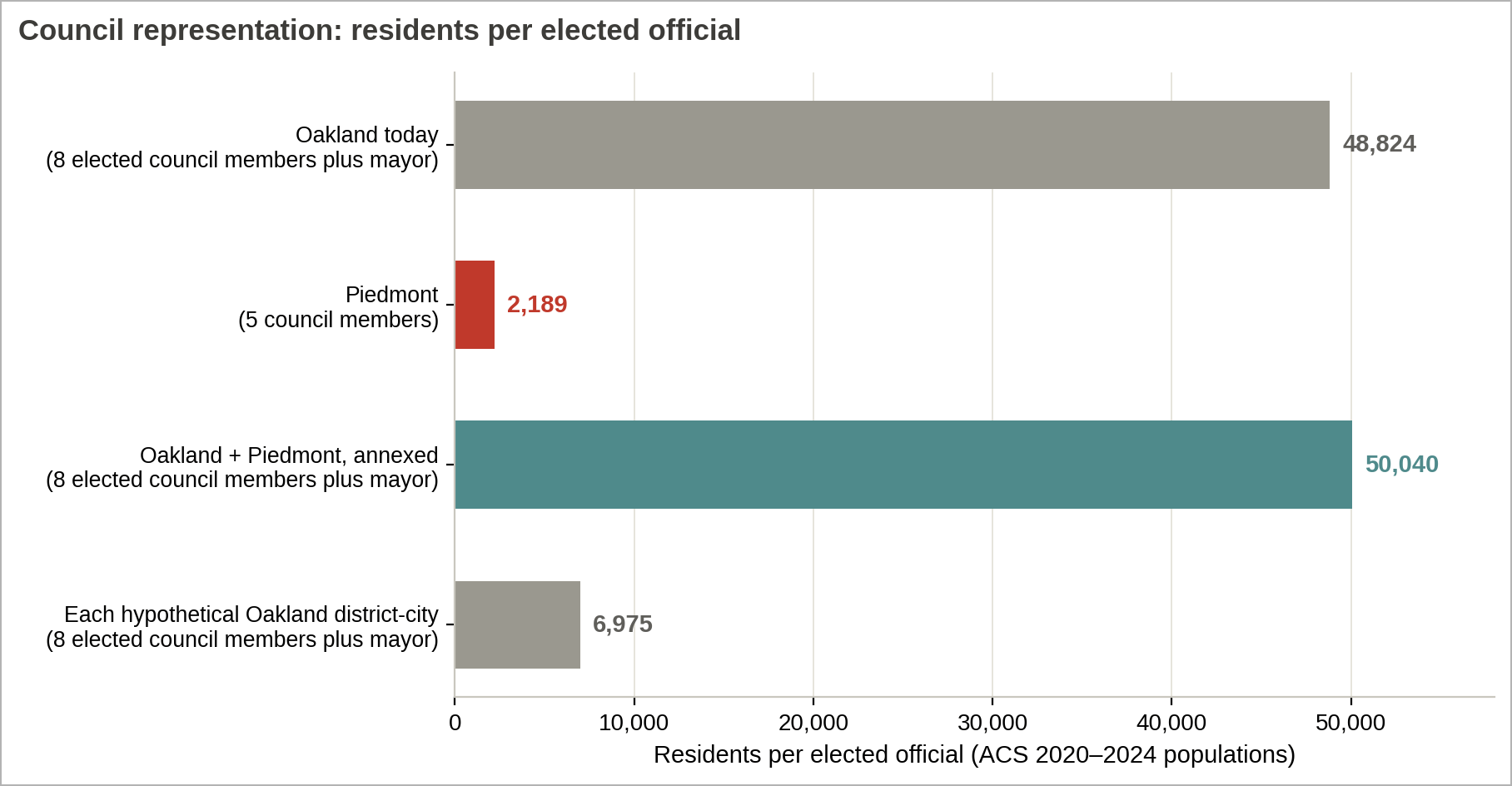
Oakland’s roughly 439,000 residents elect eight council members plus a mayor. That is one elected official for around every 48,800 residents.
Piedmont’s roughly 11,000 residents elect five council members — one for around every 2,200 residents.
Put another way, a Piedmont resident has about 21 times more representation on their city council than an Oakland resident has on theirs.
If Oakland was broken up into seven separate cities corresponding to the current council districts, and each new city had eight council members plus a mayor, Oakland’s representation ratio would be about one official per 7,000 residents.
In other words, breaking up Oakland into seven smaller cities would result in seven times as much representation per resident, though still three times thinner than Piedmont’s.
Housing: both cities exceeded their topline state goal — but with vastly different scales and means
California assigns every city housing goals, called the Regional Housing Needs Allocation (RHNA). In the 2015–2023 cycle, both cities exceeded their topline goals.456
Oakland permitted 128% of its 14,765-unit goal — though it fell short in every affordable category.
Piedmont permitted 160% of its goal. But its goal was just 60 units, and nearly everything it built was a backyard accessory dwelling unit (ADU).
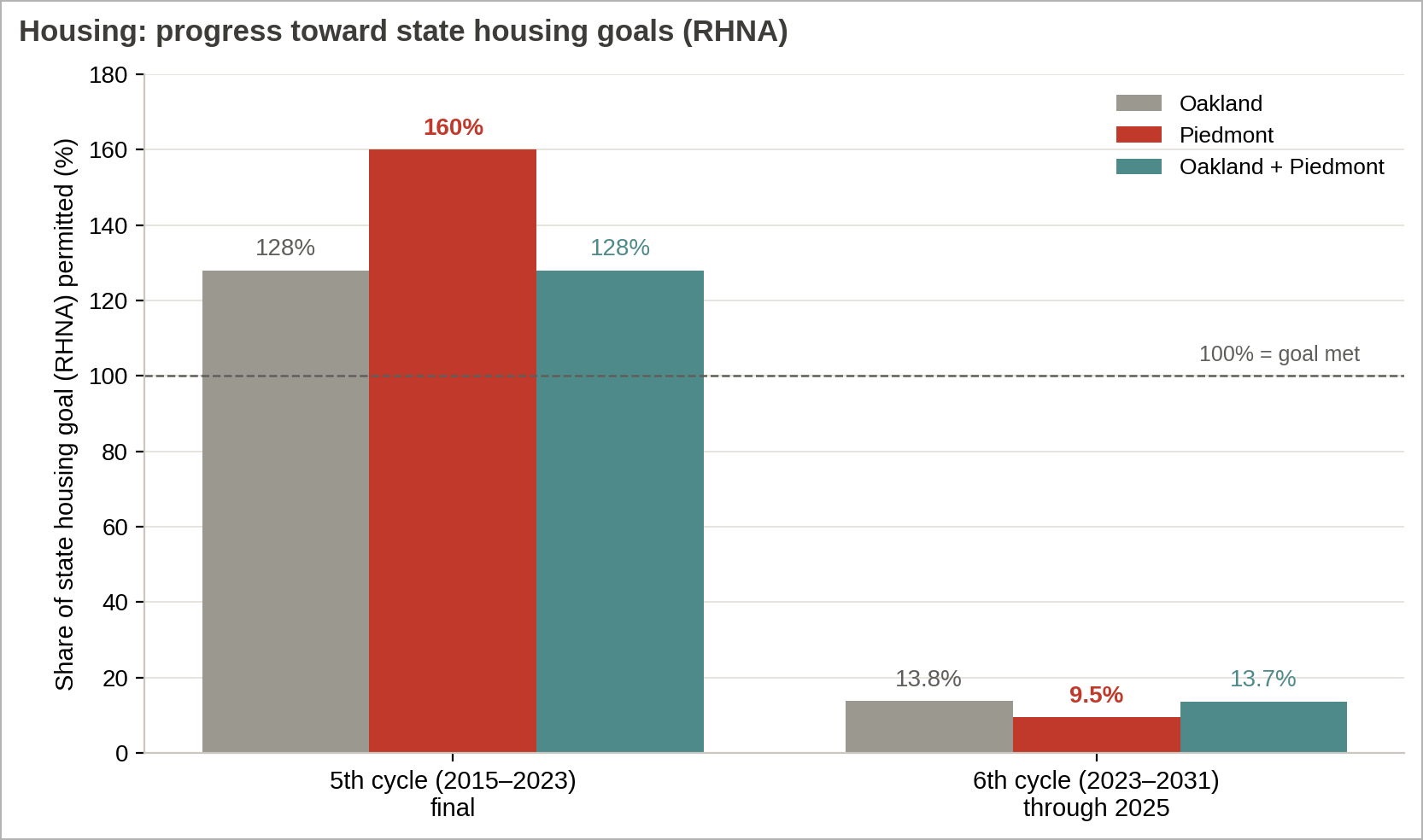
The current cycle’s goals (2023–2031) will prove harder for both cities.
Per the city’s 2025 Housing Element progress report, Oakland has permitted 13.8% of its 26,251-unit goal — on par with San José and Fremont, but well behind pace.
Oakland would need about 4,528 permits a year for five years to catch up. Its 2025 permits equaled just 0.4% of its existing stock, though 84% were affordable, and city staff anticipated more than 1,000 affordable permits in the first half of 2026.78
Piedmont has permitted 9.5% of its 587-unit goal — all but three units of it ADUs or SB 9 units.910
Once more, annexation would barely move the needle: Piedmont would add 2.2% to Oakland’s housing stock, and the combined city’s progress toward its RHNA topline goal would remain virtually unchanged — from 13.8% to 13.7%.
Over 60% of Oakland’s land, including much of downtown, is classified “lower resource” — and that is where the zoned housing capacity sits. The high-resource hills carry little capacity as currently zoned, and about 70% of the highest-resource areas sit inside the Fire Hazard Severity Zone.
It is reasonable to consider the possibility that a hills district-city (for example if District 1 — Rockridge and North Oakland — were its own city), would build almost nothing, relatively speaking — while downtown district-cities (such as Oakland Districts 3 and 4) would carry the bulk of the region’s growth.
One notable contrast: Oakland largely eliminated single-family zoning in October 2023. Piedmont’s zoning remains roughly 95% single-family.
A history of segregation — in both cities
Piedmont incorporated as a city in 1907. Historic records indicate that the goal was to avoid rapid annexation by Oakland, which was gobbling up numerous nearby towns at the time.11
In 1924, Sidney Dearing — believed to be Piedmont’s first Black homeowner — bought a home in Piedmont. Within months, a mob of more than 500 people surrounded the home and terrorized its residents. The city then moved to condemn the property for a road it never built.
A 1924 Oakland Tribune account reportedly quoted Piedmont’s mayor saying the condemnation was “for the improvement of the city as well as to make the negro move from Piedmont.” A lawsuit filed by Dearing’s great-granddaughter this February is now testing that record in court.12
Around the same time, much of Oakland’s hill districts followed a similar path of restrictive deed covenants that prevented non-White people from buying homes.
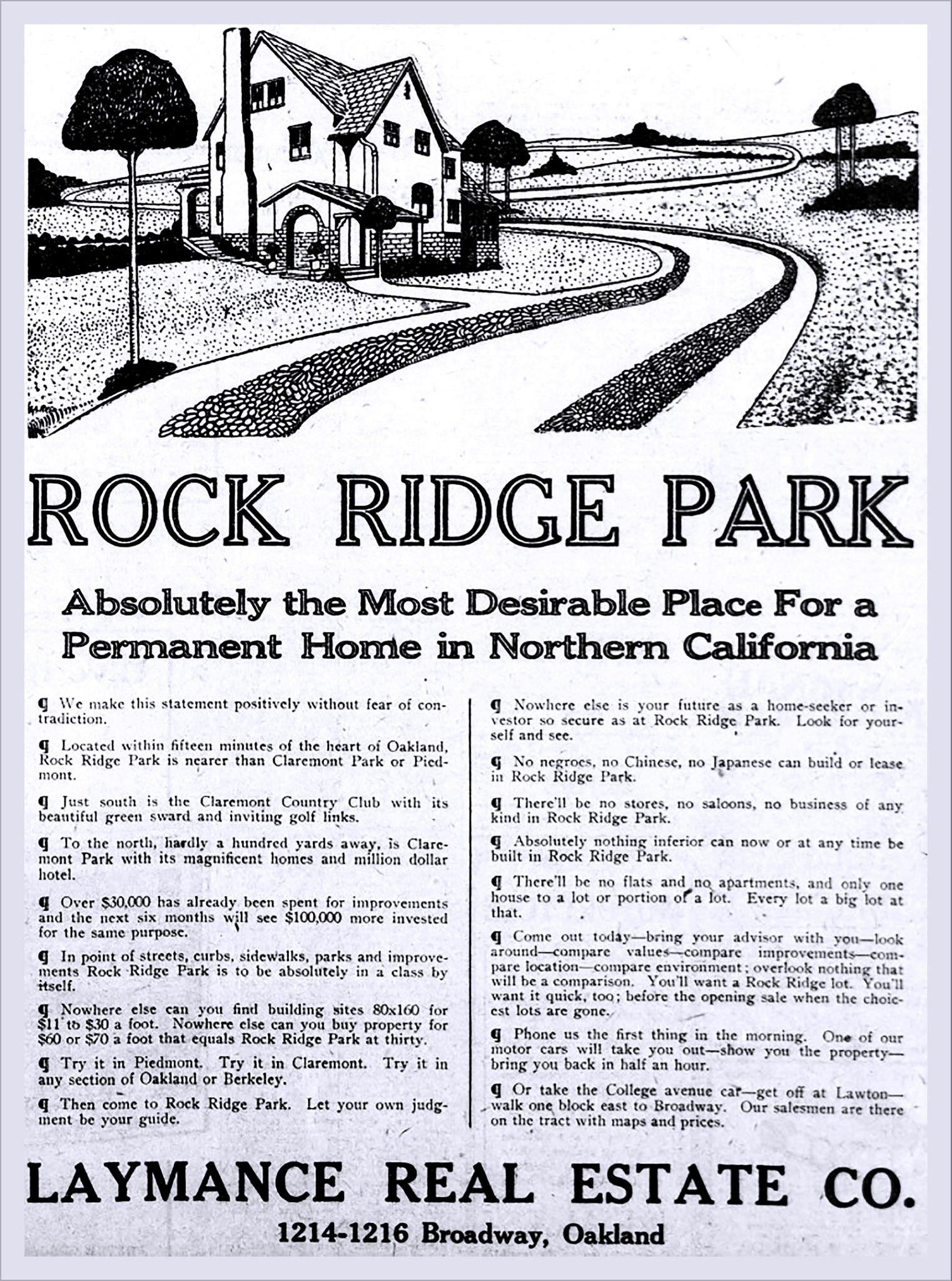
For example, a circa-1906 advertisement for new homes in what is today’s Rockridge district promised: “No negroes, no Chinese, no Japanese can build or lease in Rock Ridge Park.”1314
In 1937, the federal Home Owners’ Loan Corporation gave the covenant-protected hills of Oakland an “A” grade (the infamous “redlining” map). One area was rated highly in part because it was “restricted by deed to Caucasian ownership.” The same maps redlined the flatlands for the “infiltration of Negroes and Orientals.”15
In Oakland, the impacts of those color-coded maps persist in today’s districts with striking continuity. The A-graded hills are today’s Districts 1 and 4. The redlined flatlands are primarily in Districts 3, 5, 6, and 7.
The data suggest that Oakland’s current vastly different district demographics are not a natural sorting, but rather, like Piedmont, are partly due to historic, legally enforced segregation.
Share this article with someone you know.
Other considerations and counterpoints
Piedmont’s defenders make fair points, which we present for readers to consider.
The city is hardly unique among wealthy Bay Area suburbs like Hillsborough, Los Altos Hills, or Atherton — yet it is the only such city to be subject to a “cancel” campaign.
Piedmont has formally apologized for its history and commissioned the Dearing memorial.
It has met its topline state housing goals and adopted the controversial 132-home Moraga Canyon housing plan to meet its goals in the next round.
Annexation would require Piedmont voters’ approval — a highly unlikely outcome — which makes the “Cancel Piedmont” campaign purely symbolic, by its own creator’s admission.
A look ahead
Future installments in this series may examine other aspects of the “Cancel Piedmont or break up Oakland?” thought experiment, including: incomes, home values, crime, economic opportunity, infrastructure, service delivery, and tax revenues.
(Here’s a preview of the tax revenues data: Piedmont collects $2,690 per resident, compared to Oakland’s $2,440 per resident. Annexation would add an estimated 2.8% to Oakland’s overall tax revenue — not accounting for the increased expenses that adding approximately 11,000 new residents would bring.)
The interesting question the data raises may not be whether Piedmont should exist, but what it reveals about both cities: The same forces that created a city surrounded by Oakland in 1907 also helped to create Oakland’s district map.
“Canceling” Piedmont through annexation into Oakland would barely move the needle on Oakland’s demographics, tax base, or housing capacity.
Conversely, breaking up Oakland potentially could multiply its residents’ representation power sevenfold — but only through the virtually impossible change of turning its district lines into municipal borders.
These data tell a story. The reader can decide for themselves what to think about it.
📖
Oakland Report is an experiment in a new form of media. We present the facts and let the reader decide. Your donation toward our nonprofit work helps us continue to produce accurate, well-researched, deep-dive articles like this one.
ABOUT THE AUTHOR
Sean S. Reinhart is a former library director, now retired after 26 years in local government. He served as library and community services director for the cities of Hayward and Menlo Park for a combined 16 years, where he helped build Hayward’s new main library and Menlo Park’s new multi-service community center. His post-retirement endeavors include serving as the managing editor of Oakland Report.
Sean and his family have lived in Oakland for 15 years. He grew up in nearby Hayward. Sean enjoys exploring California’s world-renowned coastline, valleys, deserts and mountains. His creative pursuits include writing, printmaking, carpentry, music and visual arts. He enjoys meeting new people, reading, hiking, gardening, and spending time with his family.

Letourneau, Connor. “Why is there a push to ‘cancel’ one of the wealthiest Bay Area cities?” San Francisco Chronicle, Aug. 10, 2026. https://www.sfchronicle.com/bayarea/article/cancel-piedmont-wealthy-city-22364459.php; https://archive.is/9QPz0
Joudeh, Nina. “Civil war breaks out in rich, white California town as activists from crime-plagued neighboring city demand it’s ‘canceled’.” California Post, Aug. 10, 2026. https://nypost.com/2026/08/10/us-news/cancel-piedmont-movement-gains-momentum-in-oakland/
U.S. Census Bureau contributors. “American Community Survey 2020–2024 5-year estimates.” U.S. Census Bureau data portal, accessed Aug. 10, 2026. https://data.census.gov/table/ACSDT5Y2024.B03002
Orenstein, Natalie. “Oakland home-building back on track, but affordable housing still lags.” The Oaklandside, May 16, 2023. https://oaklandside.org/2023/05/16/oakland-home-building-back-on-track-affordable-housing-lags/
Bayon Moore, Rosanna et al. "Housing Element Annual Progress Reports." City of Piedmont, Apr. 19, 2021. https://piedmont.hosted.civiclive.com/common/pages/GetFile.ashx?key=z8lFAXU3
U.S. Census Bureau contributors. "2020 Census, Demographic and Housing Characteristics File, Table H1 (Housing Units)." U.S. Census Bureau data portal, accessed Aug. 10, 2026. https://data.census.gov/table/DECENNIALDHC2020.H1; https://data.census.gov/table/DECENNIALSF12010.H1
Johnson, Bradley et al. “Annual Comprehensive Financial Report, fiscal year ended June 30, 2025.” City of Oakland, Dec. 20, 2025. https://www.oaklandca.gov/files/assets/city/v/1/finance/documents/financial-reporting/annual-comprehensive-financial-reports/2025-city-of-oakland-acfr_final-123025.pdf
LeGardeur, Bebe et al. “2025 Housing Element annual progress report.” City of Oakland, Apr. 22, 2026. https://www.oaklandca.gov/files/assets/city/v/1/public-meetings/zoning-update-committee/2026/2025-apr-staff-report_zuc_for-signatures.pdf
Ibid. Bayon Moore, Rosanna et al.
California Senate Bill 9 (Atkins), “Housing development: approvals,” Stats. 2021, ch. 162 (the California Housing Opportunity and More Efficiency ‘HOME’ Act).” Cal. Gov. Code §§ 65852.21, 66411.7, signed Sept. 16, 2021, effective Jan. 1, 2022. https://leginfo.legislature.ca.gov/faces/billTextClient.xhtml?bill_id=202120220SB9
Hambrick, Chris. “Why is Piedmont a separate city from Oakland? Bay Curious explains.” KQED, Apr. 4, 2019 (updated Feb. 1, 2024). https://www.kqed.org/news/11737575/why-is-piedmont-a-separate-city-from-oakland-2
Bondgraham, Darwin. “Piedmont’s first Black home owners were forced out by fraud, new lawsuit alleges.” The Oaklandside, Feb. 4, 2026. https://oaklandside.org/2026/02/04/piedmont-sidney-dearing-first-black-residents-racism-housing-history/
Manley, Cole. “The subdivision and the restrictive covenant in Oakland, California, 1900–1930.” Journal of Urban History, Mar. 29, 2026. https://journals.sagepub.com/doi/10.1177/00961442261423523
Moore, Eli et al. "Roots, race, & place: a history of racially exclusionary housing in the San Francisco Bay Area." University of California, Berkeley, Oct. 2, 2019. https://belonging.berkeley.edu/rootsraceplace
Nelson, Robert K. et al. "Mapping inequality: redlining in New Deal America." University of Richmond Digital Scholarship Lab, accessed Aug. 10, 2026. https://dsl.richmond.edu/panorama/redlining/
I lived in Oakland for 12 years and would have much preferred to stay there. Three simple reasons to move to Piedmont:
If you call the police, they show up.
Trash on the streets is not a "feature."
The school district is not in a permanent state of disarray.
Oaklanders deserve this level of service too.
The SF Chronicle article was very disappointing: one guy with bumper stickers does not a movement. But the article failed to look at the diverse racial and cultural makeup of Piedmont's City Council and school board. The media seem focused on historical racism, while the main reason people move to Piedmont is for the superior schools, not to mention a more responsive and functional city government. Real estate agents will tell you that the price difference between two essentially identical houses in the two towns works out to be about the cost of sending two children to private school.