



BY EMMET GARDNER
EDITOR’S NOTE: Oakland Report is launching a new series featuring analyses and commentaries by Oakland youth writers ages 13-24. We invite submissions from other youth voices in Oakland. Do you have something to say on this issue or others? Visit our About page for more information.
UC’s decision to eliminate standardized testing from admissions was counterproductive
How do you evaluate the future of 200,000 people? This is the difficult problem that the University of California (UC) admissions system faces every year when high school students from around the country apply to the UC undergraduate system.
According to the UC undergraduate admissions summary, over 200,000 applicants have applied to the UC system each year since 2021, with an acceptance rate of around 70 percent. The top schools – Berkeley and Los Angeles – have acceptance rates as low as 9–10 percent.1
UC admissions officers use a variety of metrics and considerations to make these admissions decisions, including high school grade point average (GPA), extracurricular activities, personal essays, and other factors.
However, one specific metric has come under significant scrutiny since 2020: standardized testing.
The SAT and ACT are the two primary tests used in admissions by U.S. colleges. In response to a lawsuit claiming the tests are discriminatory, UC dropped the tests from its admission process in 2020.
Based on an analysis of multiple empirical studies on the subject of standardized testing and its effects on university admissions,2 the evidence suggests that the decision by UC was counterproductive:
Eliminating test results from admissions took away an important tool that helped admissions officers identify high-achieving students from disadvantaged backgrounds who otherwise might have been overlooked. Including a high SAT score raised admission chances for disadvantaged students by 7.3 percent (absolute), while the comparable effect for advantaged students was only about a 3.7 percent.
SAT math scores are especially valuable as an indicator of quantitative readiness for STEM curriculum, helping to identify students who are likely to excel in the curriculum, and those who are likely to struggle.
Importantly, removing standardized testing eliminated all of these benefits without eliminating socioeconomic bias. It simply shifted the socioeconomic inequalities into other parts of the students’ applications.
Evidence shows that 74.5 percent of the Black–White test score gap is due to unequal access to resources and opportunities, and is not due to an inherently racially-flawed exam. These unequal access factors shape not only standardized test scores, but GPA, extracurricular activities, and virtually all other aspects of college applications.
Removing test scores from the admissions process weakened UC’s ability to evaluate academic readiness while ignoring the real causes of racial disparity.
If UC’s admissions goal is fairness and accurate prediction of student success, the most logical decision is a test-optional policy that strengthens merit-based evaluations, not pretending that a test-free policy is a replacement for the deeper systemic reforms that achieving equity actually requires.

Lawsuit claimed racial and economic bias
On May 21, 2020, the UC Board of Regents voted to remove standardized testing from admissions consideration for the 2020–2021 admissions cycle and onward. The primary factors accelerating UC’s policy shift away from standardized testing were claims of racial and economic bias, including a lawsuit.3
Supporters of standardized tests argue that the SAT/ACT provides admissions officers with additional data that helps them identify high-achieving students across socioeconomic backgrounds. For example, Yale’s admissions dean stated that test scores, “gave them a better sense of whether students had excelled in their circumstances and were ready for the university’s academic rigor” when used alongside other application components.4
The University of California justifies its decision to remove standardized testing by claiming it hurts diversity and equity goals. However, its decision is unsupported by evidence: by removing standardized tests, UC also removed an accurate predictor of college success and weakened its ability to identify standout students.

UC argues that eliminating standardized testing was necessary because current tests contain an inherent racial bias.
When first deciding to move away from standardized tests, the University of California Academic Senate created a standardized testing task force with the purpose of evaluating and advising the UC Senate and Board of Regents on whether standardized tests served a valid role in admissions.5
In their 2020 final report, the task force found that the average SAT score by race is:
1356 for Asians
1338 for Whites
1166 for African Americans
1122 for Hispanics.
According to the task force report, the discrepancy amongst African American and Hispanic applicants can be attributed to unequal access to testing resources, such as quality of K-12 schooling, test prep and tutoring, and the time and money required to retake the test. Since underrepresented minorities are more likely to face economic disadvantages, standardized tests are thus a measurement of racial inequalities as much as academic readiness.
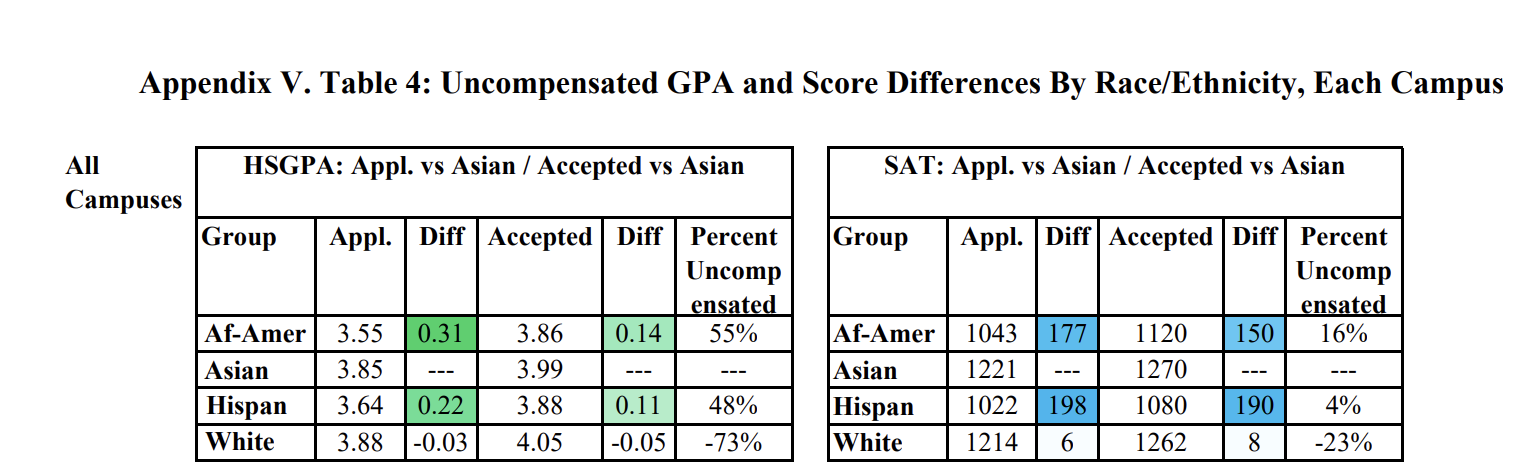
As a result, UC has argued that relying on standardized testing reinforces societal inequalities by rewarding those who have access to greater financial and institutional support.
Additionally, uncompensated SAT score differences between African-Americans and Hispanics versus Asians (the highest scorers) decreased only by 16 and 4 percent, respectively, after admission.6
UC said that these small changes in the gap after admission indicate that admissions officers must actively compensate for score differences across demographic groups through their process of comprehensive review. Therefore, they argue, it demonstrates that test scores work against UC’s stated goal of equity.7

Racial differences in test scores are a consequence of socioeconomic disparities, not an indication of inherent racial bias
At first glance, the racial score differences presented by the standardized testing task force appear very striking. While it is true that minority students score lower on standardized tests than White and Asian students on average, critics of such gaps fail to consider the root causes of test bias.
To better understand what these racial gaps actually reflect, a 2018 large-scale meta-regression analyzed 165 peer-reviewed studies on racial standardized testing score gaps. The researchers found, “socioeconomic status, including factors such as income, wealth indicators, parental education, as a whole explains 74.5% of the gap”.8
The findings suggest that racial differences in test scores are a consequence of socioeconomic disparities, not an indication of inherent racial bias. Thus, claiming an inherent racial bias is a correlation-causation fallacy.
Instead, what this evidence suggests is that the racial score gap is actually a reflection of a systemic issue created by unequal access to resources, academic preparation, and educational opportunities–factors that fall under socioeconomic status.
Additionally, the bias that these socioeconomic factors create isn’t unique to standardized tests; it materializes in GPA, extracurricular activities, and other educational opportunities.9
Removing standardized tests does not eliminate inequity
Since these other components of college applications also reflect socioeconomic bias, removing standardized tests does not eliminate inequity—it only shifts the emphasis onto other, similarly biased factors.
Furthermore, demographic data from the UC’s reported undergraduate admissions summary suggests that removing standardized test requirements resulted in no significant demographic shift in the admitted student population.10
There is a clear shift in the 2019–2020 admission cycle, before the change in no-test policy went into effect, but no further shift after the policy change. In the 2019-2020 admission cycle, the acceptance rates for Black and Hispanic students rose around twelve percent when comparing five-year period means (Figure 3) 11

This increase was significant (p-value < 0.001) indicating statistical significance , but in the years following the policy change there was no significant shift (p-value 0.324) in admissions demographics (Figure 4).

Because the demographic increase precedes the policy change, it cannot be caused by it. Therefore, the claim that eliminating standardized tests improved diversity and equity is not supported by the timing of the data.

High school GPA is a stronger predictor of college graduation than ACT scores
Regardless of whether these standardized testing bias concerns are substantiated or not, critics of tests still claim that high school GPA should be used as an alternative assessment of student quality due to it being a better predictor of sustained effort and long-term success through college, as measured by graduation rates.
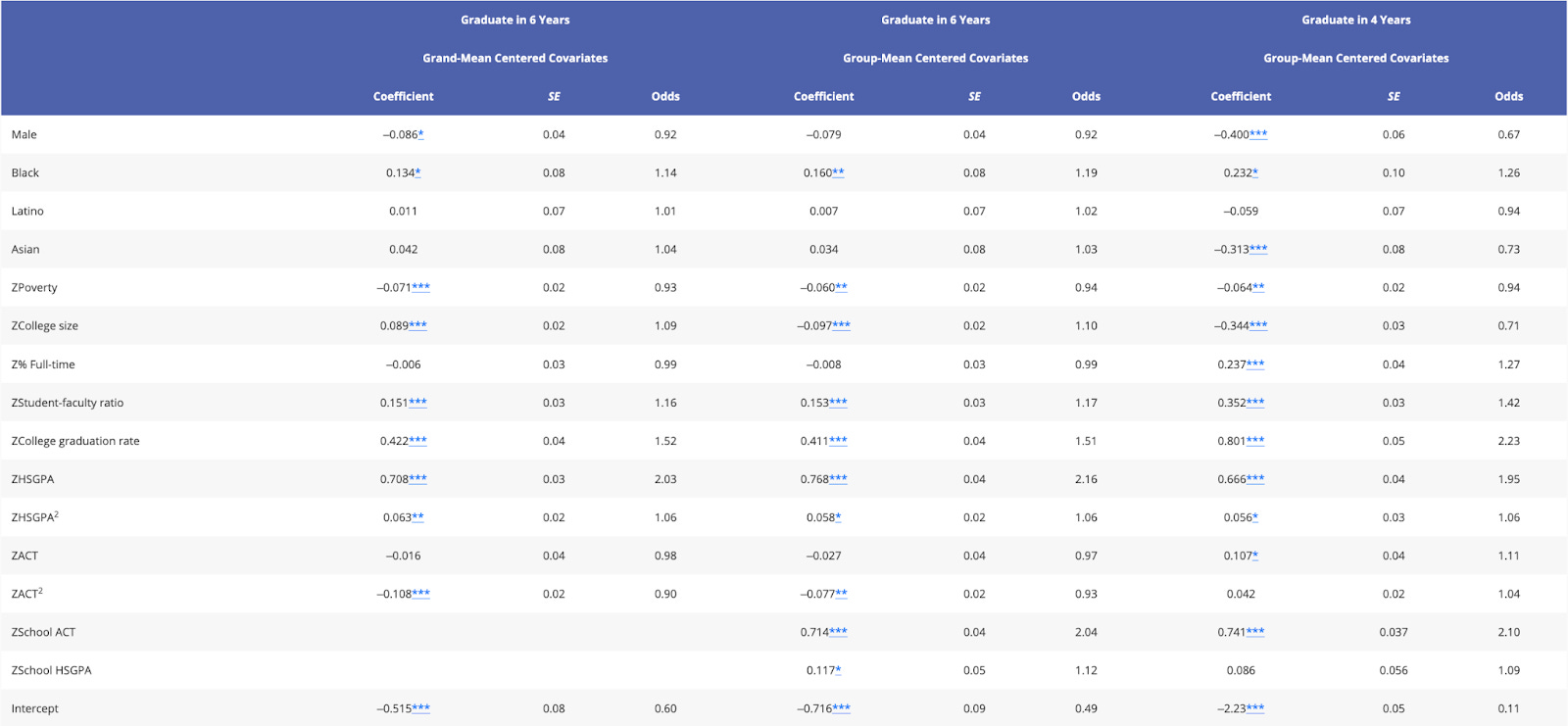
In predictive models examining college graduation rates, high school GPA was found to be a much stronger predictor of whether students graduated from college than ACT scores.12
A one–standard deviation increase in high school GPA more than doubled the likelihood of graduating compared to not graduating (coefficient = 0.708; odds ratio = 2.03), even after controlling for ACT scores and institutional characteristics.
By contrast, in the combined GPA and ACT model, the ACT coefficient was statistically insignificant (–0.016), indicating that ACT scores added little independent predictive value beyond GPA.
Similar patterns appear in the four-year graduation model, where GPA remained strongly significant (odds ratio = 1.95), while ACT showed only a small positive association (odds ratio = 1.11).13
The difference in predictive strength between GPA and ACT supports UC’s position that high school GPA is a more meaningful indicator of long-term performance than a standardized exam. Potential explanations for this discrepancy may be that, unlike standardized tests, which are measured at a single point in time, GPA reflects sustained performance over multiple years, which may materialize in college success and graduation, more so than standardized tests.

College GPA is closely correlated with standardized test scores
Even though standardized tests add little value when predicting graduation rates, this does not prove they are useless in their entirety and thus should be removed. In fact, graduation rates, although a useful metric for colleges, do not show the full extent of students’ college success. An important piece of context that is overlooked, when only focusing on graduation rates, is how students perform in college, not just if they met the requirements to graduate.
Help us reach our goal of 10,000 subscribers.
Instead, a more direct metric of college performance is college GPA, a metric that is correlated with standardized test scores.
In the UC’s standardized testing task force report, they found that across all students, GPA-only predictive models explain only 16 percent of the variation of first-year college GPA. In comparison, SAT-only models explain 21 percent of the variance in first-year college GPA.14
This discrepancy matters because it shows that standardized tests capture academic information that high school GPA alone does not, making them a valuable metric for predicting college success.
This is not to fully discredit GPA as a predictive metric for college GPA. In fact, the most important finding of the task force’s report is that in GPA + SAT combined models, the percent of first-year GPA variance explained rises to 26 percent, showing the importance of having both measures.15
These findings show that standardized tests serve as a valid academic metric that improves the UC’s ability to distinguish between applicants based on their academic potential, and that they should be reinstated into college admissions to improve on its goal of predicting students’ collegiate success.
Standardized tests help identify high-achieving students from disadvantaged backgrounds
Standardized tests help identify high-achieving students from disadvantaged backgrounds and are especially useful for identifying high-achieving STEM majors.
According to a 2025 working paper, reporting a high SAT score at or above 1420 during test-optional policies raised admission chances for disadvantaged students from 2.9 percent to 10.2 percent, a 7.3 percentage point increase, while the comparable effect for advantaged students was only about a 3.7 percentage point increase.16
For disadvantaged students, the significantly larger percentage point increase compared to advantaged students shows how admissions officers don’t evaluate test scores in a vacuum. Instead, they interpret scores in context, meaning a high SAT score carries more weight when it comes from a student whose background offers fewer academic advantages.
On the other hand, advantaged applicants often have better access to stronger high school course offerings and academic extracurricular activities, making their academic strengths visible through other parts of their application.
For some students from disadvantaged backgrounds, those same context clues are weaker or not present at all, making high standardized test scores one of the few ways to demonstrate academic readiness.
Effectively, standardized tests help admissions officers recognize high academic achievement in places where it otherwise might have been overlooked.

Standardized tests help identify potential standouts not just in high school, but also at the college level
Standardized tests are not only useful in identifying standouts at the high school level, but also in identifying potential standouts at the college level.
Studies have shown that for physics and math majors in particular, not a single student with a SAT math section score below 600 achieved a college GPA above 3.5, the minimum threshold for admission into graduate school.
Additionally, the researchers found that “only for [SAT math scores] well above 700 do students have more than a 50 percent chance of obtaining GPA > 3.5”.17
Such a clear SAT math cutoff for a 3.5 college GPA, an indicator of subject mastery, demonstrates the usefulness of standardized testing for identifying core proficiency and therefore the likelihood of success with STEM curriculum.
Become a supporting member of Oakland Report. We rely on our readers to provide financial support to continue our nonprofit work.
The high probability of students who score higher than 700 in achieving a 3.5 college GPA not only signals potential high achievers, but also the potential high achievers with the strongest likelihood of excelling in the curriculum. Therefore, standardized testing is especially useful in UC admissions for distinguishing applicants who are most likely to thrive in STEM majors, where math competency is a core requirement for success.
Together, the data on disadvantaged students and STEM majors demonstrate that reinstating optional standardized tests would strengthen UC admissions by revealing high-achieving disadvantaged students and more accurately identifying high-achieving students in STEM majors.

Standardized tests have been proven to give consistent, reliable results.
In addition to improving the predictive accuracy of college GPA, standardized tests have been proven to give consistent, reliable results.
A 2010 research paper on standardized tests found that retaking the SAT or ACT only improved scores an average of 20 points per section, noting that, “The use of average vs. peak SAT score has little impact on our subsequent analysis.”18
These findings show that standardized tests aren’t easily “gamed” through repeated attempts, but instead produce a reliable score output that reflects consistent academic ability. This reliability is especially valuable in college admissions, where other measures, such as GPA, are drastically affected by differences such as grading standards and course access that vary significantly across high schools.
Essentially, standardized tests provide UC campuses with an academic metric that is predictive of college GPA, as well as being consistent and reliable across applicants.
The University of California’s decision to remove standardized testing was meant to eliminate racial and socioeconomic bias, but the evidence shows it instead sacrificed a valuable admissions tool without actually addressing the inequities it seeks to eliminate.
The views expressed in our Commentaries do not necessarily reflect the editorial views of Oakland Report or its contributing writers
ABOUT THE AUTHOR
Emmet Gardner is a student-leader at Bishop O’Dowd High School with a strong focus on youth STEM education and peer mentorship. Over the past three years, he has worked closely with Kids Teach Tech, an organization dedicated to providing technology and engineering education to underserved youth, and is a teacher at their UC Berkeley Programming Summer Camps.
Building on this experience, Emmet is currently focused on expanding Kids Teach Tech’s reach into Oakland, aiming to bring hands-on STEM opportunities to the local community. He believes in using education as a tool for opportunity and the power of student-led initiatives to drive meaningful change.

Sajid, Sumair. “Undergraduate Admissions Summary.” University of California, 23 Jan. 2026, universityofcalifornia.edu/about-us/information-center/admissions-residency-and-ethnicity
For simplicity, this analysis treats the SAT and ACT interchangeably because both exams assess similar academic skills and function as similar indicators of college readiness. As shown in the 1999 College Board concordance study, the two tests exhibit extremely high correlation scores, indicating that they measure highly overlapping constructs of academic ability. See Dorans, Neil J., Concordance Between ACT and SAT Scores. ACT, Inc., 1999. ERIC, ED562654, files.eric.ed.gov/fulltext/ED562654.pdf
Smith v. UC Regents. Settlement Agreement and Release of All Claims. 14 May 2021, Superior Court of the State of California, County of Alameda, Case No. RG19046222. Public Counsel, publiccounsel.org/wp-content/uploads/2021/12/Smith-v-UC-Regents_SE TTLEMENT-AGREEMENT.pdf
Borter, Gabriella. “Yale University Reinstates Standardized Test Requirement.” Reuters, 22 Feb. 2024, reuters.com/world/us/yale-university-reinstates-standardized-test-requi rement-2024-02-22/
Comeaux, Eddie, and Henry Sánchez, co-chairs. Report of the Standardized Testing Task Force. University of California Academic Senate, 27 Jan. 2020, senate.universityofcalifornia.edu/_files/committees/sttf/sttf-report.pdf
Ibid. Comeaux and Sánchez.
Ibid.
Huntington-Klein, Nick, and Elizabeth Ackert. “The Long Road to Equality: A Meta-Regression Analysis of Changes in the Black Test Score Gap over Time.” Social Science Quarterly, vol. 99, no. 3, 2018, pp. 1119–1133. doi.org/10.1111/ssqu.12483
Ibid. Comeaux and Sánchez.
Ibid. Sajid.
Ibid.
Allensworth, Elaine M., and Kallie Clark. “High School GPAs and ACT Scores as Predictors of College Completion: Examining Assumptions About Consistency Across High Schools.” Educational Researcher, vol. 49, no. 3, 2020, pp. 198–211. SAGE Journals, doi.org/10.3102/0013189X20902110
Ibid. Allensworth and Clark.
Ibid. Comeaux and Sánchez.
Ibid.
Sacerdote, Bruce, Douglas O. Staiger, and Michele Tine. How Test Optional Policies in College Admissions Disproportionately Harm High Achieving Applicants from Disadvantaged Backgrounds. National Bureau of Economic Research, Jan. 2025, Working Paper no. 33389. doi.org/10.3386/w33389
Hsu, Stephen D.H., and James Schombert. Data Mining the University: College GPA Predictions from SAT Scores. 15 Apr. 2010. arXiv, doi.org/10.48550/arXiv.1004.2731
Ibid. Hsu and Schombert.

OAKLAND REPORT
WE NEED YOUR SUPPORT
We rely on you, our readers, to donate to Oakland Report to financially support our work. Please join us as a subscribing member by signing up with a monthly or one-time donation.
We are a 501(c)(3) charitable nonprofit based in beautiful Oakland, California. Our mission is to make truth more accessible to all Oakland residents. Your donation is tax-deductible.
Is there an antidote to the virtue signaling virus that has swept through Western democracies in the past few years?